A Guide to Content Marketing for B2B Companies

Master content marketing for B2B companies with this complete guide. Learn strategies for audience mapping, content creation, distribution, and scaling.
B2B content marketing isn't about shouting from the rooftops with a sales pitch. It’s the art of creating and sharing genuinely useful content that attracts, engages, and helps a specific business audience. Forget the hard sell; the goal here is to educate and build trust, guiding potential customers through what’s often a long and complicated buying decision.
Why B2B Content Marketing Is Your Engine for Sustainable Growth
B2B purchases are rarely a spur-of-the-moment thing. These decisions involve multiple stakeholders, hefty budgets, and months of careful evaluation. Traditional ads often don't cut it here—they interrupt a thoughtful process instead of helping it along.
This is where content marketing flips the script entirely.
Instead of shoving a sales message in someone's face, you’re pulling them in by offering real value first. When you consistently share expert insights, you stop being just another vendor and start becoming a trusted advisor. This isn't just a "nice-to-have"—it’s a powerful economic engine for your entire business.
Building Trust Before the Sale
Trust is the bedrock of any solid B2B partnership. A potential client has to believe you know your stuff and can solve their problems long before they'll even think about signing a contract.
Content marketing is how you build that trust, piece by piece:
- Demonstrate Your Expertise: Deep-dive whitepapers, detailed case studies, and insightful articles are your proof. They show you don’t just sell a solution; you truly understand the industry's toughest challenges.
- Solve Problems Proactively: Think how-to guides and best-practice checklists. This kind of content offers immediate, real-world value and positions your brand as a go-to resource.
- Foster Familiarity: Consistently putting out high-quality content keeps your brand top-of-mind. When a need finally arises, you’re the first call they make.
Driving High-Quality Leads Cost-Effectively
Good content is also one of the most efficient lead-gen tools you can have. It naturally attracts prospects who are already actively researching solutions. That means they're more qualified and much further along in their buying journey.
The numbers don't lie. Content marketing costs 62% less than other marketing channels, yet it delivers 3 times as many leads. It's an almost irresistible strategy for any B2B company looking to get more from their marketing budget. This incredible efficiency is exactly why 73% of B2B marketers now bake content into their core strategies.
Ultimately, content marketing aligns your business with how modern B2B buyers actually think and act. You replace the pushy sales pitch with helpful guidance, creating a solid foundation for profitable, long-term client relationships. For a deeper look, you can explore our guide on how to scale content marketing for more actionable strategies.
Mapping Your B2B Audience and Their Buying Journey
Great B2B content marketing doesn't start with writing. It starts long before that, with a deep, almost obsessive understanding of your audience. If you’re just creating content for a vague “business professional,” you’re basically shouting into the void.
The goal is to move from fuzzy assumptions to sharp insights. You need to know more than just a job title; you have to understand the real-world pressures, goals, and pain points that keep your ideal customer up at night. This groundwork is what makes every blog post, whitepaper, and social graphic hit the mark.
Developing Your B2B Buyer Personas
A buyer persona is a semi-fictional profile of your ideal customer, sketched out with enough detail that they feel like a real person. Think of it less as a demographic summary and more as a character study for a movie. This character becomes the compass for your entire content strategy.
A solid B2B persona should answer questions like:
- What’s their real role? Forget the title on their business card. What do they actually do all day? Who do they report to? What pressures are they under?
- What are their biggest headaches? Are they wrestling with clunky, inefficient processes? Are they getting squeezed on costs? Or are they just trying to keep up with the competition?
- What does a "win" look like for them? Are they trying to drive revenue, make their team more productive, or just look good in front of their boss?
- Where do they hang out online? Do they religiously read certain industry blogs, follow specific thought leaders on LinkedIn, or just ask their peers for recommendations in a private Slack group?
- What makes them say "no"? What are their knee-jerk objections to a new solution? Is it the price tag, the fear of a messy implementation, or just a deep-seated resistance to change?
Answering these questions gives you a crystal-clear picture of who you're talking to. Suddenly, you're not just writing content; you're having a conversation with a specific person.
Connecting Personas to the Buyer Journey
Once you know who you’re talking to, the next trick is figuring out when to talk to them about what. The B2B buyer journey isn't random; it's a predictable path people follow, and your content needs to act as a helpful guide at every turn.
This simple diagram shows how the journey really works as a growth engine. You provide value, which builds trust, which in turn generates qualified leads.
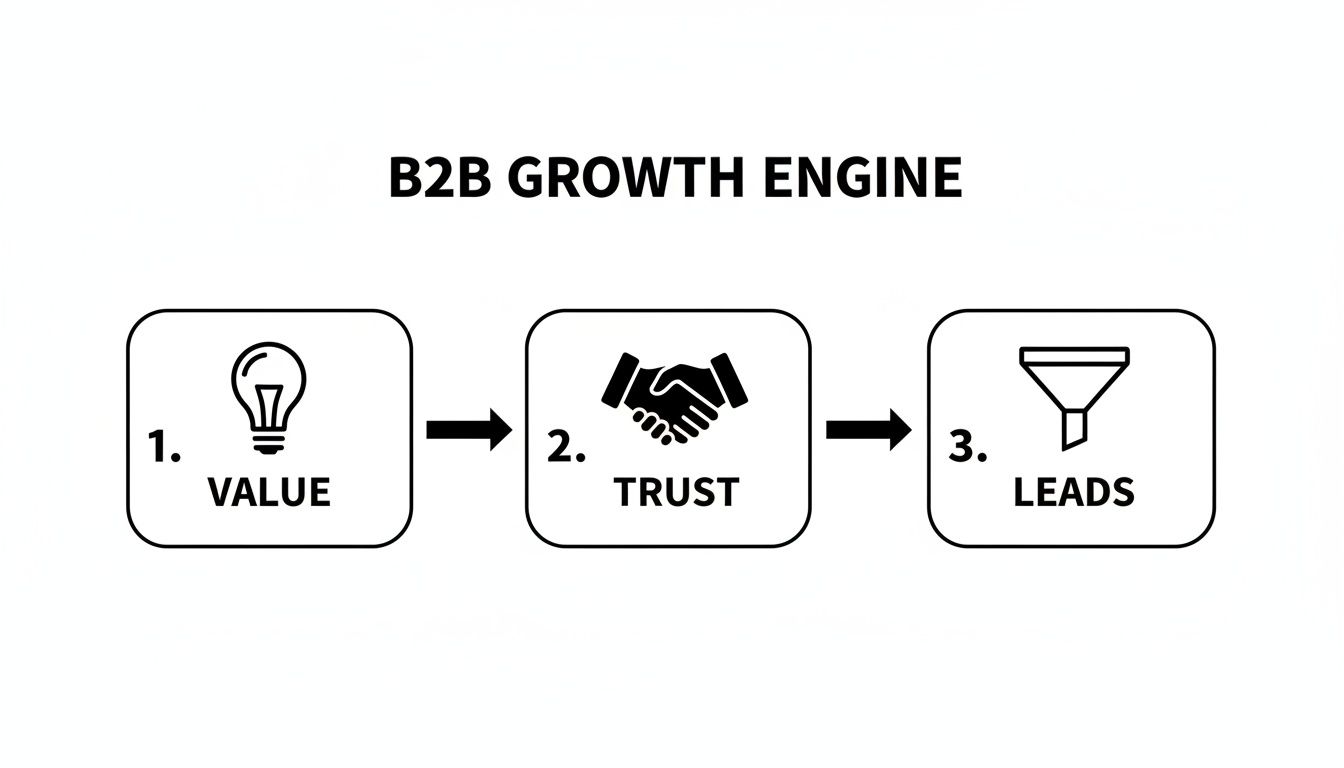
It’s a straightforward formula: give first, earn trust, then ask for the sale. Trying to skip a step is a recipe for failure.
Let's break down the three core stages of that journey:
The Awareness Stage: Right now, your prospect just knows something hurts. They might not even have a name for their problem yet. They’re Googling symptoms, not solutions. Their questions sound like, "Why is my team’s productivity in the gutter?" or "How to reduce customer churn." They're craving educational, non-salesy content.
The Consideration Stage: Okay, now they’ve put a name to their problem and are actively hunting for a cure. They’re comparing different types of solutions, methodologies, and approaches. Their questions get more specific: "What are the best project management tools for marketing agencies?" or "Zapier vs. Make for workflow automation."
The Decision Stage: This is the final stretch. The prospect has picked a category of solution and is now trying to choose a specific vendor. They’re looking for proof and validation. Their questions are all about you: "Does this platform integrate with our Salesforce setup?" or "Show me a case study of a company like mine getting a real ROI."
To bring this all together, here’s a quick-reference table that maps the right content to the right stage.
B2B Buyer Journey Content Mapping
| Buyer Journey Stage | Audience Goal | High-Impact Content Types |
|---|---|---|
| Awareness | "I have a problem but I don't know what it is." | Blog Posts, Ebooks, Educational Social Graphics, Industry Reports, Webinars |
| Consideration | "I'm researching all the ways to solve my problem." | Case Studies, Whitepapers, Comparison Guides, Product Webinars, Checklists |
| Decision | "Which specific solution is the best fit for me?" | Free Trials, Demos, ROI Calculators, Pricing Pages, Customer Testimonials |
Mapping your content this way is critical. It stops you from pushing a hard sales pitch on someone who is still just trying to understand their problem—a mistake that turns off potential customers faster than anything else.
Creating High-Impact Content That Drives B2B Engagement
Once you’ve mapped out your audience’s journey, it’s time to translate that blueprint into the actual assets that will do the heavy lifting. This is where you create the specific pieces of content that attract, educate, and ultimately persuade your ideal customers. In the B2B world, we're not chasing fleeting trends. We're building a library of resources that establish deep, unshakable authority.
The guiding principle is simple: educate, don't just sell. B2B buyers are sharp and research-obsessed. They’re looking for partners who genuinely understand their world, not just vendors pushing a product. Your content has to prove you’re that partner.

This educational mindset isn’t just a nice-to-have; it's what modern marketers overwhelmingly prefer. In fact, a staggering 90% of B2B marketers focus on informative, trust-building content over direct sales pitches. Among the most effective formats, good old-fashioned blog posts have climbed into the top five for ROI, with small businesses being 23% more likely to see profits from their blogging efforts. You can dig into more data on these trends and see exactly why website and SEO content deliver the highest returns.
Foundational Content for Building Credibility
Certain types of content are simply non-negotiable if you want to be taken seriously in the B2B space. Think of these long-form assets as your heavy hitters, designed to tackle complex subjects in detail and give decision-makers the substance they crave during the critical consideration and decision stages.
- In-Depth Case Studies: A case study is so much more than a testimonial. It's a story that proves your value. It walks a prospect through a real customer’s journey, laying out their initial problem, the solution you delivered, and—most importantly—the measurable results you generated.
- Comprehensive Whitepapers and Ebooks: This is your stage for true thought leadership. Use these to present original research, offer a deep-dive analysis of an industry problem, or provide the definitive guide to a complex process. They also happen to be powerful lead magnets for capturing high-intent prospects.
These assets become the bedrock of your B2B content marketing, showcasing your expertise in a way a simple ad never could. They need to be thorough, well-researched, and genuinely helpful.
Scaling Authority with Visual Social Content
While long-form content builds deep credibility, it doesn't always travel well on fast-moving platforms like LinkedIn. This is where sharp, visually-driven educational content becomes essential for grabbing attention and building a wide audience of followers who start to see you as an industry leader.
A busy executive isn't going to read a 20-page whitepaper on their lunch break. But they absolutely will stop scrolling for a smart, insightful visual post that teaches them something valuable in under a minute.
The goal of B2B social media isn't just to be present; it's to be a primary source of industry education. By consistently sharing valuable insights in a digestible format, you train your audience to look for your content.
This is where formats like multi-slide carousels and infographics really shine. They break down the complex ideas from your long-form content into bite-sized, shareable pieces that people actually consume.
- Educational Carousels: Turn a key chapter from your ebook into a 10-slide carousel. Each slide can hit one key idea, a powerful statistic, or a single step in a process, making it incredibly easy to digest and share.
- Informative Listicles: A listicle post like "5 Common Mistakes in Supply Chain Management" is brutally effective. It's scannable, practical, and speaks directly to a reader’s pain points.
- Data-Driven Infographics: Take the most compelling stats from a case study or industry report and transform them into a visually engaging infographic that highlights the key takeaways at a glance.
The challenge, of course, is producing these high-quality visual assets consistently. It's a multidisciplinary process that requires research, writing, and design skills—a combination that can become a serious bottleneck for many teams.
Fortunately, modern AI agents like Postbae can solve this problem by completely automating the production of professional visual posts. Postbae works autonomously in the background to generate industry-specific carousels, listicles, and educational graphics that are ready to post, without needing a single prompt. This allows B2B marketing teams to scale their authority-building content on social media without needing a dedicated design team, and users retain full editing control to customize every single post.
Building Your B2B Content Distribution Strategy
Creating brilliant content is only half the battle. Getting it in front of the right people? That’s where the real work begins. An airtight distribution plan is what turns a valuable asset sitting on your server into a machine that generates actual leads.
Without one, you’re just creating content for yourself. With one, you maximize the reach and impact of every single piece you publish.
The key is to stop thinking about your channels in isolation. Your blog, SEO efforts, LinkedIn presence, and email newsletters aren't separate projects. They're interconnected pathways designed to guide your ideal customer from discovery to decision, all fueled by the same foundational content.
Choosing Your Core B2B Distribution Channels
Not all channels are created equal in the B2B world. While it's tempting to be everywhere, your focus should be laser-sharp, zeroed in on the platforms where your audience actively looks for professional solutions and insights.
For most B2B companies, a winning distribution mix comes down to three powerhouses:
- Your Company Blog (Fueled by SEO): This is your home base, the media hub you own completely. It’s the primary destination for your long-form, authoritative content and the engine that drives organic search traffic. Every post should be meticulously optimized to rank for the specific problems your ideal customers are trying to solve.
- LinkedIn: This is the undisputed champion for B2B social media. It's the perfect place to share educational content, build your brand's voice, and engage directly with industry professionals and decision-makers. It’s the digital conference hall where your buyers are already hanging out.
- Targeted Email Newsletters: Email is your direct line to your most engaged audience—the people who have explicitly raised their hands and said, "Yes, I want to hear from you." It lets you nurture leads by delivering curated content, company news, and exclusive insights straight to their inbox, building a real relationship over time.
Speaking of direct lines, learning how to start a newsletter is a game-changer. This channel gives you unparalleled control over your message and your audience relationship, making it a non-negotiable for serious B2B marketers.
The Power of Smart Content Repurposing
The secret to a scalable and sustainable content marketing strategy for b2b companies isn't about creating more content from scratch. It's about doing more with the content you already have.
Content repurposing is the art of taking one big, high-effort asset and slicing and dicing it into dozens of smaller, channel-specific pieces. It saves a massive amount of time and reinforces your core message across every single touchpoint.
A single, in-depth whitepaper isn't just one piece of content. It's the raw material for a month's worth of blog posts, social media carousels, email campaigns, and video scripts.
Imagine you just published a comprehensive guide on "The Future of AI in Logistics." Instead of just dropping a link and hoping for the best, you can deconstruct it into an entire distribution campaign.
Here’s what that looks like in practice:
- Blog Post Series: Carve out the main chapters of your guide and expand them into three or four detailed blog posts. Each one can dive deeper into a specific sub-topic, optimized for a different long-tail keyword to capture more search traffic.
- LinkedIn Carousels: Pull the most compelling stats and key takeaways and turn them into a sharp, 10-slide educational carousel. This visual format is perfect for grabbing attention in the fast-scrolling LinkedIn feed.
- Targeted Email Sequence: Craft a three-part email series for your subscribers. The first email can introduce the topic and link to the full guide, while the next two can share juicy highlights from the blog posts, driving engaged traffic back to your site.
- Infographic: Condense the most powerful data points and process flows from the guide into a clean, shareable infographic. This is a perfect visual asset for both your blog and for outreach to other industry publications looking for great content to share.
By adopting a repurposing mindset, you multiply the value of your initial content investment ten-fold. You ensure your hard-won insights reach the widest possible audience, in the formats they actually prefer. This systematic approach is the key to building and sustaining real momentum.
Using AI to Automate Your B2B Visual Content Production
Consistently creating high-quality visual content is a significant challenge for B2B marketers. Producing polished graphics, carousels, and infographics requires a blend of research, copywriting, and design skills. This process can quickly become a major bottleneck, especially for smaller teams.
This is exactly where AI is changing the landscape. While many associate AI with generating text, its capabilities now extend deep into visual content creation. It offers a way to automate the entire visual content workflow, from the initial idea to the final, ready-to-post graphic.
AI adoption in marketing is already happening at a massive scale. A recent study found that 95% of marketers are now using AI applications in their day-to-day, and 89% lean on it for writing or optimizing content. The challenge? While 58% say the quality has improved, there’s a real need for tools that create authentic, on-brand material that doesn't feel like it came from a robot.
Moving Beyond Manual Design Work
For years, creating visual assets meant spending hours in design tools. A social media manager would have to research a topic, distill it into concise copy, and then painstakingly arrange text and graphics into a layout. That slow, manual process makes scaling a high-quality visual strategy nearly impossible.
Modern AI agents offer a much smarter path. Instead of just generating text for you to copy and paste, these systems can autonomously run the entire production line for your visual social media posts.

How AI Agents Automate Visual Content
Imagine an AI that works quietly in the background, like a dedicated member of your content team. That's the core idea behind an AI content agent like Postbae. It goes beyond the simple prompt-and-response model of most AI tools and operates on full autopilot.
Here’s a look at how this automated process actually works:
- Intelligent Ideation: The AI agent pinpoints relevant, authority-building topics for your specific industry, like practical tips, surprising industry stats, or educational explainers.
- Content and Design Pairing: It then intelligently matches that topic with a proven, professional template—like a multi-slide carousel or a listicle—that’s best suited to present the information clearly and effectively.
- Autonomous Generation: Finally, the agent programmatically fills the template with well-researched copy and professional graphics, delivering a complete, polished visual asset that’s ready to go.
This approach completely removes the manual design bottleneck. It allows small businesses and marketing agencies to maintain a sharp, authoritative presence on platforms like LinkedIn without the associated overhead. For teams exploring different options, there are plenty of generative AI tools for marketing that can help with different parts of the creation process.
By automating the most time-consuming part of visual content creation—the design and layout process—B2B teams can shift their focus from tactical execution to high-level strategy and audience engagement.
And here's the crucial part: this level of automation doesn't mean giving up creative control. With a tool like Postbae, every single graphic it generates is fully editable. You can tweak the text, adjust colors, or swap out images to make sure the final product aligns perfectly with your brand standards.
By bringing this kind of autonomous AI into the mix, B2B companies can finally nail the consistency needed to build a powerful visual brand. This frees up your team's valuable time and creativity for the strategic work that actually drives growth. If you are interested in this topic, check out our guide on AI content creation tools.
Measuring the ROI of Your B2B Content Strategy
Creating great content takes real time and real money. To keep the budget flowing and get buy-in for your next big idea, you have to prove it’s all worth it. And you have to do it in the one language every department understands: revenue.
That means we have to stop obsessing over surface-level wins like likes and shares. It’s time to connect the dots between your content and the metrics that actually move the needle for the business.
Measuring the return on investment (ROI) of your content marketing for b2b companies isn’t just about justifying your job. It’s about making smarter bets. It’s how you turn content from a creative expense into a predictable, scalable engine for growth.
Moving Beyond Vanity Metrics
A LinkedIn post getting a ton of engagement feels great, but it doesn’t directly pay the bills. True B2B measurement is all about linking what you create to tangible business outcomes. Instead of getting lost in a sea of social media analytics, your focus needs to shift to the metrics that tell the real story of customer acquisition and revenue.
Here are the key performance indicators (KPIs) that actually matter:
- Lead Quality: Are the right people downloading your content? When you look at the titles, companies, and industries of who’s signing up for your webinars or grabbing your ebooks, you’ll know if your content is hitting the mark with your ideal customer profile.
- Pipeline Influence: How many deals in your sales pipeline touched a piece of your content before they became a qualified lead? Your CRM is a goldmine for this. You can literally see which assets—that case study or a specific whitepaper—are helping push deals closer to the finish line.
- Customer Acquisition Cost (CAC): How much does it cost you to land a new customer through your content versus, say, paid ads? Over time, a solid content strategy should actually lower your overall CAC by pulling in organic, high-intent leads that cost you less to acquire.
- Conversion Rates: Of all the people who read a blog post, what percentage takes the next step? Do they download a resource, book a demo, or start a trial? This metric is a direct measure of how persuasive your content really is.
Building a Simple Measurement Framework
You don’t need a ridiculously complex, ten-thousand-dollar-a-month analytics suite to get started. You can build a surprisingly powerful measurement framework with the tools you probably already have. The whole point is to connect the dots from a person's very first interaction with your content all the way to them becoming a paying customer.
The most effective measurement strategies don't track everything. They track the right things—the specific data points that link content consumption directly to sales pipeline activity and closed deals.
This really just boils down to integrating two core platforms:
- Google Analytics: This is your go-to for tracking website traffic, seeing how people behave on your site, and monitoring on-site conversions. Set up goals for things like ebook downloads or contact form submissions. This tells you which pieces of content are successfully sparking that initial interest.
- Your CRM (e.g., Salesforce, HubSpot): This is where the magic happens. Here, you connect all that content engagement to actual sales data. By tracking which leads consumed which assets, you can start attributing real revenue back to specific campaigns and prove how your content directly influenced closed-won deals.
When you link these two systems, you create a powerful feedback loop. You can confidently walk into a meeting and say that a specific blog post drove 50 qualified leads last quarter, and that those leads ultimately turned into $25,000 in new business.
Now that's a number everyone can get excited about.
For a more detailed breakdown of this process, you can explore our complete guide on how to measure content marketing ROI. This data-first approach lets you constantly tweak and optimize, ensuring your strategy gets smarter with every single piece you publish.
Got Questions About B2B Content Marketing? We've Got Answers.
Jumping into B2B content marketing always brings up a few questions. It’s a different beast than other types of marketing, and there’s a lot to wrap your head around. Below, I’ve tackled some of the most common questions I hear, with straightforward answers to help you get your strategy dialed in.
How Long Does It Take for B2B Content Marketing to Show Results?
B2B content marketing is a long-term play. Given the long sales cycles and the absolute need to build trust with busy decision-makers, you should expect it to take 6 to 12 months to see significant, measurable results—like a consistent flow of qualified leads.
That said, you won't be flying blind for a year. You should start seeing early signs of life, like better website traffic and more chatter on social media, within the first 3 to 4 months. Ultimately, how fast you see results comes down to how consistently you show up, the actual quality of your content, and whether you're getting it in front of the right people.
What Is the Difference Between B2B and B2C Content Marketing?
The biggest difference boils down to who you’re talking to and what they care about. B2B and B2C marketing run on completely different engines because they're built for entirely different buyers.
- B2B Content Marketing is for businesses selling to other businesses. It's all about logic, building professional trust, and proving a clear return on investment (ROI). The content is educational and helps solve complex business problems. Think in-depth whitepapers, detailed case studies, and comprehensive guides.
- B2C Content Marketing is for businesses selling to individual consumers. This world is driven by emotion, entertainment, and solving an immediate personal need. The content is usually shorter, highly visual, and designed for quick hits of engagement—like influencer posts, viral videos, or social media giveaways.
How Can a Small B2B Company Compete with Larger Competitors?
You absolutely can compete—and win. The trick is to be smarter and more focused, not just louder. Forget trying to be everything to everyone. Your power lies in owning a specific niche. Zero in on a specialized area of expertise and become the go-to authority that no one else can touch.
The advantage of a small business isn't a massive budget; it's the ability to build a deep, authentic connection with a targeted audience. Go deep where your larger competitors can only go wide.
Instead of churning out tons of average content, prioritize creating exceptionally high-quality, insightful pieces that your audience can't find anywhere else. You can also lean on smart automation to level the playing field. For example, an AI agent like Postbae can autonomously generate professional visual content, like carousels and infographics, giving you a polished social media presence without needing a big design team.
What Are the Most Important B2B Content Formats Today?
The foundational stuff—blogs, whitepapers, and case studies—will always be crucial for building deep credibility. But the biggest shift we’re seeing is the absolute dominance of visual and interactive content on social platforms, especially LinkedIn. Busy professionals are way more likely to stop scrolling for something that’s easy to digest.
Right now, the formats getting the most traction are:
- Multi-slide carousels that break down complex ideas into a simple, swipeable story.
- Educational infographics that turn dry data and insights into something visually compelling.
- Short video clips and webinars that offer direct, expert advice from a real person.
The winning move is to repurpose your deep, long-form content into these snackable visual formats. It’s the best way to maximize your reach and make your expertise impossible to ignore.
Ready to scale your visual content without the manual work? Postbae is an AI-powered agent that autonomously creates professional, industry-specific social media graphics for you. Get started at https://postbae.com and put your authority-building content on autopilot.