How to Measure Content Marketing ROI for Real Business Growth

Learn how to measure content marketing ROI with this complete guide. Discover the metrics, tools, and formulas you need to prove the value of your content.
Measuring content marketing ROI isn't just about justifying your budget. It’s about drawing a straight line from the content you create to the revenue it brings in, giving you the clarity to make much smarter business decisions. When you track the right metrics and attribute sales back to specific content pieces, you can finally prove its value and build a strategy that actually drives growth.
Why Proving Your Content's Value Is Non-Negotiable

For far too long, we’ve measured content marketing with vanity metrics. Likes, shares, page views—they feel good, but they don’t pay the bills. They completely fail to answer the one question every stakeholder eventually asks: "What tangible business results did this content actually drive?"
Without a clear answer, your content budget is always on the chopping block. Measuring ROI completely reframes the conversation, turning content from a simple marketing expense into a compounding business asset. Getting a solid grasp on the overall landscape of digital marketing is a great first step, as it shows you exactly why this measurement is so critical for any kind of sustainable growth.
Moving Beyond Surface-Level Metrics
The real challenge is connecting your content efforts to bottom-line outcomes like qualified leads, sales pipeline, and closed deals. A high-performing blog post or an engaging social media carousel is only truly valuable if it moves a potential customer closer to making a purchase.
This is where ROI calculation becomes absolutely essential. It forces you to look past the surface and evaluate the real-world impact of your work.
When you measure effectively, you can:
- Justify and Secure Budget: With hard numbers in hand, you can build a powerful business case for continued—or even increased—investment in content.
- Optimize Your Strategy: Data tells you what’s working and what isn’t, allowing you to double down on the topics and formats that have the biggest impact.
- Align with Business Goals: Tying content directly to revenue ensures your team’s efforts are supporting the company's most important objectives.
- Prove Your Team's Value: Demonstrating a positive ROI is the ultimate way to showcase your team's contribution to the company's financial success.
By quantifying the return on your content investment, you shift from simply creating content to strategically building revenue-generating assets. It's the difference between being busy and being effective.
The Role of Automation in ROI Strategy
Calculating ROI demands focus, sharp analysis, and strategic thinking. The problem is, many teams are so bogged down by the day-to-day grind of content production that they have almost no time left for the crucial work of measurement and optimization.
This is where automation becomes a powerful ally. For instance, Postbae is an AI agent that works autonomously to generate professional visual social media posts—from multi-slide carousels to educational infographics. It completely automates the production of these graphics, freeing up countless hours that would otherwise be spent on manual design. This allows your team to shift its focus from production to the high-value task of analyzing performance data and refining strategy.
By streamlining the creation of visual assets, you create the bandwidth needed to properly measure your impact. You can explore the advantages of content marketing further to see how a well-oiled system like this pays dividends over time.
Defining Your Goals and Key Performance Indicators

Before you even think about plugging numbers into a formula, you need to know what the "R" is supposed to be. Trying to calculate a return without clear goals is like driving without a destination. You’re burning fuel, but you have no idea if you're getting any closer to where you want to go.
Meaningful measurement starts by connecting your content directly to your bigger business strategy. Just aiming for "more traffic" is a common misstep. You need goals that tie your content directly to tangible, financial outcomes.
Primary vs. Secondary Goals: What Really Moves the Needle?
Not all goals are created equal, and it helps to think of them in two camps: the ones that generate revenue, and the ones that set you up to generate revenue later.
Primary Goals are directly tied to revenue and customer acquisition. They represent the ultimate objective of your content marketing efforts.
These include things like:
- Generating Qualified Leads: Attracting people who are a genuine fit for what you sell.
- Driving Sales: Directly converting a reader or viewer into a paying customer.
- Increasing Customer Lifetime Value (CLV): Using content to keep customers around longer and encourage repeat business.
- Reducing Customer Acquisition Cost (CAC): Creating content that brings in customers more affordably than paid ads.
Secondary Goals are all about building the foundation for future growth. While they don't have an immediate, dollar-for-dollar impact, they are absolutely essential for building an audience that trusts you.
These goals often look like:
- Building Brand Awareness: Getting your name out there so you’re top-of-mind in your market.
- Growing Audience Engagement: Encouraging comments, shares, and saves that signal a healthy, interested community.
- Establishing Thought Leadership: Creating content that positions you as the go-to expert.
- Improving Search Engine Rankings: Grabbing top spots for valuable keywords to drive consistent, free traffic.
The key is to see how your secondary goals feed your primary ones. For instance, strong engagement on a social post (secondary) is the first step toward driving website clicks that turn into qualified leads (primary).
Choosing the Right KPIs to Track Your Progress
Once you know your destination (your goals), you need Key Performance Indicators (KPIs) to act as the signposts along the way. KPIs are the specific, quantifiable metrics that tell you if you're actually on track.
If your goal is to generate leads, your KPIs might be the conversion rate on a landing page, your cost per lead, and the raw number of marketing-qualified leads (MQLs) you get each month. Each goal needs at least one KPI—otherwise, you’re just guessing.
This is just as crucial for the visual social media content you create. An AI agent like Postbae can autonomously generate a professional educational carousel that racks up secondary KPIs like saves and shares, which is fantastic for building authority. But a primary KPI like the click-through rate on the link in your bio is what measures its direct ability to drive traffic and potential leads. It's important to remember users retain full creative control and can edit any generated post to optimize for these KPIs.
To make this crystal clear, here’s a quick-reference table to help you connect high-level business objectives with specific, trackable content marketing metrics.
Mapping Content Goals to Key Performance Indicators (KPIs)
| Business Goal | Primary Content Goal | Key Performance Indicators (KPIs) | Example Metric |
|---|---|---|---|
| Increase Revenue | Drive Sales | Conversion Rate, Average Order Value (AOV) | 4% conversion rate on product pages linked from content |
| Improve Profitability | Reduce Customer Acquisition Cost (CAC) | Cost per Lead, Cost per Acquisition | $25 cost per lead from organic blog traffic |
| Grow Market Share | Generate Qualified Leads | MQLs, SQLs, Lead-to-Customer Rate | 150 MQLs generated from gated content per month |
| Enhance Brand Loyalty | Increase Customer Lifetime Value (CLV) | Customer Retention Rate, Churn Rate, Repeat Purchase Rate | 10% decrease in customer churn for users who read blog |
| Build Brand Authority | Establish Thought Leadership | Social Shares, Backlinks, Brand Mentions, SERP Rankings | 50 new backlinks from industry sites in Q2 |
This table isn't exhaustive, but it shows how every business objective can be broken down into content goals with clear, measurable signposts.
Don't Forget to Set Your Benchmarks
Finally, your goals and KPIs need context. A 5% conversion rate sounds nice, but is it any good? That’s where benchmarks come in.
You can set benchmarks in two simple ways:
- Your Own History: Look at your past performance. If your blog’s average conversion rate last year was 2%, a solid goal for next quarter is to push it to 3%. This is the most relevant benchmark you have.
- Industry Averages: Do a little research to see how you stack up. While less personalized, industry data provides a valuable gut check to see if you’re ahead of or behind the curve.
By setting clear goals, picking the right KPIs, and establishing realistic benchmarks, you build a rock-solid framework. This structure is what allows you to accurately measure your content marketing ROI and, more importantly, tell a compelling story about your content's real impact on the business.
Calculating Your Content Marketing ROI
Once you've got your goals locked in, it's time to crunch the numbers. The basic formula for content marketing ROI is actually pretty simple. It boils down to taking an honest look at what you spent versus what you brought in.
The classic formula goes like this:
(Return – Investment) / Investment * 100% = ROI
The real work is in getting the "Return" and "Investment" parts of that equation right. Nailing those two numbers is everything.
Tallying Up Your Total Investment
To get a true picture of your ROI, you have to account for every single dollar that went into your content marketing. If you miss things—especially the "hidden" costs—you'll end up with a dangerously inflated ROI that doesn't reflect reality. Your investment is more than just what you spent on ads; it’s the total cost of keeping your content machine running.
Think of your costs in two main buckets:
Direct Costs (The Obvious Stuff):
- Tools and Subscriptions: This is all your software—analytics platforms, SEO tools like Ahrefs, project management systems, and any content creation apps you use.
- Freelancers and Agencies: Any money you paid out to external writers, designers, video editors, or a marketing agency.
- Paid Promotion: Your budget for social media ads, search ads, or any sponsored content you used to get eyes on your articles and videos.
Indirect Costs (The Stuff Everyone Forgets):
- Internal Salaries: You have to account for the portion of your team's salaries dedicated to content. A simple way to do this is to figure out what percentage of their time they spend on content-related work and apply that to their salary.
- Overhead: This is a small slice of your operational costs, like office rent and utilities, that supports the content team.
- Time: This one is tougher to pin down, but the hours your team spends in planning meetings, doing revisions, and managing projects are a very real cost.
A common mistake is only counting the money spent on outside help. Your team's time is your most valuable asset, and its cost has to be in the calculation for your ROI to be honest.
Quantifying Your Return
Figuring out your return is often the trickiest part because content creates value in so many different ways. The goal is to put a real dollar value on the results your content drives, going way beyond simple vanity metrics like likes and shares. To get a better handle on this, it helps to understand the general principles of how to measure marketing ROI from a broader perspective.
Here are a few solid ways to put a number on your return:
- Direct Revenue Attribution: This is the cleanest method. Someone clicks a link in your blog post and buys something. You can attribute that sale directly to that piece of content. This is easiest for e-commerce brands or businesses with a clear online sales process.
- Value of Qualified Leads: For B2B or service-based companies, a lead is the main prize. You can calculate its value by multiplying the average lifetime value (LTV) of a customer by your lead-to-customer conversion rate. If your average customer LTV is $5,000 and 10% of your leads turn into customers, each lead is worth $500.
- Monetary Value of Organic Traffic: Think about what your organic traffic would have cost if you’d paid for it with ads. Use an SEO tool to find the average cost-per-click (CPC) for your target keywords, then multiply that by the organic traffic you brought in for those terms.
Putting It All Together: A Practical Example
Let's walk through a real-world scenario. Imagine you're a B2B software company and you just launched a big, in-depth guide with the goal of getting people to request a demo.
Investment Calculation:
- Freelance Writer: $1,500
- Graphic Designer (for custom visuals): $500
- Internal Marketer's Time (20 hours at $50/hour): $1,000
- Paid Social Promotion: $1,000
- Total Investment: $4,000
Return Calculation:
- The guide generated 50 demo requests (leads).
- Looking at your historical data, you know that 20% of demo requests convert into paying customers.
- The average lifetime value (LTV) of a customer is $10,000.
- Value per lead = 20% of $10,000 = $2,000
- Total Return = 50 leads * $2,000/lead = $100,000
ROI Calculation:
($100,000 Return - $4,000 Investment) / $4,000 Investment * 100% = 2,400% ROI
A 2,400% ROI is massive. This calculation proves that the guide wasn't just a nice piece of content—it was an incredibly successful business asset. This is the kind of data that helps you make smart decisions and get more budget for what's working.
By breaking down the formula and meticulously tracking both sides of the equation, you can confidently figure out what you’re getting back from your content. This same process applies to the social media content you create, too. To see how this works for platforms like Instagram and TikTok, check out our guide on how to measure social media engagement.
Essential Tools and Techniques for Accurate Tracking
Accurate measurement isn't just about spreadsheets and formulas; it hinges on having the right technical foundation. Without a solid tracking setup, you’re essentially guessing at your ROI, no matter how precise your final calculations seem.
The goal is to build a closed-loop reporting system where you can see the entire customer journey—from the first social media post they saw to the moment they became a customer. This visibility is what transforms ROI from a theoretical number into a set of actionable insights.
Mastering Google Analytics for Conversion Tracking
Google Analytics (specifically GA4) is the cornerstone of any modern tracking system. While it's great for tracking traffic and user behavior, its real power in measuring content ROI comes from setting up Goals and Events. These let you track the specific, valuable actions people take on your site after they engage with your content.
Instead of just looking at pageviews, you can monitor the conversions that actually move the needle for your business.
Common goals worth tracking include:
- Demo Requests: A high-intent action that signals a potential sale.
- Contact Form Submissions: Captures leads who are actively seeking more information.
- Newsletter Sign-ups: Builds your audience and gives you a direct channel for nurturing leads.
- Ebook or Whitepaper Downloads: Shows topic-specific interest and helps you segment your audience.
By setting these up as conversion events in GA4, you can directly measure how many valuable actions a specific blog post or social campaign generated. This shifts your analysis from "how many people saw it?" to "how many people took the next step?"
The Critical Role of UTM Parameters
If Google Analytics is your tracking engine, then Urchin Tracking Module (UTM) parameters are its GPS. These are simple tags you add to the end of a URL to tell analytics platforms exactly where your traffic is coming from.
Without them, all your social media traffic might just get lumped together as "Direct" or "Social," making it impossible to know which specific post drove a conversion.
For example, when you share a link to a new blog post from a visual graphic generated on LinkedIn, your URL should have UTMs that identify the source (LinkedIn), the medium (social), and the specific campaign (e.g., "q3-educational-carousel"). This level of detail is what lets you attribute every click, lead, and sale back to the exact piece of content that initiated it.
Neglecting UTM parameters is one of the most common and costly mistakes in measuring content marketing ROI. It’s like running a dozen different ads but having all the revenue go into one unlabeled bucket—you know you made money, but you have no idea which ad actually worked.
This simple diagram breaks down the core ROI calculation process, which is only possible with the kind of robust tracking we're talking about.
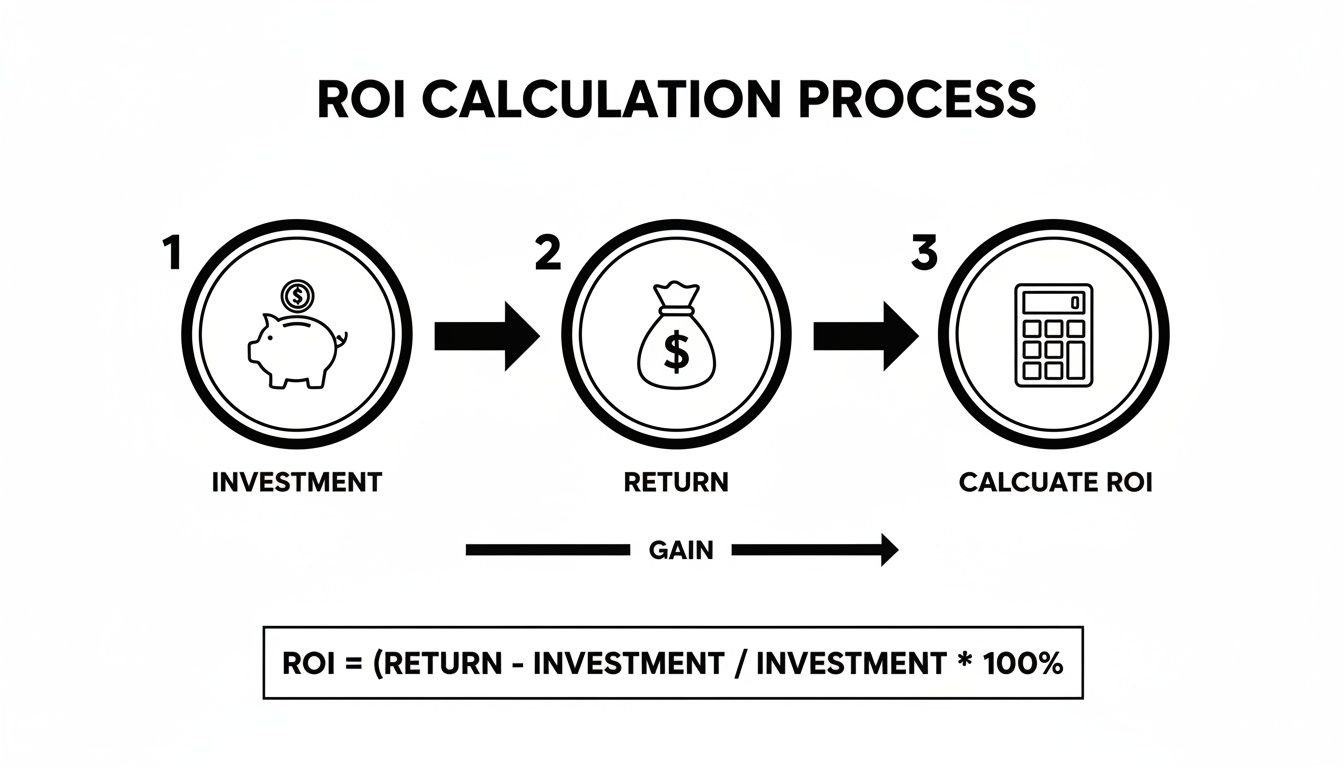
As you can see, clear tracking is what allows you to define both the "investment" and the "return" sides of the equation accurately.
Choosing the Right Attribution Model
Once you're tracking conversions, the next big question is: who gets the credit? A customer might read three blog posts, click a social media ad, and open two emails before finally making a purchase. An attribution model is simply the rule you use to distribute credit for that sale among all those different touchpoints.
There are several models to consider:
- First-Touch Attribution: Gives 100% of the credit to the very first piece of content a customer interacted with. This model is excellent for figuring out which content is best at generating initial awareness and bringing new people into your funnel.
- Last-Touch Attribution: Assigns 100% of the credit to the final touchpoint right before a conversion. This is super useful for identifying the content that effectively closes deals and pushes customers over the finish line.
- Linear Attribution: This model splits credit evenly across every single touchpoint in the customer's journey. It acknowledges that every interaction played a role, giving you a more balanced view of your overall content ecosystem.
- Position-Based (or U-Shaped) Attribution: A hybrid model that gives more weight to the first and last touches (often 40% each) and distributes the remaining 20% among the interactions in the middle. It values both what started the journey and what closed it.
The right model really depends on your business goals. If your main priority is finding new customers, First-Touch is invaluable. If you want to optimize your sales process, Last-Touch provides key insights. For a more holistic view, Linear or Position-Based models often tell a more complete story.
Many of these tracking techniques can be supercharged by exploring marketing automation software for small business, which can help connect these dots for you automatically.
So You've Got Your ROI Number. What Now?
Calculating your content marketing ROI is a huge step, but it’s a checkpoint, not the finish line. The real magic happens in what you do with that number.
Raw data tells you if you won or lost the last round. A deeper analysis tells you why—and that insight is what turns one-off wins into a sustainable growth engine. This is the moment you graduate from being a content producer to a true content strategist. It's about looking at the results, finding the patterns, and building a feedback loop that makes every new piece of content smarter than the last.
You stop just making content and start making more of the right content.
Interpreting Your ROI: What’s a “Good” Result, Anyway?
One of the first questions many marketers ask is, "So... is this ROI any good?" The answer isn't a single number. It's wildly contextual and depends on your industry, your business model, and how long you've been executing your content strategy.
A commonly cited benchmark is a 5:1 ratio (that's a 400% ROI), meaning you make $5 for every $1 you spend. But honestly, that number can be misleading without context.
Content marketing ROI isn't a straight line; it compounds. Performance often accelerates in years two and three as your content gains authority and starts pulling in organic traffic. For instance, one analysis showed an industry growing from a 367% ROI in Year 1 all the way to 656% by Year 3. You can dig into these industry-specific ROI patterns to set some realistic expectations for yourself.
A "good" ROI is one that:
- Beats what you're getting from other channels (like your paid ad spend).
- Shows a positive, upward trend over time.
- Hits or surpasses the goals you set in the first place.
Pinpoint Your Power Content
Your next move is to find your winners. Dive into your analytics and start sorting your content by the KPIs you decided on earlier. You're not just looking for the blog post with the most pageviews; you're hunting for the content that delivers real business value.
Start asking the right questions:
- Which articles or videos brought in the most qualified leads? This tells you what actually resonates with your ideal customer.
- Which pieces did our eventual high-value customers read or watch? Get into your CRM and connect the dots between content and closed deals.
- What formats consistently perform best on conversions? Maybe your in-depth guides are outperforming your short-form posts by a mile.
- Which topics have the best engagement-to-lead ratio? A million shares are nice, but a hundred high-quality sign-ups are better.
By finding your "power content," you uncover the sweet spot where your audience's needs and your business goals perfectly intersect. This isn't about finding your most popular post; it’s about finding your most profitable one.
Build a Continuous Feedback Loop
The whole point of this analysis is to build a cycle of continuous improvement. It’s a simple but incredibly powerful framework: measure, analyze, and iterate.
Double Down on What Works
Once you've identified your top-performing formats and topics, you need to make them a central part of your strategy. If you discover that case studies showing real-world results convert 3x better than anything else you publish, your path forward is crystal clear: make more case studies.
This also means finding new ways to get more mileage out of those winning formats. For instance, an AI agent like Postbae could autonomously break down a successful case study into a dozen different visual social media posts to share across your channels, maximizing its reach and impact without extra manual work.
Re-Optimize Your Existing Assets
Your analysis will also shine a light on content that gets tons of traffic but fails to convert. These pieces are prime candidates for a refresh.
Can you add a stronger call-to-action? What about embedding a link to a relevant webinar recording? Or maybe the data is just a bit stale and needs an update to be truly useful again. Small tweaks can turn a high-traffic underperformer into a lead-gen workhorse.
Reallocate Your Resources (The Hard Part)
If certain channels or content types are consistently delivering a low or negative ROI, it's time to make some tough calls. Your data is the evidence you need to shift budget and team resources away from what isn't working and pour them into the areas with the highest proven return.
This data-driven approach removes emotion and guesswork from your strategy. It ensures every dollar and every hour is spent for maximum impact.
Common Questions About Measuring Content ROI
Diving into content marketing ROI can feel like a maze, and it's totally normal for questions to pop up as you try to nail down your strategy. Here are the answers to the questions we hear most often, designed to clear up the trickiest parts you're likely to run into.
How Long Does It Take to See a Positive ROI from Content Marketing?
This is a critical question, and the honest answer is: it takes time. You can usually expect to see the first measurable results, like a bump in traffic and better engagement, within 3-6 months.
But a real, significant positive ROI? That often takes closer to 6-12 months to show up. Content is a long game that compounds on itself. Your early wins are just building the foundation; the real financial returns come later as your content matures, starts ranking in search, and builds trust with your audience.
Patience and consistency are your best friends here.
What If My Content Does Not Directly Lead to Sales?
It’s a huge misconception that every single piece of content needs to be a sales closer. In reality, a lot of your content, especially the top-of-funnel stuff, is there to build brand awareness, educate your audience, and establish your authority—not to drive an immediate sale.
To figure out its value, you have to assign a dollar amount to these "softer" outcomes.
- Calculate the PPC Value of Organic Traffic: Figure out what you would have paid to get that same traffic through paid ads. This puts a tangible dollar value on your organic reach.
- Assign a Value to Leads: Track secondary conversions like newsletter sign-ups or e-book downloads. Look at your historical data to determine the average value of each new lead that enters your system.
This approach helps you quantify the impact of content that assists in a sale, even if it wasn't the final touchpoint.
Remember, content that builds trust and educates is what warms up a cold audience, making them receptive to a sales conversation down the line. Ignoring its value means you're only seeing a fraction of the full picture.
What Are the Most Common Mistakes When Measuring Content ROI?
Even with the best intentions, a few common pitfalls can completely skew your results and lead you down the wrong strategic path. Just being aware of them is the first step to avoiding them.
Here are the mistakes we see most often:
- Fixating on Last-Touch Attribution: This is the big one. It completely ignores all the blog posts, social media updates, and emails that nurtured a lead, giving 100% of the credit to whatever they clicked last.
- Forgetting to Track All Costs: So many teams only count direct expenses like what they paid a freelancer or their ad spend. Forgetting to factor in indirect costs like your team's salaries and tool subscriptions gives you a dangerously inflated and inaccurate ROI figure.
- Relying on Vanity Metrics: Chasing likes, shares, and page views without connecting them to actual business goals is a recipe for busy work, not business growth.
- Inconsistent Tracking: If you're not using UTM parameters for every single campaign, accurate attribution is basically impossible. You end up with data gaps that undermine the integrity of your entire measurement process.
How Can I Measure the ROI of My Social Media Content?
Measuring the ROI of your social media content means blending on-platform and off-platform tracking. For the kind of visual, authority-building content created by an AI agent, the process is pretty straightforward.
First, you must use unique UTM parameters in every link you share. This is non-negotiable. It lets you see exactly how much website traffic and how many conversions came from specific platforms—and even individual posts.
Next, you'll want to set up conversion goals in Google Analytics for actions taken by visitors who land on your site from your social channels. This could be anything from a form submission to a demo request. By connecting these dots, you can directly attribute revenue-generating activities to a specific social post.
For example, with a multi-slide educational carousel from an AI tool, you can track on-platform metrics like shares and saves as key indicators of its authority-building power. At the same time, you track the click-through rate on the link in your bio and the subsequent conversion rate on your website to measure its direct, tangible ROI.
Ready to stop spending hours on manual design and start focusing on strategy? Postbae is an AI agent that automatically creates professional, visual social media content for you. Get authority-building carousels, infographics, and listicles generated on autopilot, freeing you up to do the high-impact work of measuring and optimizing your ROI. Learn more at https://postbae.com.