How to Scale Content Marketing Without Losing Quality

Learn how to scale content marketing with our guide on building systems, using automation, and optimizing workflows to drive sustainable growth.
Trying to scale your content marketing without a solid foundation is like trying to build a skyscraper on sand. It’s a recipe for disaster.
Before you even think about hitting the gas, you have to establish the systems that keep your quality high and your purpose clear. This isn't about speed—it's about building the strategic infrastructure that makes future speed even possible.
You wouldn't start a road trip without a map, right? Same logic applies here. This is where you connect every blog post, social graphic, and email directly to tangible business outcomes.
Building Your Foundation for Scalable Content
Scaling content isn't just about yelling louder; it's about making sure your message is crystal clear and hits the right people, every single time. Without a blueprint, you’ll end up with a chaotic mess of off-brand messaging, wasted effort, and content that goes nowhere.
Think of it this way: a strong foundation makes every future decision ten times easier. It's the boring-but-necessary work that separates the brands that grow from the ones that just make noise.
Define Your Core Content Pillars
Your content pillars are the 3-5 massive topics your brand is going to own. These aren't just random subjects; they're the strategic themes that sit right at the intersection of what your audience desperately needs and what your business knows best.
For a B2B SaaS company, these pillars might look something like:
- Productivity Hacks
- Team Collaboration
- The Future of Work
Defining these pillars gives you guardrails. When someone on your team throws out a new idea, the first question is always, "Does this fit under a pillar?" If the answer's no, it's probably a distraction. This keeps you from chasing shiny objects and helps you build real authority where it counts.
Get Laser-Focused on Audience Personas
Scaling means talking to more people, but it absolutely does not mean talking to everyone. Vague, generic content is the fastest way to get ignored. You need deeply researched audience personas that go way beyond "Marketing Manager, age 30-45."
What keeps them up at night? What are the questions they're secretly typing into Google? What kind of content do they actually find valuable, not just tolerable? A killer persona feels like a real person, guiding your tone, topics, and even the formats you choose. This clarity ensures that as you ramp up production, your message stays sharp.
Establish a Consistent Brand Voice and Identity
As your team grows, keeping a consistent brand voice becomes non-negotiable. A documented style guide is your single source of truth and your best defense against brand chaos.
This guide should be ruthlessly specific:
- Tone: Are you authoritative and professional, or witty and informal? Show, don't just tell—provide real examples.
- Vocabulary: Are there specific industry terms you own? Words you never, ever use?
- Formatting: How do you use headings, lists, and bold text? Get granular.
- Visuals: What are your exact brand colors, fonts, and logo usage rules? No exceptions.
This isn't just about making things look pretty. It's about building a recognizable, trustworthy brand. When every piece of content looks and sounds like it came from the same brain, you build brand equity that makes you instantly stand out in a crowded feed.
A crucial element for consistency and efficiency when scaling is knowing how to create standard operating procedures that truly work. These documents turn your strategy into a repeatable, teachable process for your entire team.
Putting these systems in place pays off, big time. Companies that maintain blogs, for instance, generate 55% more website traffic and a whopping 67% more leads than those that don't. That’s the power of a solid, repeatable foundation.
Before moving on, let’s quickly recap the core building blocks for a content machine that can actually scale.
Core Components of a Scalable Content Foundation
| Component | Description | Key Action for Scalability |
|---|---|---|
| Documented Strategy | A clear plan connecting content efforts to specific business goals. | Define KPIs upfront to ensure every piece has a purpose. |
| Content Pillars | The 3-5 core topics your brand will own and build authority around. | Use pillars as a filter to approve or reject new content ideas. |
| Audience Personas | Deeply understood profiles of your target audience, beyond demographics. | Create detailed "day-in-the-life" scenarios to guide content creation. |
| Brand & Voice Guide | A single source of truth for tone, style, vocabulary, and visual identity. | Make the guide a non-negotiable part of the onboarding process. |
| Standard Operating Procedures (SOPs) | Repeatable, step-by-step instructions for content workflows. | Document everything from ideation to promotion for easy delegation. |
Nailing these components isn't the sexy part of content marketing, but it's the part that actually works. With this foundation, you're ready to build something that lasts.
Dialing In Your Content Creation Workflows
A solid foundation stops you from building on sand, but a killer workflow is what lets you build a skyscraper. When you're ready to scale content, you have to shift your process from a chaotic, unpredictable art form into a repeatable, well-oiled production line.
The whole point is to hunt down and eliminate bottlenecks, cut out the friction, and give your team the green light to produce top-tier work consistently—even when the volume cranks up to eleven.
This all starts with standardization. Stop reinventing the wheel for every single blog post or social graphic. It's time to build a library of proven templates. These aren't just about saving a few minutes here and there; they're about baking quality and consistency right into your DNA.
Nail Your Standardized Templates
Templates are your secret weapon for moving fast without breaking things. They guarantee that every piece of content, no matter who's creating it, lines up perfectly with your brand standards and strategic goals.
Think about building out templates for your most common formats:
- Blog Posts: A pre-structured doc with placeholders for the intro, H2s, H3s, a conclusion, and a CTA. It should have little reminders baked in, like "Don't forget internal links!" and "Insert an image here."
- Social Media Visuals: Pre-designed layouts for different platforms and post types. Having ready-made templates for tips, quotes, and data points keeps your feed looking sharp and consistent.
- Email Newsletters: A modular template that lets you drag and drop different content blocks for feature announcements, blog roundups, and company news.
When you standardize these, you slash production time. A writer can pour all their energy into crafting a killer article instead of messing with formatting, and a designer isn't staring at a blank canvas every single time. It also makes bringing on new people a breeze.
The diagram below shows how a solid strategic foundation naturally flows into this kind of efficient workflow.
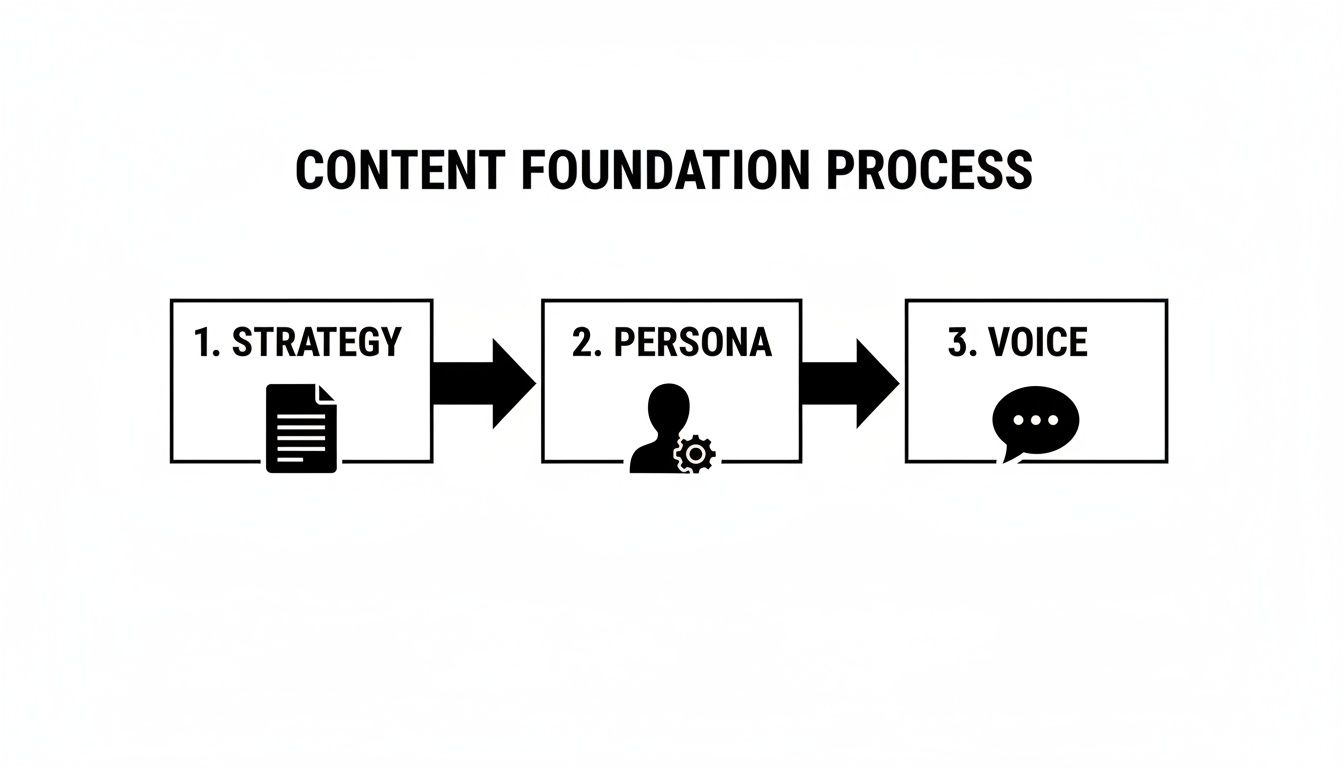
As you can see, you can't even think about workflows until your strategy, personas, and voice are locked in. First things first.
Implement Bulletproof Content Briefs
A weak content brief is the #1 reason for endless, soul-crushing revisions and wasted days. A great brief gives your creators everything they need to know right from the start, killing the guesswork and making sure the first draft is 90% of the way there.
A bulletproof content brief isn't a suggestion; it's a contract. It's the single source of truth that defines the scope, goals, and expectations for a piece of content, protecting everyone from miscommunication and scope creep.
Your content brief template should be non-negotiable. No brief, no work. Period. Make sure it includes:
- Primary Keyword & Goal: What search term are we targeting? What specific action do we want the reader to take?
- Target Audience Persona: Who are we actually talking to? What's their biggest headache related to this topic?
- Key Talking Points: What are the absolute must-have concepts or data points that need to be in this piece?
- Internal Linking Opportunities: Which of our existing pages should this new article link out to?
- Competitor Examples: What do the top-ranking articles for this keyword look like? How are we going to be better?
- Tone of Voice: Point back to your brand guide and be specific (e.g., "expert but approachable, like a knowledgeable friend").
With a brief this detailed, you're not just delegating tasks; you're empowering your writers and designers to work with confidence. This one document is probably the most powerful lever you have for improving both speed and quality.
Map Out Clear Production Stages
Finally, get your entire content workflow down on paper (or, you know, in a project management tool). Map it out from the first spark of an idea all the way to hitting "publish" and promoting it. A clear, documented process ensures handoffs are smooth and nothing ever falls through the cracks.
A well-structured plan is everything. To see how these stages fit into a bigger picture, check out our guide on building a rock-solid marketing content calendar.
By dialing in these workflows, you're not just building a system that can handle more content—you're building one that actually thrives on it.
Using Automation and Tech to Actually Scale
If you want to scale your content marketing, technology is the only way to multiply your efforts. The old model—where more content required more people and more hours—is a recipe for burnout. The real trick is building a smart tech stack that handles the repetitive junk, freeing up your team to focus on strategy and creative work.

And no, this isn't just about AI writers. While those tools can help with first drafts, the real slowdown for most teams happens somewhere else entirely: visual content. For small businesses, social media managers, and marketing agencies, creating a steady stream of professional-looking social media graphics is often the single biggest bottleneck.
Automate Your Biggest Bottleneck: Visuals
Every marketer knows this pain. You’ve got a killer blog post, an eye-opening statistic, or a brilliant tip, but turning it into a scroll-stopping Instagram carousel or a sharp LinkedIn infographic eats up hours of manual design work. It’s slow, expensive, and a massive barrier to scaling your social media presence.
This is exactly where specialized automation tools come in. Instead of spending hours in manual design software, you can use an AI agent built to handle the entire visual creation process for you.
For example, Postbae is an AI-powered agent designed to completely automate the production of professional visual social media graphics. It works in the background to create industry-specific, ready-to-post assets like:
- Multi-slide educational carousels
- Visually engaging listicles
- TikTok Slideshows
- Data-driven industry insights
- Tips & tricks visual posts
The key difference here is that it requires zero prompts from you. The AI agent autonomously generates authority-building content that establishes you as an expert on platforms like Instagram, Facebook, and LinkedIn. And while it automates the creation, you always keep full control; every post it generates is completely editable, so you can tweak it to perfection.
Build Your Essential Content Tech Stack
Beyond visuals, a truly scalable operation needs a few other core pieces of tech to keep things organized and data-driven. The goal is to create a seamless flow from idea to analysis without pulling your hair out.
A solid project management tool is non-negotiable. Platforms like Asana, Trello, or Monday.com act as your command center. They show you the entire production pipeline, make it clear who owns what, and ensure deadlines are met without you having to chase people down.
Next, you need robust analytics. While your project management system tracks output (what you made), tools like Google Analytics and platform-native insights track outcomes (what actually worked). These are the tools that tell you what's a hit so you can double down on your winners and stop wasting time on content that's going nowhere.
Technology is the main lever for getting more done without hiring an army. Research shows that companies using AI for content tasks can seriously shorten production times, letting them pump out more volume without a proportional increase in headcount. To learn more about how automation can improve your processes, check out these marketing automation best practices.
Connecting Production with Performance
The most successful teams connect their production tools directly to their performance data. Recent industry stats back this up, showing that winning teams are combining AI-assisted creation with obsessive measurement. But there's a huge gap—only about 29–41% of marketers reliably measure content ROI, a massive blind spot that makes true scaling impossible.
By integrating automation for creation with analytics for measurement, you create a powerful feedback loop. You're not just creating more content; you're creating more of the right content. This is how you transform your content marketing from a simple business function into a predictable, scalable growth engine.
Your Guide to Smart Content Repurposing
Creating amazing content is just step one. If you really want to scale, you need to live by the "create once, distribute forever" philosophy. This isn't about just reposting old links; it's about being smart and squeezing every last drop of value out of the hard work you've already done.
Think about that in-depth research report you just published. That’s not a single piece of content; it's a goldmine. With the right system, you can chop it up into a dozen smaller assets, effectively multiplying your output without burning out your team.

From Pillar to Micro Content
At the heart of any solid repurposing strategy is what’s known as the "pillar and cluster" model. Your pillar is the big, substantial piece—think of an ultimate guide, a webinar, or a deep-dive case study. The clusters are all the smaller, bite-sized pieces you break off from it for different channels.
This approach stops you from just posting random, disconnected stuff. Instead, every micro-post, graphic, and video clip works together to drive traffic back to that original pillar piece. You end up creating a powerful, interconnected web of content that reinforces your expertise. It's a foundational technique for anyone serious about how to scale content marketing.
A Practical Framework for Repurposing
Let’s get practical. Here’s how one big asset can fuel your entire content calendar for weeks.
Pillar Asset: An hour-long webinar on "The Future of Small Business Marketing."
From this one recording, you can easily pull:
- A series of short blog posts: Take each key topic from the webinar and expand on it in a dedicated post.
- An educational Instagram carousel: Pull out the top 5 key statistics mentioned and design a simple, swipeable graphic.
- Quote graphics for LinkedIn: Isolate the most powerful quotes from your speakers and turn them into shareable images.
- A downloadable checklist: Condense all the actionable tips into a handy one-page PDF to use as a lead magnet.
- A short video script: Find the most compelling 2-minute segment and script it out for a TikTok or Reel.
This is how you serve different parts of your audience on the platforms they actually use, all while hammering home your core message.
To show you how this looks in practice, here’s a quick matrix mapping one pillar piece to various micro-assets.
Content Repurposing Matrix Example Pillar to Micro
| Pillar Content (Source) | Micro-Content (Carousel) | Micro-Content (Short Video) | Micro-Content (Text Post) |
|---|---|---|---|
| Blog Post: "The Ultimate Guide to SEO in 2024" | LinkedIn Carousel: "5 SEO Mistakes You're Making Right Now" (pulls 5 key points from the guide). | Instagram Reel: "30-Second SEO Tip: How to Find Low-Competition Keywords" (based on one tactic). | Tweet Thread: A breakdown of the guide's core concepts with a link back to the full article. |
| Webinar: "Mastering Cold Email Outreach" | Instagram Carousel: "Swipe Our Top 5 Cold Email Subject Lines" (features high-performing examples). | YouTube Short: "Watch Me Write a Cold Email That Gets Replies" (a screen recording snippet). | LinkedIn Post: A text-only summary of the webinar's key takeaways, asking for audience tips. |
| Podcast Episode: Interview with a Sales Leader | LinkedIn Carousel: "3 Brutal Truths About Sales from [Guest Name]" (features powerful quotes). | TikTok Video: A clip of the guest sharing their most controversial opinion. | Facebook Post: A personal story related to the interview topic, encouraging comments. |
See how that works? One piece of heavy lifting fuels a whole ecosystem of content, meeting your audience where they are.
Repurposing isn't about being lazy; it's about being strategic. It recognizes that different people consume content in different ways. By repackaging your best insights into multiple formats, you dramatically increase their reach and impact.
Automating the Visual Repurposing Bottleneck
Let’s be honest, the biggest hurdle here is usually creating all the visuals. Manually designing carousels, quote graphics, and audiograms for every single pillar piece is a massive time-suck that kills all your momentum.
This is where automation becomes a true game-changer.
Tools like Postbae are built to solve this exact problem. It’s an AI agent that works in the background to autonomously generate professional, industry-specific visual posts for you. You don’t even have to feed it prompts.
It can take the key ideas from your pillar content and automatically create the visual assets you need to scale, like:
- Multi-slide carousels for Instagram.
- Educational listicles for Facebook.
- Authority-building infographics for LinkedIn.
By handing off the creation of these visual micro-assets, you free up your team to focus on high-level strategy and finding the next great repurposing opportunity. And since every graphic generated by Postbae is fully editable, you always have the final say to make sure it’s perfectly on-brand.
Scaling Your Content Distribution and Promotion
Making more content is only half the job. Honestly, it's the easier half.
If you don’t have a killer system for getting that content in front of the right eyeballs, all that work might as well have never happened. As you ramp up production, your distribution strategy has to keep pace. This isn't just about tweeting a link; it's about building a multi-channel engine that squeezes every last drop of value out of every single thing you create.
The goal here is to get away from random, "oh crap, I forgot to promote this" moments and move toward a repeatable, strategic playbook. For every new blog post or case study, you should have a pre-defined process for how it gets amplified across your owned, earned, and paid channels. This is how you stop your best work from getting lost in the noise.
Building Repeatable Promotion Playbooks
A promotion playbook is just a fancy term for a checklist. It’s your standard operating procedure for distributing a new piece of content, and it takes all the guesswork out of the equation. No more reinventing the wheel every time you hit publish.
Your playbook should change depending on the content type and its main goal. A quick-win blog post doesn't need the same push as a massive, cornerstone guide.
For example, a playbook for a new, in-depth guide might look something like this:
- Email Blast: A dedicated email to your newsletter subscribers, teasing the guide's best takeaways. Don't just send the link; sell the value.
- Social Media Campaign: Plan a full week of posts across LinkedIn and Instagram. Pull out different stats, create carousels from key sections, and make quote graphics. Don't just post the same thing every day.
- Internal Nudge: A simple Slack message asking your team to share the guide with their networks. The key is to make it easy for them—give them pre-written copy and a graphic.
- Community Drop: Share the guide in relevant Slack communities or forums where your audience actually hangs out. But don't just spam the link. Add some context and start a real conversation.
By writing these steps down, promotion becomes a system, not an afterthought. You can have different playbooks for different formats—one for blogs, another for webinars, a third for case studies—to make sure each one gets the push it deserves.
Prioritizing Channels and Visual Formats
Look, as you scale, you can't be everywhere. You just can't. Your distribution has to be ruthlessly prioritized based on where your audience actually spends their time. Is your ideal customer a LinkedIn power user who never touches Facebook? Then double down on LinkedIn and forget the rest.
Just as important is the format of your content. On crowded, fast-scrolling feeds like Instagram and LinkedIn, visuals aren't a nice-to-have; they're the price of entry. A simple text update is basically invisible. You need professionally designed graphics, educational carousels, and slick infographics to make people stop scrolling.
This is where channel and format decisions become critical. The data is screaming at us: video and short-form media are absolutely dominating reach right now. Multiple sources for 2024–2025 report that video is the highest-performing content format, with platforms like YouTube seeing massive year-over-year growth. This forces you to shift resources toward more visual, dynamic content. If you want to dive deeper into the numbers behind these trends, you can explore detailed content marketing statistics and trends.
Your entire distribution strategy should boil down to this: deliver the right message, in the right format, on the right channel. A single pillar article can be sliced and diced into dozens of visual assets, each one perfectly tailored for a different platform.
Integrating Owned, Earned, and Paid Media
A truly scalable distribution machine doesn't just rely on one channel. It integrates all three types of media to create a powerful compounding effect.
- Owned Media: This is your home base—your blog, your email list, your social profiles. It's the most reliable channel because you have complete control. No algorithm can take it away from you.
- Earned Media: This is when other people do the shouting for you. Think guest posts, PR mentions, or just organic social shares from influential accounts. This is how you build credibility and tap into new audiences you couldn't reach on your own.
- Paid Media: This is your accelerator pedal. Using targeted ads on platforms like LinkedIn or Facebook, you can guarantee your best content reaches a very specific, highly relevant audience. It’s how you drive traffic and leads on demand.
The real magic happens when you get these three working together. You publish a killer guide on your blog (owned), promote it with a small ad budget to get the ball rolling (paid), and that initial traction leads to industry experts sharing it with their followers (earned). This integrated approach ensures your content reaches its maximum potential, turning your scaled-up production into scaled-up results.
Measuring Performance to Optimize for Growth
You can't scale what you don't measure. Period.
Shoving more content out the door without knowing what’s actually working is like flooring it in a car with the windshield blacked out. Sure, you're moving faster, but you're probably headed straight for a wall. To make sure your scaled-up efforts are smarter, not just bigger, you need a data-driven feedback loop that tells you what to do more of and what to kill.
This is about moving past the ego-stroking "vanity metrics" and dialing in on the numbers that actually connect your content to real business results. It’s the difference between celebrating a traffic spike and celebrating qualified leads that came from that traffic.
Identifying KPIs That Actually Matter
As you ramp up content production, your data gets noisy. It’s way too easy to get distracted by numbers that look good but mean nothing. You have to filter out the junk and zero in on what truly drives growth for your business.
The easiest way I've found to do this is by mapping your KPIs to the marketing funnel. This gives you a complete, honest picture of how your content is performing from first touch to final sale.
Here’s a simple breakdown:
- Top of Funnel (Awareness): This tells you if you're even reaching new people. Keep a close eye on organic traffic, keyword rankings, and social media reach.
- Middle of Funnel (Consideration): Now we're measuring actual interest. The gold here is in newsletter sign-ups, lead magnet downloads, and time on page.
- Bottom of Funnel (Decision): These are the money metrics. You need to be tracking conversion rates from specific content pieces (like demo requests from a blog post), content-attributed revenue, and your customer acquisition cost (CAC).
Tracking social media engagement is especially crucial here, since it gives you a real-time pulse on how your audience is reacting to your message. To really get into the weeds, check out our guide on how to measure social media engagement and pick the metrics that make sense for your goals.
Building Your Content Performance Dashboard
Your dashboard is your mission control. It pulls all your most important KPIs into one place, making it dead simple to spot trends, see what’s crushing it, and figure out what’s broken at a glance.
You don't need some ridiculously expensive, over-engineered tool to start. A simple dashboard in Google Data Studio or even just a well-organized spreadsheet can be a total game-changer.
While you should tailor it to your specific goals, a solid starting point always includes:
- Traffic & Lead Sources: See which channels (organic, social, direct, etc.) are bringing in the eyeballs and, more importantly, the leads.
- Top Performing Content: This should be a ranked list of your content by conversions. It instantly tells you what your audience loves and what you should create more of.
- Funnel Conversion Rates: Track the percentage of people moving from one stage to the next, like from a blog reader to a newsletter subscriber.
Glance at this weekly for your core metrics and do a deeper dive monthly to spot bigger trends. This is how you turn raw data into decisions that actually move the needle.
Conducting Regular Content Audits
A content audit is your secret weapon for scaling sustainably. It’s basically a systematic review of everything you’ve ever published to decide what to keep, what to update, and what to just delete. This process forces you to build on a foundation of quality, not just a mountain of mediocre content.
A content audit isn't just about cleaning house; it’s about finding hidden opportunities. Your top-performing articles are prime candidates for repurposing, while underperforming assets can be pruned to improve your site's overall SEO health.
To get the most out of your audit, you first have to know how to properly analyze content performance. This is the core of the whole process.
Start by sorting your content into four simple buckets:
- Keep: High-performing stuff that's still relevant and bringing in results. Don't touch it.
- Update: Content that has potential—maybe it gets some traffic but it's outdated. Refresh it with new data, better visuals, and a stronger call-to-action.
- Consolidate: Got multiple articles on the same topic? Combine them into one monster pillar page that becomes the definitive resource.
- Prune: Low-quality, low-traffic content that adds zero value. It might even be hurting your SEO. Get rid of it.
By making measurement a core part of your team's culture, you guarantee that as your content program grows, it also gets smarter and more effective. You stop just creating more, and you start creating smarter.
Got Questions About Scaling Content?
Look, scaling content isn't just about hitting "publish" more often. It's a minefield of potential mistakes. Here are some of the most common questions I hear from marketers trying to ramp things up without everything catching fire.
"Okay, So Where Do I Actually Start with Scaling?"
Don't even think about hiring another writer or buying a new tool yet. Your first move is always to document your content strategy. I know, it sounds boring, but trust me on this.
Without a written playbook, you’re just creating chaos faster. Before you increase volume, you need a rock-solid foundation that spells out your goals, who you're talking to, your core topics, and your brand voice. This document is your North Star. It ensures every new piece of content is consistent, has a purpose, and actually ties back to your business goals. Skip this, and you'll be wasting a ton of time and money down the line.
"We're a Small Team with a Tiny Budget. How Can We Compete?"
This is where you have to get scrappy and smart. Small teams can absolutely punch above their weight by focusing on two things: content repurposing and automation.
Stop thinking of a blog post as just a blog post. That one long-form piece is a goldmine. It can be chopped up into a dozen smaller assets: social media graphics, email snippets, a carousel post, maybe even a short video script. It’s about working smarter, not harder.
Then, lean on automation. Use tools to handle the repetitive, time-sucking tasks like generating visuals for social media. This frees up your brainpower for the stuff that really matters—strategy and promotion.
"What Metrics Should I Actually Care About When We're Pumping Out More Content?"
Traffic is a nice ego boost, but it doesn't pay the bills. When you start scaling, the most important metrics are the ones that show a real business impact.
Sure, keep an eye on traffic, but your real focus should be on things like:
- Conversion rates (newsletter sign-ups, demo requests, etc.)
- Lead quality (are these people actually potential customers?)
- And the big one: content marketing ROI.
Tracking these metrics is the only way to know if your increased output is actually driving meaningful growth. Otherwise, you're just making more noise, not more money.
Ready to automate the biggest bottleneck in your content scaling process? With Postbae, you can generate professional, industry-specific visual posts like carousels and infographics without writing a single prompt. Free up your team and scale your social media presence effortlessly. Discover how at postbae.com.