What is Visual Content Marketing: A Quick Guide to High-Impact Strategy

What is visual content marketing? Learn its essentials, key types, and a practical approach to building an effective visual strategy.
At its core, visual content marketing is all about using compelling images, infographics, videos, and charts to tell your brand’s story. It’s the difference between showing someone a blueprint and letting them walk through a finished house.
Instead of just decorating a blog post with a stock photo, you’re turning complex ideas into messages people can digest and actually remember. In a world where everyone’s fighting for a split second of attention, visuals are your secret weapon to cut through the noise.
Why Visual Content Is No Longer Optional
Visual content isn’t a ‘nice-to-have’ anymore. It’s a core part of any effective marketing plan. Think about your own behavior for a second. When you’re scrolling through a feed, what makes you stop? Is it a giant block of text, or is it an eye-catching graphic or a quick video?
It’s almost always the visual. And the data supports this.
The human brain processes images a staggering 60,000 times faster than text. This isn't just a fun fact; it's a biological advantage for marketers. This preference is exactly why visual-first platforms became so popular and why a visual-first strategy can be the difference between being seen and getting scrolled past into oblivion.
The Growing Demand for Visuals
This shift toward visuals isn't a passing trend; it's a fundamental change in how we consume information online. The global visual content market hit $5.2 billion last year and is on track to grow to $19.17 billion by 2032. That's not just hype—it's fueled by real results.
Visual posts consistently rack up more views and shares than their text-only counterparts. But don't just create visuals in a vacuum. To really make them work, they need to be part of a foundational digital content strategy that supports your bigger business goals.
Before we dive deeper, let’s quickly break down the fundamental differences between visual and text-based content. Seeing them side-by-side really clarifies why a visual-first approach is so powerful.
Key Differences Between Visual Content And Text-Based Content
| Attribute | Visual Content | Text-Based Content |
|---|---|---|
| Processing Speed | Instantaneous; processed by the brain almost immediately. | Sequential; requires reading and cognitive processing. |
| Emotional Impact | High; evokes emotions and creates a gut reaction quickly. | Lower; builds emotion through narrative and description. |
| Memorability | High; images and colors are easily recalled. | Moderate; depends on the quality of the writing. |
| Information Density | Can convey complex data and relationships at a glance. | Explains nuances and details step-by-step. |
| Universal Appeal | Crosses language barriers more easily. | Language-dependent; requires translation. |
This table makes it clear: while text is crucial for depth and detail, visuals win the battle for immediate attention, emotional connection, and memory.
What This Means for Your Business
A smart visual strategy does a few things for you all at once. First, it grabs that initial attention. But more importantly, it helps you build a memorable brand identity through consistent colors, fonts, and styles. People start to recognize your look.
That consistency builds trust and helps position your brand as an authority in your space.
Visuals are the new universal language of marketing. They convey emotion, simplify complexity, and build brand recognition in a fraction of the time it takes to read a sentence.
Ultimately, investing in visual content is about finding a better, more engaging way to talk to your audience. It’s about making sure your message isn't just sent out into the world, but that it's actually seen, understood, and remembered.
The Core Visual Formats You Need to Master
Think of visual content marketing less as a single strategy and more like a toolkit. You wouldn't use a hammer to saw a piece of wood, right? Same idea here. Picking the right visual format for the job is everything when it comes to grabbing attention and actually getting your message across.
We're moving way beyond just slapping a stock photo on a post. A modern visual strategy uses a whole range of formats, each designed to do something different—educate, engage, tell a story, or build your authority.
Why the variety? Because a complex industry stat that would get completely ignored as a single image can be highly effective as a multi-slide carousel on LinkedIn. A quick tip that's perfect for a simple graphic on Instagram might fall flat somewhere else.
Getting a handle on this toolkit means you can match your goals to the perfect format, making sure every ounce of effort you put in actually connects with your audience.
Infographics: Making Complex Ideas Simple
Infographics are the workhorses of data-driven storytelling. Their magic is in taking dense stats, complicated processes, or timelines and transforming them into something that's not only easy on the eyes but also simple to understand.
There's a reason research shows infographics are 30 times more likely to be read than a wall of text. They're built for how our brains are wired to process information.
They are especially effective for:
Presenting survey results: Turning raw numbers into charts and graphs that tell a clear, compelling story.
Explaining a process: Breaking down a step-by-step workflow into a logical visual sequence people can actually follow.
Comparing data points: Using side-by-side visuals to make differences or similarities pop.
By boiling down complexity into a single, shareable graphic, infographics position your brand as the go-to expert who makes hard stuff easy.
Multi-Slide Carousels: The Art of Narrative Storytelling
There's a reason carousels have become so popular on platforms like Instagram and LinkedIn: they're incredible at telling a story. Instead of trying to cram an entire novel into one image, carousels walk your audience through a narrative, one slide at a time.
This step-by-step flow is addictive. It keeps people engaged and encourages them to swipe all the way to the end to get the full picture.
Carousels are perfect for:
Educational content: Breaking down a big topic into bite-sized chapters or key takeaways.
Step-by-step guides: Literally showing people how to do something or use your product.
Showcasing features: Highlighting multiple benefits of a product or service in a smooth, cohesive way.
This format doesn't just increase your engagement; it also massively increases the time people spend with your content, which is huge for message retention and brand recall.
Graphical Listicles and Educational Posts
Beyond the big infographics and detailed carousels, there's a whole world of powerful, single-image graphics. These are designed for the fast scroll—delivering a quick hit of value in a matter of seconds. They're the backbone of any strategy that aims to build authority through consistent, helpful content.
These formats include things like:
Graphical Listicles: Presenting tips, facts, or resources in a visually clean list (e.g., "5 Ways to Nail Your Next Launch").
Myth vs. Fact Graphics: Busting common industry myths and positioning your brand as the voice of reason.
Tip & Trick Visuals: Offering a single piece of actionable advice your audience can use right now.
Industry Insights: Sharing one powerful statistic or quote with a clean, professional design that makes you look smart.
These formats are essential for building up a library of helpful, save-worthy resources. If you want to dive deeper, you can learn more about creating a diverse mix of visual content for social media to keep your feed from getting stale.
A well-rounded visual strategy leverages a mix of formats. The key is to match the format not just to the message, but to the audience's mindset on a specific platform.
Ultimately, mastering these core visual types gives you a massive communication advantage. When you pick the right format for your message, you ensure your content doesn’t just get seen—it gets understood, saved, and shared.
What a Strong Visual Strategy Actually Does for Your Business
Investing in visual content isn’t just about making your social media feeds look pretty. It’s a business decision that directly impacts your bottom line. An effective visual strategy isn’t an expense—it’s an investment in growth, turning abstract ideas into tangible results.
When you execute it well, professional visuals become a powerful engine driving engagement, memory, and trust. They take your brand’s message and make it something people can see, feel, and remember. That’s what leads to more traffic, better leads, and sales. Let’s break down exactly why this works.
It Skyrockets Your Audience Engagement
The first thing you’ll notice is a jump in audience engagement. Social media is a visual game. Content that grabs your eye is the content that gets a reaction, and posts with compelling images consistently outperform text-only updates.
This isn't just about vanity metrics. More likes, comments, and shares tell the platform's algorithm that your content is valuable. What happens next? The algorithm shows it to more people, organically.
You get more interaction: Visuals are just easier and faster for our brains to process, which means people react instantly while scrolling through a crowded feed.
People share it more: A brilliant infographic or a slick multi-slide carousel is more shareable than a block of text, pushing your brand in front of entirely new audiences.
They stick around longer: Engaging formats like carousels get people to slow down and spend more time with your post, letting your message sink in.
This cycle of engagement and reach is how you build a real, active community around your brand instead of just shouting into the void.
It Makes Your Brand Unforgettable
Here’s one of the most powerful—and most overlooked—benefits of visual content: its effect on memory. People are wired to remember information when it’s tied to a relevant image.
Consider this. When people just hear information, they'll probably only remember 10% of it three days later. But if you pair that same info with a relevant image? That number jumps to 65%.
A strong visual doesn’t just show information; it anchors it in your audience's brain. This makes your brand the one they remember when they're finally ready to buy.
This is a critical advantage for any business trying to build authority. Whether you're a marketing agency explaining a complex strategy or a small shop showing off product features, you need your message to stick. Visuals make your key points easy to digest and, more importantly, hard to forget.
It Builds Brand Recognition and Trust, Fast
Consistency is everything when it comes to building a recognizable brand, and a cohesive visual strategy is the fastest way to get there. When your audience starts seeing the same colors, fonts, and graphic styles everywhere, they begin to recognize your brand in a split second. That familiarity builds a deep sense of trust and professionalism.
A consistent visual identity communicates stability and reliability. It tells your audience you’re a serious, credible player in your space. For social media managers and marketing agencies, this is gold. It positions you (or your clients) as a trustworthy resource, and that trust is the foundation for turning passive followers into loyal customers who believe in what you’re selling.
Building Your Visual Content Strategy From The Ground Up
A powerful visual presence doesn’t just happen. It’s not about luck or randomly posting pretty pictures. It’s the direct result of a smart, deliberate strategy that connects every single graphic, carousel, and video back to your actual business goals.
Without a plan, even the most stunning visuals end up as just digital noise. They might look good, but they won't connect, convert, or build your brand. The good news? Building this strategy isn't a complex process reserved for large marketing agencies. It breaks down into a few straightforward steps anyone can follow.
This framework is all about making sure your efforts are focused, consistent, and designed to get real, measurable results from day one.
Define Your Goals and Key Metrics
Before you design anything, you need to know why you're creating it in the first place. What’s the end game? Are you trying to get your name out there, pull in qualified leads, or maybe just teach your current customers something new?
Your goals will steer every single decision you make, from the type of content you create to the platforms you post on.
The trick is to tie every goal to a specific Key Performance Indicator (KPI). This turns fuzzy ambitions into something you can actually track.
Goal: Increase Brand Awareness. Your main metric here is reach and impressions—basically, how many unique eyeballs see your content.
Goal: Drive Engagement. You’ll be monitoring likes, comments, shares, and saves. This tells you if people actually care about what you’re posting.
Goal: Generate Leads. All that matters is the click-through rate (CTR) from your visual to a landing page and, ultimately, how many people fill out that form.
When your goals are this clear, you stop making content "just because." Every visual suddenly has a job to do.
Identify and Understand Your Target Audience
The best visual content feels like it was made just for the person looking at it. It speaks their language and hits on their specific pain points. A design that grabs a tech CEO on LinkedIn is going to be totally different from what stops a designer scrolling through Instagram.
To create visuals that actually land, you have to get inside your audience's head.
Start asking the important questions. What are their biggest headaches? What information would make their lives easier? And, crucially, where are they hanging out online? Answering these questions lets you tailor your visual style, tone, and format so it feels native to their world.
A visual strategy built without a deep understanding of the audience is like shouting into an empty room. You might be making a lot of noise, but nobody's there to listen.
Align Visual Formats With Your Core Message
Okay, you know your goals and who you're talking to. Now it’s time to pick the right tool for the job. Different visual formats are good for different things. A multi-slide carousel, for example, is perfect for walking someone through a complex process step-by-step. An infographic? That’s your go-to for making a bunch of data look compelling and easy to digest.
Think about the story you want to tell, then choose the format that tells it best.
To teach a step-by-step process: Go with a multi-slide carousel.
To make complex data simple: An infographic is your best friend.
To share quick, punchy tips: A simple graphical listicle works wonders.
To establish yourself as an expert: Share industry insights or charts that make you look smart.
This simple infographic below shows exactly how connecting your strategy to these outcomes pays off.
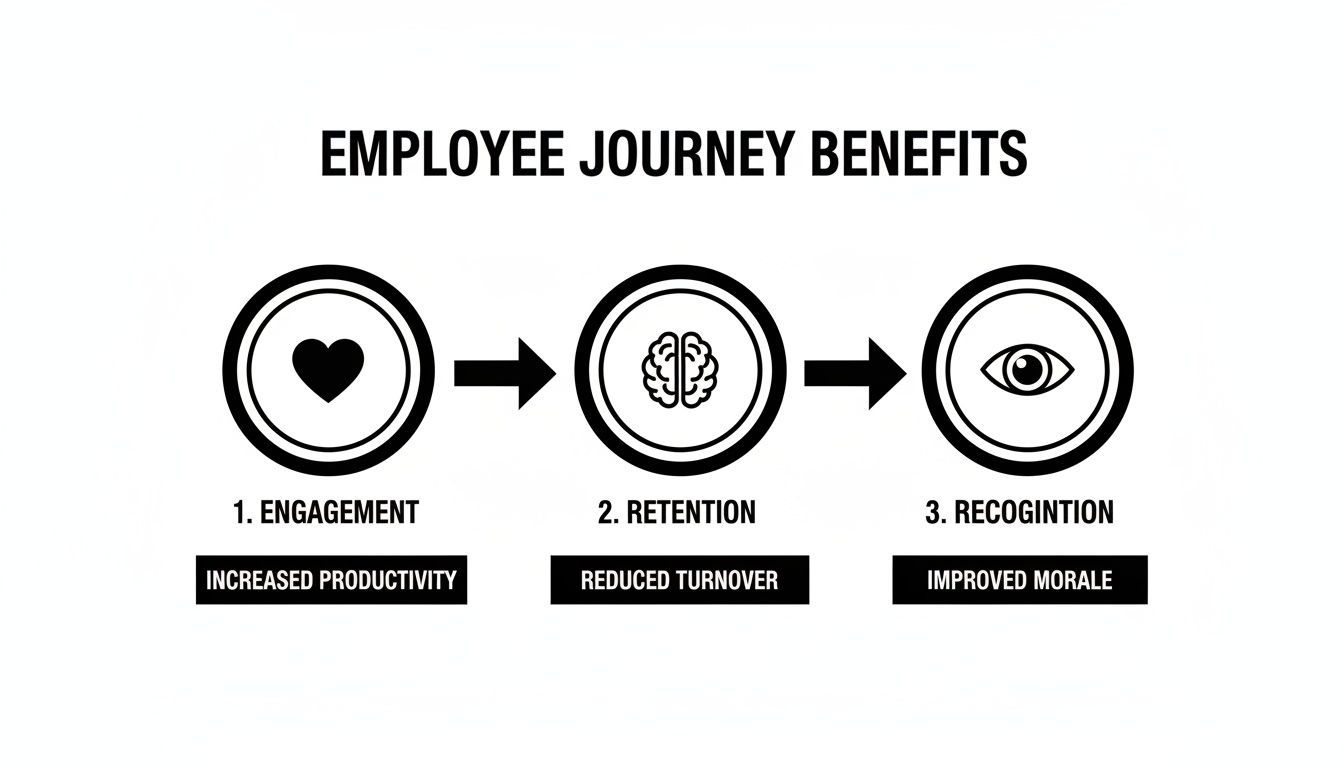
This isn’t just marketing theory. A planned approach like this directly leads to a stronger connection with your audience, makes your message stick, and helps you stand out in a ridiculously crowded feed.
Create a Cohesive Brand Identity and Content Calendar
The final piece of the puzzle is consistency. A cohesive brand identity—using the same colors, fonts, and logo placement over and over—makes your content instantly recognizable. Think of it as your brand’s uniform. It builds trust and makes you look professional across every platform. A simple style guide is non-negotiable for keeping this locked in.
Finally, get organized with a content calendar. This doesn't have to be fancy; a simple spreadsheet will do. Planning your posts in advance guarantees you’ll have a steady flow of high-quality content. It lets you map out your themes, schedule big announcements, and avoid that last-minute panic of "what do I post today?"
How To Streamline And Automate Visual Content Creation
Having a killer visual content strategy is one thing. Actually executing it day after day is a whole different beast. For most small businesses, startups, and agencies, the real roadblock isn't a lack of good ideas—it's the crushing lack of time and design resources. The daily grind of producing professional, high-quality visual graphics can bring your marketing to a screeching halt.
Sure, manual design tools are fine for a one-off project. But when you’re trying to build a consistent social media presence? The process of researching topics, writing copy, and designing every single graphic consumes hours each week. This is exactly the problem modern automation tools were built to solve.
The Shift From Manual Design To AI Automation
The biggest evolution in visual content isn't just about better design software. It’s about smart automation that takes over the entire creative workflow. AI-driven platforms have evolved beyond simple templates; they can now manage the entire multi-step process of creating professional visual content.
This is a massive leap from the old way of doing things. Instead of one person manually handling ideation, research, writing, and design, an autonomous system can run the whole sequence on its own. This frees up an immense amount of time for marketers and founders, letting you focus on strategy and community engagement instead of being stuck in content production.
How Autonomous AI Agents Work
Imagine having a dedicated social media content creator who works for you 24/7 in the background. That's the basic idea behind an autonomous AI agent like Postbae. It's a system that operates without you needing to constantly provide prompts or direction.
Here’s a look at how it generally works:
It Understands Your Business: The AI starts by analyzing your industry and target audience to identify relevant topics and content themes.
It Proactively Researches: It then finds industry insights, pro tips, interesting facts, and educational tidbits that your audience will actually care about.
It Pairs Content with Design: The AI writes the copy for your posts and then programmatically matches it with professionally designed, proven visual layouts, ensuring the final graphic is both informative and aesthetically pleasing.
It Generates Ready-to-Post Visuals: Finally, it automatically produces complete visual social media graphics like multi-slide carousels, educational infographics, and graphic-based listicles.
This hands-off process delivers a steady stream of ready-to-post visual content that's already tailored to your specific niche. If you want to get a head start on what works, checking out different social media graphics templates can give you a solid foundation.
Regaining Control Without Sacrificing Efficiency
One of the biggest concerns with automation is losing creative control. Nobody wants their brand to sound robotic. But the best modern platforms are built specifically to solve this problem. While the AI handles the initial creation, you always have the final say.
Automation should empower, not replace. The best AI tools handle the heavy lifting of content production while giving users complete freedom to edit, customize, and approve every single asset.
With a platform like Postbae, every visual graphic the AI generates is fully editable. You can jump in and tweak the text, change the brand colors, swap out images, or adjust the layout to get it just right. It strikes the perfect balance: you get the speed of AI production combined with the nuance of human oversight. This hybrid approach makes sure the final product feels authentic to your brand, not generic.
This level of automation is especially powerful for authority-building content. Creating deep, educational posts that position you as an expert takes a ton of work. By automating the production of these high-value assets, you can maintain a professional social media presence for a fraction of the usual cost and effort.
And while Postbae excels at this for graphics, the same AI principles can be applied to other formats. You can find AI video editing guides to help you become more efficient with video production as well. By embracing these tools, you can finally scale your visual marketing without having to scale your workload.
Measuring The Impact Of Your Visual Content
Making great visuals is only half the job. The other half—the part that turns a good strategy into a dominant one—is figuring out what actually works.
If you aren't measuring, you're just throwing content at the wall and hoping something sticks. Tracking your visual content's impact lets you see what your audience is actually paying attention to, ditch what's falling flat, and prove that all this effort is making a real difference.
A great visual strategy needs equally great measurement. This means you have to look past vanity metrics like follower counts and zero in on the numbers that signal real connection and, more importantly, business growth.
Key Metrics To Monitor
To get a clear picture of how your visuals are performing, you need a handful of go-to metrics. Each one tells a different part of the story, from "did anyone see this?" to "did it make us money?"
Here are the numbers you should have on your radar at all times:
Reach and Impressions: Think of reach as the number of unique people who saw your post, while impressions is the total number of times it was shown. High numbers here are the first sign that you're cutting through the noise.
Engagement Rate: This is arguably the most important number of them all. It lumps together likes, comments, shares, and saves to show what percentage of your audience actually interacted with your content. A high engagement rate means your visuals are hitting the mark.
Click-Through Rate (CTR): If your visual has a link pointing back to your site or a landing page, the CTR tells you what percentage of people actually clicked it. This metric is the bridge connecting your social content to your traffic goals.
Conversions: This is the finish line. A conversion is any action you want a user to take after seeing your visual—signing up for a newsletter, downloading an ebook, or making a purchase. This is your ROI.
Nailing down these numbers gives you the insights to double down on what’s working and fix what isn’t. For a deeper dive into the nitty-gritty, check out our full guide on how to measure social media engagement.
Leveraging Platform Analytics
You don't need to purchase expensive third-party tools to get started. Most of the big social platforms have powerful, built-in analytics that give you a treasure trove of data on your visual content.
The point of measurement isn’t just to report on what happened. It's to find actionable insights that make your next piece of content even better.
For example, Instagram Insights and LinkedIn Analytics offer detailed dashboards with post-by-post breakdowns of reach, engagement, and even who your audience is. By checking in on this data regularly, you can spot patterns. Maybe your carousels consistently outperform your infographics. Maybe your audience is way more active on Thursday mornings.
This data-driven feedback loop is what separates the pros from the amateurs. It transforms your visual content from a creative shot in the dark into a predictable engine for business growth.
Got Questions About Visual Content?
Alright, let's wrap this up by tackling some of the questions that always pop up when people decide to get serious about visual content. Think of this as the final pep talk to clear up any lingering doubts.
How Much Is This Visual Content Thing Going to Cost Me?
The honest answer? It can range from "a whole lot of your time" to "a whole lot of your money."
On one end of the spectrum, you’ve got the DIY route with manual tools, which is great until you realize you're spending hours tweaking designs instead of running your business. On the other end, you can hire a professional designer or an agency, but that gets pricey, fast.
A more balanced approach has emerged, especially with advancements in AI. Tools like Postbae have created a new category, giving small businesses a professional social media presence for just $30/month. It's like having a full-time social media manager for a fraction of the cost, making a high-end look accessible without that high-end invoice.
How Often Should I Be Posting Visuals on Social Media?
Stop obsessing over frequency. Seriously. Consistency is what actually matters.
Sure, you'll see generic advice telling you to post 3-5 times per week, but the perfect schedule is the one you can actually stick to without sacrificing quality. It all comes down to your audience and what you can realistically create.
Focus on shipping polished, valuable visual graphics on a regular schedule rather than scrambling to post low-effort filler just to hit some magic number. In the long run, quality always beats quantity.
Can I Reuse My Visuals on Different Platforms?
Absolutely—and if you’re not, you’re working way too hard. Repurposing isn't just smart; it's a non-negotiable strategy for getting the most out of your creative energy.
Think about it. You spend all that time creating one killer infographic. Why let it just sit on your blog? You can break that single asset down into a goldmine of content:
Slice it up into a multi-slide carousel for a deep-dive on Instagram or LinkedIn.
Pull out individual tip graphics for quick, shareable posts on Facebook.
Tweet out the juiciest stats or charts to get a conversation started.
This is how you get maximum mileage from every single thing you create. Work smarter, not harder.
What Actually Makes a Visual Post Successful?
A winning visual post has to nail three things. First, it has to be a scroll-stopper. If it doesn't instantly grab someone's attention in a crowded feed, it's already failed.
Second, it needs to deliver a clear, valuable message in seconds. No one has time to decipher a confusing graphic. They should get the point at a single glance.
A successful visual post achieves three things: it grabs attention instantly, delivers a clear and valuable message, and reinforces your brand identity. It should be easy to understand, visually appealing, and relevant to your audience's interests or pain points.
And finally, it has to feel like you. It needs to scream your brand with consistent colors, fonts, and overall style. The best visuals tell a story, solve a problem, or teach something useful without needing a long caption to explain it.
Ready to stop spending hours on design and start building your brand's authority on autopilot? Postbae is an AI agent that automatically generates professional, industry-specific visual posts for your social media, no prompts required. Get a consistent stream of high-quality content and take back your time. Discover the future of social media content at https://postbae.com.