What Is Thought Leadership Marketing and How Does It Drive Growth

Learn what is thought leadership marketing and how to build brand authority. Discover proven strategies, examples, and tactics to drive real business growth.
Thought leadership marketing is all about becoming the recognized expert in your industry by consistently sharing original, valuable insights. Instead of a hard sell, you focus on educating your audience and shaping the conversation around your niche. Do it right, and you'll build deep, lasting trust.
What Thought Leadership Marketing Looks Like in Practice

To really get what thought leadership marketing is, you have to look past the buzzwords. Think of it less like a sales tactic and more like a long-term strategy to build undeniable authority in your field.
Here’s a useful analogy: imagine the difference between a tour guide and a cartographer. A traditional marketer is often like a great tour guide, expertly selling tickets to a well-known destination. They are fantastic at promotion and guiding people down a path that already exists.
A thought leader, on the other hand, is the cartographer who drew the map in the first place. They don't just point out landmarks; they provide the original research, unique perspectives, and foundational knowledge that define the entire landscape. Their goal isn't just to produce content; it's to deliver groundbreaking insights that change how their audience thinks about a problem or even an entire industry.
Beyond Generic Content
Many brands fall into the trap of confusing content marketing with thought leadership. While they're related, they are not the same thing. Content marketing is the broad discipline of creating and sharing any content to attract an audience. Thought leadership is a specific, much more advanced form of it.
The core difference comes down to originality and influence. A blog post that summarizes common industry tips is content marketing. A detailed report based on your own proprietary data that uncovers a new trend? That's thought leadership.
This distinction is crucial. Helpful, generic content positions you as just another participant in the conversation. True thought leadership positions you as the leader of that conversation, making your brand the go-to resource people actively seek out for credible, forward-thinking guidance.
The Three Core Components
To break it down further, an effective thought leadership strategy is built on a few key pillars. Here’s a quick look at what they are, what they mean, and what they look like in the real world.
Core Components of Thought Leadership Marketing
This table gives a quick overview of the key elements, goals, and common formats that define an effective thought leadership strategy.
| Component | Description | Example Format |
|---|---|---|
| Original Insights | Providing a unique perspective or proprietary data that isn't available elsewhere. | Industry Research Reports |
| Audience Education | Consistently teaching your audience something valuable about their challenges or industry. | Educational Carousels |
| Building Authority | Becoming the recognized expert in a specific niche through high-quality content. | Webinars, LinkedIn Articles |
Ultimately, this strategy is all about building unshakable trust. When you consistently offer valuable perspectives without asking for anything in return, you become more than just a vendor—you become an indispensable advisor. This authority is the foundation for sustainable business growth, attracting higher-quality leads and loyal customers who see the value in your expertise long before they ever see a price tag.
Why Thought Leadership Is a Must-Have, Not a Nice-to-Have
The market is drowning in look-alike content and generic ads. Trying to stand out by shouting louder than the next brand is a losing game. This is exactly why thought leadership has gone from a fringe tactic to a core part of how smart brands grow.
Today's customers have developed an allergy to the hard sell. They’re tired of being marketed at. Instead, they actively hunt for authentic, expert voices who can help them make better decisions. When you become that trusted voice, you build a kind of loyalty that no amount of advertising can buy.
Building Real Trust in a Noisy World
Trust is the most valuable currency you have in business. When a potential customer trusts your expertise, they’ll choose you over a competitor, even if you cost more. Thought leadership is the most direct way to earn that trust.
This isn't just a hunch; it's how people actually make decisions now. They use expert content to vet their options. A 2025 Edelman-LinkedIn report found that around 55% of decision-makers across industries use thought leadership to size up potential partners. What's more, nearly 65% of these executives spend at least an hour every week consuming this content, searching for fresh ideas that cut through the noise. You can learn more about how to stand out in AI-flooded markets at MarketSmiths.com.
Thought leadership moves your brand from being one of many options to being the only logical choice. It shortens sales cycles because prospects arrive already convinced of your value.
This trust-building isn't just for feel-good vibes—it has a real impact on your business. It naturally attracts higher-quality leads because your audience is already interested in what you know. This same principle is key for individuals trying to grow their influence, a topic we dive into in our guide on how to build a personal brand.
The Bottom-Line Benefits
Putting in the work to become an authority isn't just about building a shiny reputation—it directly beefs up your bottom line. Brands that are seen as leaders in their field command more respect and can often charge a premium for what they offer.
To really see the difference, let's compare the old way of thinking with the new.
Traditional Marketing vs Thought Leadership Marketing
Traditional marketing is about interruption—getting in front of as many people as possible. Thought leadership is about attraction—becoming a magnet for the right people. The goals, methods, and outcomes couldn't be more different.
| Aspect | Traditional Marketing | Thought Leadership Marketing |
|---|---|---|
| Primary Goal | Generate immediate sales and leads. | Build long-term trust and authority. |
| Audience Focus | Targets a broad audience with promotional messages. | Nurtures a niche audience with educational content. |
| Key Metric | Conversion rates and short-term ROI. | Audience engagement and brand influence. |
| Outcome | Creates customers for a single transaction. | Cultivates loyal advocates for the brand. |
The takeaway here is pretty clear. Even if you're a small team with a tiny budget, investing in your authority is the most sustainable way to break through. You stop chasing customers and start attracting partners who see you as essential to their success.
The Four Pillars of an Effective Thought Leadership Strategy
Shifting from just creating content to building real authority isn't about random blog posts or a lucky viral hit. It demands a structured game plan. A real thought leadership strategy is built on four core pillars. Get these right, and you turn your expertise into an engine for growth.
This is how those efforts actually translate into business results—better leads, deeper trust, and the power to charge what you're worth.
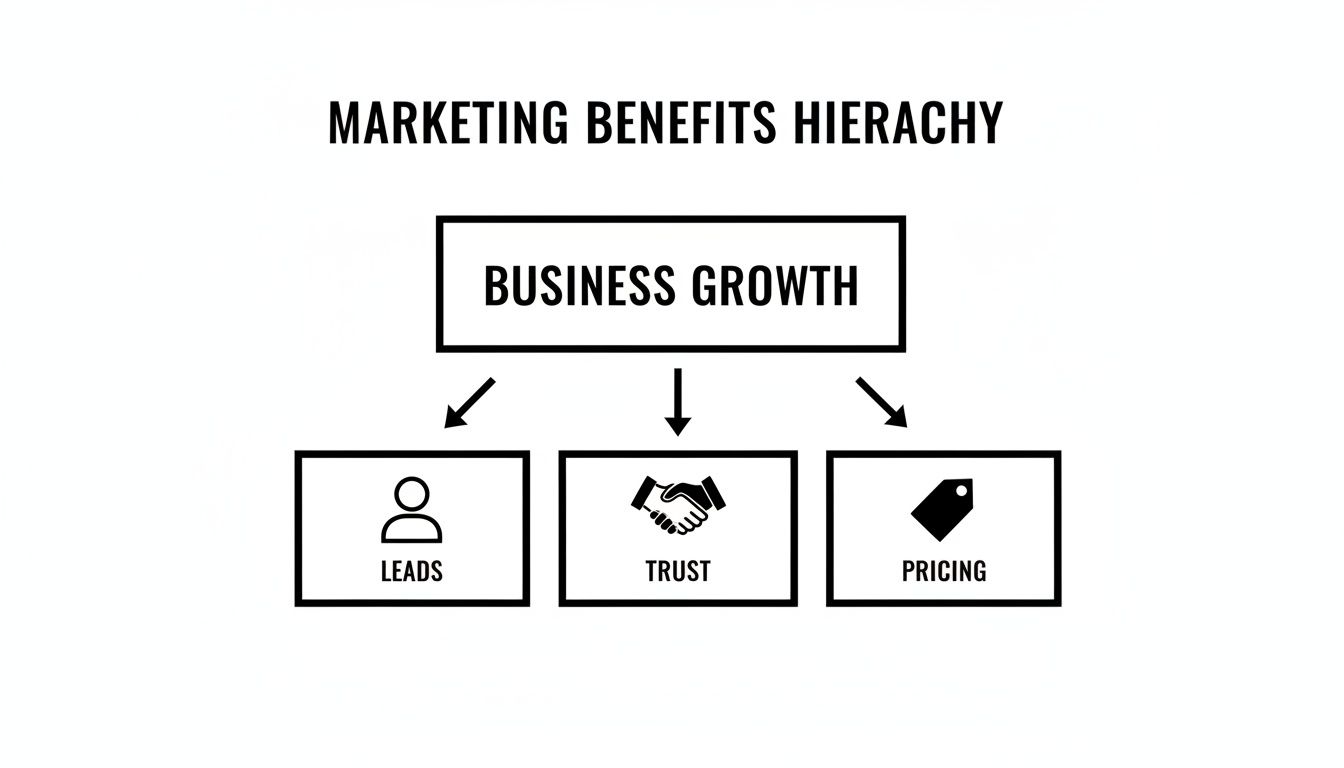
As you can see, sustainable growth is the end goal. It’s the direct result of attracting high-quality leads, building unshakable trust with your audience, and earning the right to command premium prices.
Pillar 1: Expertise
Before you can lead any conversation, you have to genuinely know your stuff. But here's the catch: being an expert in everything makes you an expert in nothing. The first step is to carve out a specific niche you can completely own.
Don't be afraid to go narrow. A laser-focused niche lets you develop deeper insights far faster than competitors trying to cover a broad topic. Ask yourself: What's the one nagging problem my audience obsesses over, and where does my unique knowledge create the most value? That intersection is your sweet spot.
Pillar 2: Originality
This is what separates the true leaders from the content curators. Originality isn’t just repackaging old ideas with a new title. It’s about bringing a fresh, insightful perspective to the table that actually pushes the conversation forward.
True thought leadership offers a viewpoint that is either based on proprietary data or presents a contrarian—yet well-reasoned—take on a common industry challenge. It’s the unique angle that makes your audience stop and think.
Developing that unique angle requires a commitment to going deeper than the surface-level chatter. Here are a few ways to cultivate it:
- Conduct original research: Survey your audience or dig into your own internal data. Uncovering trends no one else has seen is the raw material for game-changing insights.
- Take a contrarian view: When everyone else is zigging, explore the business case for zagging. A well-argued, unconventional perspective can capture massive attention.
- Connect unrelated concepts: What can marketing automation learn from supply chain logistics? Applying principles from one field to another is a powerful way to spark completely new ideas.
Pillar 3: Consistency
One brilliant article might get you a spike in attention, but it won’t build lasting authority. Consistency is the pillar that builds trust over time. Your audience needs to know they can count on you for a steady stream of valuable insights.
This doesn't mean you have to churn out content every single day. It means setting a reliable cadence—whether that's weekly or bi-weekly—and sticking to it. A predictable schedule trains your audience to look forward to your content, turning you into a trusted fixture in their professional lives.
Pillar 4: Distribution
Finally, even the most profound insights are useless if nobody sees them. Your content can’t make an impact from the sidelines. An effective distribution strategy ensures your expertise reaches the right people on the channels they actually use. Your job isn't over when you hit "publish."
This means you need to be actively sharing your work where your ideal clients hang out, whether that's on LinkedIn, in niche newsletters, or through visual formats like Instagram carousels. It also means engaging with other experts and joining relevant conversations to amplify your voice and solidify your position as someone who matters in your space.
How Winning Brands Execute Thought Leadership
It's one thing to talk about thought leadership, but it’s another to see how it works out in the real world. Let’s move past the theory and look at how winning brands actually pull it off. Success here isn’t about having the biggest marketing budget; it’s about having a killer strategy and truly understanding what your audience finds valuable.
Think about a B2B software company. They could invest in creating an annual, data-heavy "State of the Industry" report. By surveying thousands of pros and digging into their own user data, they cook up original insights nobody else has. That report becomes the go-to benchmark, something journalists, analysts, and even their competitors are waiting for and citing all year long.
Their strategy is effective because it's built on a simple pillar: originality. They aren't just commenting on industry trends—they're the ones defining them with exclusive, credible data. This makes them the ultimate authority, basically the cartographer mapping out the territory for everyone else.
From Complex Data to Compelling Visuals
Now, consider a business consultant. They can build a massive, loyal following on LinkedIn using a completely different playbook. Instead of dense reports, they break down complex business frameworks into simple, easy-to-digest visual carousels. Every week, like clockwork, they share a new multi-slide post that teaches a single, powerful concept.
This approach works because it nails consistency and distribution. The consultant delivers value on a predictable schedule, right in the feed where their ideal clients are already scrolling. The visual format makes their expertise super accessible and shareable, turning their followers into an army of advocates. These and other standout thought leadership content examples prove that different formats can all lead to the same goal.
The common thread isn't the format—it's the commitment to providing genuine, educational value. Whether it's a deep-dive report or a concise visual carousel, the goal is to teach, not just to sell.
Maximizing Impact Through Smart Strategy
To squeeze every last drop of value from their content, the smartest brands employ clever content repurposing strategies. That single data report? It can be sliced and diced into dozens of social media infographics, a whole series of blog posts, a webinar, and several LinkedIn carousels.
This approach guarantees their core insights hit the widest possible audience across different platforms, all without having to create brand-new content from scratch. It’s an efficient way to play the game, proving that even a small team can build a huge reputation by focusing on quality and strategic amplification.
Automating Your Visual Thought Leadership with Postbae

Executing a real thought leadership strategy is demanding. It’s a constant grind of high-quality content, and for most small businesses and marketing agencies, the biggest bottleneck isn't the ideas—it's creating the professional visuals to go with them. A brilliant insight can easily fall flat if it looks like it was thrown together in five minutes.
This is where things get tricky. Crafting educational carousels for Instagram, insightful infographics for LinkedIn, or data-driven listicles takes a mix of research, writing, and design skills. It’s a time-consuming, multidisciplinary process that can feel completely overwhelming.
This is the exact problem Postbae was built to solve. It’s an AI-powered content creation agent designed to completely automate the production of visual social media posts, turning your thought leadership goals into a reality without all the manual labor.
From Strategy to Ready-to-Post Graphics
Postbae focuses on creating the kind of authority-building visual content that is crucial for modern thought leadership. Instead of just generating text or captions, it produces complete, professionally designed graphical posts that are ready to share.
The system works on autopilot, autonomously generating industry-specific content that educates and engages your audience. Key visual formats include:
- Multi-slide carousels that break down complex topics into simple, digestible steps.
- Educational infographics that make data and insights compelling and easy to understand.
- Listicles with graphics that share valuable tips, tricks, and best practices.
- TikTok Slideshows that present industry insights in a visually engaging format.
This automated approach gives small businesses, content creators, and marketing agencies the power to maintain an authoritative online presence without needing a dedicated design team. For a closer look at how the tech works, check out our guide on using an AI social media post generator.
No Prompts Needed, Full Creative Control
What makes Postbae unique is that users don't even need to provide prompts. The AI agent works in the background to research, write, and design industry-specific posts tailored to your business. It removes the creative heavy lifting and ensures a consistent flow of high-quality content.
Postbae bridges the gap between having a great idea and having a great visual post. It handles the entire multidisciplinary process—from ideation and writing to layout and design—so you can focus on your core expertise.
But even with all that automation, you are always in control. Every graphic Postbae creates is fully editable. You can tweak the text, swap images, or adjust colors to perfectly match your brand. This blend of autonomous creation and full customization makes it possible to scale your thought leadership marketing effectively. To explore other tools that can boost your content strategy, check out these Top AI Content Creation Tools for Marketers.
The impact of this kind of content is clear. Recent data shows 97% of B2B marketers believe thought leadership is critical, and 93% report that original, research-based content is what actually drives engagement and leads. By automating the visual side of things, Postbae makes it easier than ever to produce the content that builds trust and delivers real results.
How to Measure the ROI of Your Thought Leadership
So, you’re putting in the work to build authority. But how do you prove it’s actually paying off? Measuring the return on thought leadership isn't as simple as tracking a direct sale from an ad. Likes and shares are nice, but they're vanity metrics. They tell you people saw your content, not that they see you as an expert.
The real goal is to connect the dots between your expertise and tangible business results. It’s about tracking how your content is slowly but surely shaping what your audience thinks, does, and who they trust. This means shifting your focus from quick, flashy numbers to the long-term indicators of genuine influence.
Key Metrics for Tracking Authority
To get the full picture, you need to look at a mix of hard data and qualitative signals. These are the KPIs that show your influence is growing and making a real impact.
Here’s what you should be monitoring:
- Branded Search Volume: Are more people typing your company’s name directly into Google? This is a huge win. It means you're becoming the destination, not just an answer they stumble upon. People are actively seeking you out.
- Organic Rankings for Core Topics: Check your search rankings for the keywords that define your expertise. Climbing from page three to the top three for a critical topic shows that search engines are recognizing you as an authority.
- Lead Quality and Source: Don't just count leads; qualify them. Are the leads coming from your thought leadership content (like an e-book or webinar) a better fit for your business? Do they close faster? That’s a powerful sign of ROI.
- Audience Engagement Metrics: Go deeper than likes. Look for comments, shares with commentary, and DMs on places like LinkedIn. These aren't passive taps; they're conversations. They signal that your ideas are resonating enough to spark a dialogue.
True ROI isn't just about direct sales; it's about building an asset. Your brand's reputation as an expert is a long-term advantage that makes every other marketing and sales effort more effective.
Connecting Content to Business Outcomes
Ultimately, you need to show how building your brand’s authority fuels the business. And the data backs this up. According to recent industry figures, a whopping 83% of communicators believe thought leadership-driven digital PR improves brand awareness. Even better, 77% say it directly boosts organic search rankings. You can discover more insights about digital PR trends at Zilkermedia.com.
By consistently tracking these focused KPIs, you stop guessing and start proving. You can build a clear story showing how your expertise is not only educating an audience but also driving sustainable growth for the business. This gives you the leverage you need to justify the investment and double down on what’s working.
Got Questions? We’ve Got Answers
Let's tackle some of the common questions that pop up when teams start digging into thought leadership. These are the practical hurdles and nuances that can make or break a strategy.
Is Thought Leadership Just a Fancier Name for Content Marketing?
Not quite. It’s a common mix-up, but the distinction is critical.
Think of it this way: all thought leadership is content marketing, but not all content marketing is thought leadership. Content marketing is the big umbrella—it's about creating valuable stuff to pull in an audience. A "how-to" guide or a case study fits perfectly here.
Thought leadership is the pointy, super-specialized tip of that spear. It’s not about covering what everyone else is already talking about. It’s about creating original, forward-thinking insights that actually push the conversation forward. You’re not just joining the discussion; you’re starting it.
How Much Do I Have to Post to Be Seen as a Thought Leader?
This is one area where quality absolutely demolishes quantity. Don't fall into the content hamster wheel trap.
It’s a thousand times better to publish one deeply insightful, well-researched piece a week—like a killer visual carousel or a data-backed infographic—than it is to blast out five shallow updates every day.
The goal isn't to be the loudest voice in the room, but the most trusted one. You build that trust with depth and reliability, not just by showing up constantly. Focus on creating content so genuinely useful that people can't help but share it.
Your audience is drowning in noise. They’re desperate for reliable, high-signal information. A single, powerful piece of content that makes them see things differently will do more for you than a constant stream of forgettable updates.
Can a Small Business Really Compete with a Huge Corporation on This?
Yes. In fact, this is one of the few arenas where being smaller is a massive advantage.
Large corporations often have to be generalists. They’re slow-moving ships that struggle with the agility and authentic voice needed to build a real community around a niche topic. Small businesses, on the other hand, can go incredibly deep on a specific, underserved niche.
You can offer more authentic, specialized insights because you're closer to the ground. You can leverage your unique perspective and direct connection with your audience to build a loyal following that trusts you implicitly. This isn't just competing—it's how you win.
Ready to build your authority without spending hours in a design tool? Postbae's AI agent automates the creation of professional, educational visual content for your social media channels. Turn your expertise into scroll-stopping graphics, carousels, and infographics—no prompts required. Start automating your visual thought leadership today at Postbae.