How to Build a Personal Brand That Opens Doors

Learn how to build personal brand effectively with practical steps: define your niche, publish authority content, and grow your professional influence.
Building a personal brand isn't just about posting online. It’s the intentional act of shaping how people see your expertise, your personality, and what you stand for.
It all starts with a bit of self-reflection to figure out your unique angle and who you’re talking to. From there, it's about showing up consistently with that message until people see you as the go-to person in your space.
Laying Your Authentic Brand Foundation

Before you even think about a logo or your first post, the real work begins. This isn't about inventing a flashy online persona; it's about getting crystal clear on who you already are and putting that into words. The goal is to get past the generic buzzwords and tap into what makes you, well, you.
Think of it like this: your personal brand is where your passion, your skills, and the problems you solve all smash together. It's the unique blend of experience, perspective, and values that only you bring to the table. Nailing this is what separates a brand that feels real from one that just feels forced.
Pinpoint Your Genuine Expertise
First things first, look past your job title. What are you actually good at? What are the topics that get you fired up, the ones you could talk about for hours without getting bored? Your expertise isn't just your 9-to-5; it's the unique spin you put on it.
To dig this out, ask yourself a few honest questions:
- What kind of problems do friends and colleagues always ask for your help with?
- What skills feel so natural to you that they’re almost like breathing?
- If you had to run a workshop tomorrow, what topic could you teach off the cuff?
- What specific experiences have given you a point of view no one else has?
The answers will point you toward a niche that feels both authentic and something you can stick with long-term. Instead of being a generic "marketing consultant," maybe you're a "marketing strategist for early-stage SaaS founders." Get specific. It's your biggest advantage.
Your personal brand is what people say about you when you're not in the room. This foundational work ensures they're saying the right things.
Understand Your Ideal Audience
Once you've figured out what you're all about, you need to know who you're talking to. If you try to appeal to everyone, you'll end up connecting with no one. Defining your ideal audience helps you create content that hits them right where they live.
Go beyond the basic demographics and get into their heads:
- What are their biggest headaches at work? What's keeping them up at night?
- What are they trying to achieve in their careers? What does success look like for them?
- Where do they hang out online? Are they scrolling LinkedIn, listening to podcasts, or deep in niche subreddits?
- What kind of content would be most valuable for them? Do they need high-level strategy, step-by-step tutorials, or just the latest industry insights?
This deep understanding becomes the filter for everything you do, making sure you’re not just shouting into the void. It’s a step people often skip, and it shows. While most professionals know a personal brand is important, research shows only 16% actually have a real plan for it.
Craft Your Brand Statement
Okay, you know your expertise and you know your audience. Now, let's mash them together into a powerful brand statement. This is your one-sentence elevator pitch that sums up exactly what you do and for whom. It's your North Star.
This statement guides every single piece of content you create. For a deeper dive, check out a practical guide to personal branding that breaks this down for professionals. This foundation influences everything that comes next, from your visual identity and messaging right down to choosing a subtle muted color palette that feels professional and on-brand.
Crafting Your Core Message and Identity
Okay, so you’ve laid the groundwork and know why you’re doing what you’re doing. Now it's time to decide how the world actually experiences your brand. This isn't just about picking a cool font or some trendy colors; it's about creating a consistent vibe that people instantly recognize, whether they see your post, get your email, or watch your video.
Think of it this way: your foundation is the what and the why. Your brand identity is the how. It's the visual and verbal language you'll use every single day to get your expertise out there. Without a clear identity, even the sharpest insights get lost in the noise.
Define Your Visual Signature
Long before anyone reads a single word you write, they’ll see your visuals. A cohesive look instantly signals professionalism and helps you cut through the chaos of a crowded feed. This doesn't need to be complicated, but it absolutely needs to be consistent.
Start with these non-negotiables:
- A Professional Headshot: This is mandatory. Your profile picture should be high-quality, clearly show your face, and feel appropriate for your industry. It’s the first handshake you have with someone online. Make it a good one.
- A Simple Color Palette: Pick two or three primary colors that capture your brand's personality and stick to them like glue. Color consistency is one of the fastest shortcuts to building brand recognition.
- One or Two Core Fonts: Choose a clean, easy-to-read font for your headings and another for your body text. This simple decision saves you a ton of time and makes sure everything you create—from social graphics to slide decks—looks like it came from the same person.
These small details compound over time, building a powerful, professional image that reinforces your credibility at a glance.
Articulate Your Brand Voice and Messaging
With your visuals dialed in, the next step is defining how you sound. Your brand voice is the personality that comes through in everything you write. Are you sharp and authoritative? Or are you more laid-back and witty?
Your voice should feel authentic to you while also connecting with the people you’re trying to reach. It’s the throughline in everything from your LinkedIn bio to your email signature. To nail this down, write a short, punchy bio you can adapt for different platforms, and get comfortable with a 30-second elevator pitch that quickly explains who you are, what you do, and who you help.
Your brand voice isn't about inventing a persona. It's about amplifying the most effective parts of your own personality to build a genuine connection with your audience.
Establish Your Content Pillars
You can't build authority by talking about everything under the sun. You need to "own" a few core topics. These are your content pillars—the 3-5 key themes you’ll be known for. Think of them as the main buckets of your expertise.
For instance, a brand strategist might build their content around these pillars:
- Brand Positioning
- Audience Research
- Messaging Frameworks
- Visual Identity Design
These pillars become your strategic filter. Before you create anything, ask a simple question: "Does this fit under one of my pillars?" This focus ensures every post, video, or article reinforces your expertise in a specific zone, making your personal brand far more memorable and potent. To see this in action, checking out different thought leadership content examples can really spark some ideas.
To really round out your strategy, it helps to understand the bigger picture of how great brands are built; you can learn how to create a brand your customers will love for some killer insights. This structured approach is what separates random acts of content from a deliberate system for building real influence.
Building Your Content Engine
A strong personal brand runs on the steady drumbeat of consistency, not the frantic scramble of last-minute posts. You’ve done the hard work of defining your niche and messaging, but without a system, even the best strategy leads to burnout. This is where you build your content engine—a repeatable process that turns your expertise into a steady stream of valuable content.
This isn’t about creating more work. It’s about building a smarter workflow that makes content creation feel manageable and, most importantly, sustainable. The goal is to shift from "What should I post today?" to "Which of my great ideas will I share today?"
From Pillars to a Pipeline of Ideas
Your content pillars are the wellspring for a near-endless supply of ideas. For each pillar, your goal is to brainstorm a variety of content formats that can bring it to life. Think of each pillar as a major TV show and each piece of content as an individual episode—they all tie back to the central theme.
Let's say you're a brand strategist and one of your pillars is "Brand Positioning." Here’s how you could spin that into a week's worth of content:
- Educational: A multi-slide carousel breaking down the difference between brand identity and brand strategy.
- Case Study: A short story about how a client sharpened their positioning and the results they saw.
- Myth-Busting: A simple graphic debunking a common misconception about finding a niche.
- Quick Tip: A listicle post with three questions to ask when defining your target audience.
- Behind-the-Scenes: A story talking through your own process for conducting competitor research.
By applying different formats to each pillar, you generate a diverse content mix that keeps your audience hooked and reinforces your expertise from every possible angle.
The Power of Authority-Building Visuals
In a crowded feed, text alone rarely cuts it. The content that truly establishes you as an expert—what we call authority-building content—is often visual. Things like infographics, data visualizations, and educational carousels don't just stop the scroll; they make complex information simple to understand.
But creating professional-looking graphics is often the biggest bottleneck for busy people. This is where you have to get smart.
Manually designing a multi-slide carousel can easily eat up hours you just don't have. An AI agent like Postbae can handle this entire process for you. It automatically generates industry-specific, ready-to-post visual assets—like carousels, listicles, and educational graphics—without you even needing to write a prompt. This frees you up to focus on the high-level insights your audience craves, while the AI handles the time-consuming design work. Best of all, you maintain complete creative control with full editing capabilities for every generated post.
This flow chart perfectly illustrates the core components you're trying to nail down.
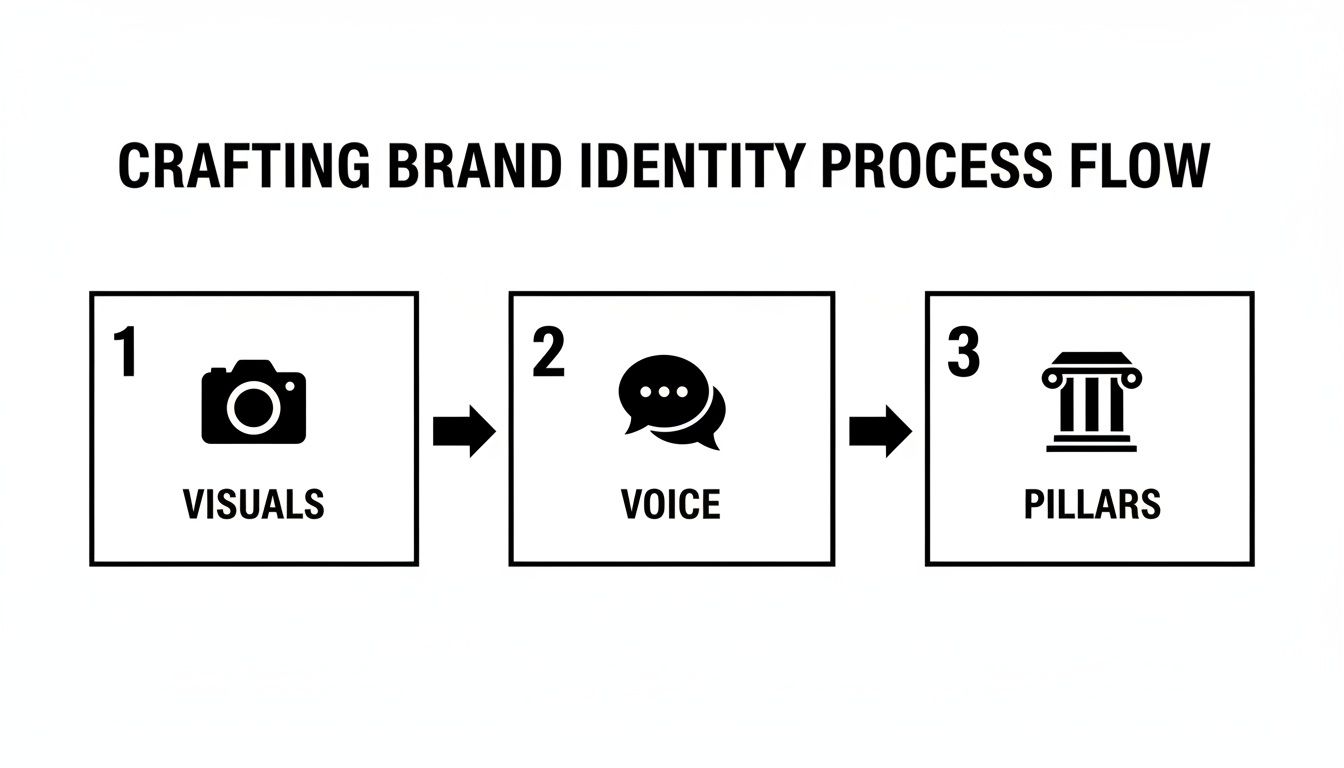
It shows how your visual look, your unique voice, and your core content pillars have to work together to create a personal brand that people actually remember.
Below is a quick breakdown of visual post types that build authority and how you can use them effectively.
High-Impact Visual Content Formats for Your Brand
| Content Format | Best For | Postbae Automation Benefit |
|---|---|---|
| Infographics | Presenting data, statistics, or complex processes in a simple, shareable way. | Autonomously generates charts and visual data representations based on your industry. |
| Carousels | Telling a story, breaking down a concept step-by-step, or showcasing a portfolio. | Automatically creates multi-slide, professionally designed carousels from a single idea or pillar. |
| Quote Graphics | Highlighting key takeaways, testimonials, or powerful statements to drive engagement. | Pulls impactful quotes from your content and turns them into branded, shareable graphics. |
| Checklists/Listicles | Providing actionable tips, resources, or quick how-to guides that are highly savable. | Transforms simple lists into visually appealing graphics that are easy for your audience to consume. |
These formats are your heavy hitters. They’re the types of posts people save and share, which signals to the algorithm that you’re providing real value.
Organizing Your Flow with a Content Calendar
A content calendar is your command center. It doesn't need to be some complex, expensive software; a simple spreadsheet or a Trello board works perfectly. Its real purpose is to give you a bird's-eye view of your content, making sure you maintain a consistent posting schedule and a balanced mix of topics.
Start by mapping out your posts one to two weeks in advance. For each day, slot in a specific idea from your brainstormed list, and make sure you’re rotating through your different content pillars.
A content calendar isn't a rigid set of rules; it's a tool for peace of mind. It kills the daily "what to post" pressure and lets you be more strategic and intentional with what you share.
Planning ahead also unlocks the magic of batch creation. Dedicate a few hours on a Sunday to write all your captions for the week, then let a tool like Postbae generate the visuals to match. This approach is worlds more efficient than creating one post at a time from scratch.
Plus, a well-structured calendar helps you spot opportunities to turn a high-performing topic into different formats. For more on that, check out our guide on how to repurpose content for social media. This system transforms content creation from a daily chore into a manageable, strategic part of building your brand.
Expanding Your Reach and Engaging Your Community
Creating great content is just the price of admission. Hitting "publish" doesn't guarantee an audience will magically show up. To actually build a personal brand that matters, your insights need to consistently find the right people.
This is where smart distribution and real community building come in. It’s the difference between shouting into the void and starting a conversation that people actually want to join. The goal is to build a loyal crew that doesn't just consume your content but engages with it, shares it, and feels a genuine connection to your work.
Choose Your Platforms Strategically
You can't be everywhere at once, and honestly, you shouldn't even try. Spreading yourself too thin is the fastest way to burn out and get mediocre results across the board. The key is to focus your energy where your ideal audience already hangs out.
Think about your end game:
- B2B and professional networking? You absolutely have to be on LinkedIn. It’s the undisputed king for showcasing expertise, dropping long-form insights, and connecting with industry players.
- Visual storytelling and creative work? Get on Instagram. It's built for building a brand through high-quality images, educational carousels, and engaging stories.
- Connecting with a broad, diverse audience? Don't sleep on Facebook. Its Groups feature is still one of the most powerful community-building tools out there for rallying people around specific interests.
Pick one or two primary platforms and go all in. Master them. Trying to juggle five different networks just dilutes your message and kills your momentum.
Optimize Your Profiles for Discovery
Your social media profile is your digital business card, and you've got about three seconds to make an impression. It needs to scream who you are, who you help, and why someone should smash that follow button. An unoptimized profile is a massive missed opportunity.
Make every pixel count. Your bio needs to nail your value proposition using keywords your target audience is actually searching for. Use a professional, high-quality headshot—and for the love of all that is holy, use the same one everywhere to build recognition. Finally, have a crystal-clear call-to-action, like a link to your newsletter or personal site.
Your profile isn't just a resume. It’s a strategic landing page designed to turn casual browsers into dedicated followers.
From Broadcasting to Engaging
This is the biggest mistake I see people make. They treat social media like a megaphone—post their content, log off, and wonder why nobody cares. Real community, the kind that builds brands, is forged in the replies, the DMs, and the comment sections.
Engagement is a two-way street. It’s not complicated, but it does take effort.
- Actually respond to comments. When someone takes the time to leave a thought on your post, acknowledge it. A simple "thank you" is good; a thoughtful reply is even better. This is how you turn a passive follower into a true fan.
- Jump into other conversations. Don't just camp out on your own profile. Find relevant discussions in your niche and add real value. Answer questions, offer a unique perspective, and engage with content from other experts in your field.
- Ask questions. Stop making statements and start asking questions. End your captions with open-ended prompts that invite your audience to share their own experiences and opinions.
This shift from broadcasting to engaging is what turns a boring content feed into a buzzing community hub. It shows you're not just some expert on a pedestal; you're a real person who's genuinely invested in the conversation. This is a non-negotiable step in learning how to build personal brand that actually lasts.
Measuring Growth and Maintaining Trust
Building a personal brand isn't a "set it and forget it" task. Think of it less like a project you finish and more like a garden you tend. It needs constant attention, measurement, and nurturing to grow.
To figure out if all this work is actually paying off, you need to look past the shiny, feel-good numbers and dig into the metrics that signal real growth and influence. This is your feedback loop—the only way to know if your message is landing and how people truly perceive you.
Tracking the Metrics That Actually Matter
It’s so easy to get obsessed with your follower count, but that number is a classic vanity metric. It doesn't tell the whole story. An engaged audience of 1,000 people who care is infinitely more valuable than 10,000 followers who scroll right past you.
To get a real pulse on your brand's health, you need to look a little deeper. These are the key performance indicators that give you a data-backed view of what's working and what's not.
Engagement Rate: This is your holy grail. It’s the measure of how many people are actually interacting with your content—likes, comments, shares, and saves. A high engagement rate is the clearest signal that you're providing real value and your audience is listening.
Audience Growth Quality: Forget just counting new followers. The real question is who is following you. Are they peers in your industry? Potential clients? People you admire? Slow growth made up of high-quality followers is always better than a fast-growing, irrelevant audience.
Inbound Opportunities: This is where the magic happens. Are people sliding into your DMs or emailing you about speaking gigs, podcast interviews, collaborations, or client work? The quality and frequency of these inbound requests are direct proof that your brand's authority is growing.
Website and Profile Clicks: If you have a personal website or portfolio, keep an eye on how many people are clicking that link in your bio. It’s a simple metric, but it shows your content is compelling enough to make someone take the next step.
I recommend checking in on these numbers monthly. It helps you spot trends, see which content pillars are hitting the mark, and double down on what your audience loves. You use this data to refine your strategy as you go.
The Unbreakable Link Between Trust and Authenticity
Data is one thing, but the soul of any powerful personal brand is trust. Without it, you’re just another voice shouting into the digital void. In a world drowning in content, people are craving authenticity more than ever. They want to connect with a real person, not a perfectly polished, corporate robot.
This is where your unique personality, your journey, and even your imperfections become your biggest strengths. Sure, sharing your wins is great. But sharing your struggles, the lessons you learned from failures, and your genuine perspective? That’s what builds a lasting bond.
Authenticity isn't about oversharing every detail of your life. It's about letting your true personality and values shine through in your work, creating content that feels real because it is real.
Consumer trust is a massive force. Research shows that 74% of people are more likely to trust someone who has an established personal brand, and 77% are more likely to buy from a company whose leadership is active on social media. This shows the direct line between a strong personal brand and real-world results. You can read the full branding statistics report to see just how deep this connection runs.
Maintaining this trust is an ongoing commitment. It means being transparent, admitting when you don't know something, and consistently giving value without always asking for a sale. When you focus on genuine connection over a flawless image, you build a loyal community that will champion your brand for the long haul.
Common Questions on Building a Personal Brand
Alright, so you’ve got the blueprint. But as you start putting the pieces together, the real-world questions pop up. It’s totally normal to wonder about timelines, screw-ups, and the tools you actually need.
Think of this as the no-BS FAQ section. I'll tackle the stuff people are usually thinking but are sometimes afraid to ask. Let's clear the air so you can get back to building.
How Long Does It Actually Take to Build a Personal Brand?
Building a personal brand is a marathon, not a sprint. Anyone promising you a massive, influential brand in 30 days is probably exaggerating.
You can get a solid foundation in place and start seeing some real traction within 3-6 months of consistent work. I’m talking about getting your messaging right, posting regularly, and starting to see a small community form. But a truly recognized, go-to brand in your space? That’s more of a 1-2 year journey. Sometimes longer.
Success isn't about one viral post. It’s the slow, compounding effect of showing up day after day, week after week. It's the consistency of your message and the value you keep delivering that builds authority. Trust the process; the results will follow.
What Are the Biggest Mistakes I Can Make?
Even with a perfect strategy, it's easy to trip over a few common hurdles. Knowing what they are is half the battle.
Here are the critical errors you need to dodge:
- Being a Ghost: Posting once this week and twice next month? You're killing your own momentum. Your audience will forget you exist. A content calendar isn't just a nice-to-have; it's your defense against inconsistency.
- Trying to Be Everything to Everyone: This is the fastest way to be nothing to no one. You can't be a marketing-sales-ops-finance guru. Pick your lane. Being a specialist is your superpower in a world full of generalists.
- The "Me, Me, Me" Show: If every single post is "buy my stuff," "hire me," or "look how great I am," people will tune out faster than a commercial break. A good rule of thumb is the 80/20 rule: provide genuine value 80% of the time, and you've earned the right to promote yourself the other 20%.
- Broadcasting, Not Connecting: A personal brand is a conversation. Ignoring comments, DMs, and questions is like walking away from someone talking to you at a party. It's a massive missed opportunity to build a real community.
The most damaging mistake is faking it. People can sniff out an inauthentic persona from a mile away. Your quirks, your voice, your actual personality—that's your most powerful branding tool. Don't hide it.
Do I Really Need a Personal Website?
You can absolutely start building your brand on social media alone. But a personal website is the ultimate long-term power move.
Think of it as your digital home base. It’s the one corner of the internet you 100% own and control. No algorithm can take it away from you. No platform policy change can shut it down overnight.
A website gives you a level of credibility that a social profile just can't match. It’s where you can showcase your portfolio, write your deepest thoughts on a blog, detail your services, and funnel all high-value opportunities. It’s the final destination you point everyone to.
How Can I Create Great Visuals if I Suck at Design?
This is the one that paralyzes so many busy professionals. Good news: you don’t need to be a graphic designer anymore. The key is to lean into what you’re good at—your ideas, your expertise—and find tools to handle the rest.
This is exactly why AI-powered platforms are becoming so essential. For instance, an AI agent like Postbae can take your raw knowledge and automatically generate professional graphics like multi-slide carousels and educational infographics.
It lets you create a consistent stream of high-quality visuals that make you look like an authority, without you ever having to open a design editor. Plus, you retain full creative control, as every post it generates can be completely customized.
Ready to stop wasting hours on design and start building your authority on autopilot? Postbae’s AI agent creates professional, industry-specific visual posts for your social media, so you can focus on what you do best. Get started today.