How to Monetize an Instagram Account: A Practical Guide for Creators

Discover how to monetize Instagram account with proven strategies for sponsorships, affiliate marketing, and selling products to grow your income.
Making money on Instagram isn't reserved for celebrities. It’s about choosing a strategy that fits your content, your audience, and—most importantly—doesn't feel forced.
Trying to do everything at once is a common mistake. Seeing one creator succeed with brand deals and another with a course might make you think you should do it all. This approach often leads to burnout and confuses your followers.
The key is to pick one or two monetization models and focus on them. A fitness creator selling workout plans is a natural fit. A fashion influencer earning from affiliate links and brand deals also makes perfect sense. The goal is to make your monetization method a seamless part of the content your audience already loves.
Choosing Your Monetization Path on Instagram
How do you decide on the right path? It comes down to your audience size, engagement level, niche, and what you’re passionate about. This decision is the foundation of your entire strategy on the platform. It dictates the type of content you create and how you nurture your community from followers into customers or brand partners.
Let’s break down the main ways creators are earning an income.
The Four Main Ways to Get Paid
Each of these models has its own requirements, process, and income potential. Let's dig into the big four.
Brand Sponsorships & Collaborations: This is the most well-known method. Brands contact you (or you contact them) and pay you to feature their products. Payouts can range from free products for a nano-influencer to a $10,000 payment for a single post from a creator with a massive, dedicated following. Success here depends on building a tight-knit community in a niche that brands want to reach.
Affiliate Marketing: This is an excellent starting point. You promote products you genuinely use and get a commission from every sale made through your unique link or discount code. There's no inventory or customer service to manage—just authentic recommendations. Commission rates typically range from 5% to 30%, making it a performance-based model. The more you sell, the more you earn.
Selling Your Own Products or Services: This is where you take full control. It offers the highest profit potential because you keep all the revenue. This can include physical merchandise, digital guides, online courses, presets, or one-on-one coaching. You are turning your followers directly into your customers.
Instagram's Built-In Tools: Instagram has been introducing its own features to help creators earn. These include Subscriptions, where dedicated fans pay a monthly fee for exclusive content, or Badges, which are essentially tips your audience can send you during a Live video. These tools are ideal for creators with an incredibly loyal community that wants to support them directly.
To help you see how these stack up, here’s a quick-glance table comparing the most common monetization models on Instagram.
Comparing Instagram Monetization Models
| Monetization Model | Best For | Typical Income Potential | Key Requirement |
|---|---|---|---|
| Brand Sponsorships | Creators with an engaged, niche audience | $100 – $25,000+ per post | Strong engagement rate & brand alignment |
| Affiliate Marketing | Beginners & creators who love recommending products | 5% – 30% commission per sale | High trust and authenticity with audience |
| Selling Your Own Products | Experts & entrepreneurs with a clear offer | Highest potential; uncapped | A valuable product/service that solves a problem |
| Instagram Subscriptions | Creators with a super-loyal community | $0.99 – $99.99 per subscriber/month | Consistent, high-value exclusive content |
| Instagram Badges/Gifts | Creators who frequently go Live | Varies; depends on viewer generosity | A highly engaged live audience |
Ultimately, the best path for you depends on where you are in your creator journey and what kind of value you provide.
Making the Right Choice for Your Account
Still not sure which way to go? Take a step back and ask yourself a few questions:
- What are people always asking me about in my DMs and comments? (This can point to product/service ideas).
- Is there a product or service I'm already passionate about and could talk about for hours? (This is a good sign for affiliate marketing).
- Do I enjoy the process of creating content for my brand more than promoting someone else's? (You might be ready to sell your own products).
The biggest takeaway here is authenticity. Your audience can tell when you're promoting something for a paycheck versus when you genuinely believe in it. The most successful creators don't just add a monetization strategy; they weave it into the very fabric of the content their community already knows and trusts.
Building an Audience That Trusts and Buys
Monetization on Instagram is not a numbers game; it's a trust game. You could have 100,000 followers, but if none of them believe what you say, you will struggle to earn anything. The foundation of making money on this platform is building an engaged community that sees you as a credible resource in your space.
It all starts with your niche. "Lifestyle creator" is too broad. Get specific. Are you a lifestyle creator focusing on minimalist, sustainable living for city dwellers? Or a food blogger creating 30-minute, gluten-free vegan meals? A sharp focus attracts a dedicated audience and makes you more appealing to brands who want to reach those exact people.
Pinpoint Your Niche and Audience
To find your sweet spot, you need to be honest with yourself. Ask a few critical questions:
- What could I talk about endlessly without getting bored? Genuine passion is the fuel that will keep you going, especially in the early stages.
- What's my unique spin or experience? Your specific angle is what separates you from the thousands of other accounts doing something similar.
- Who am I actually talking to? Create a clear picture of your ideal follower. What are their biggest challenges, questions, and goals related to your niche?
Answering these clarifies everything. A financial advisor targeting millennials with student debt will create completely different content than one advising high-net-worth retirees. Your niche dictates your content, which attracts the right people—an audience that's already primed to trust your recommendations and, eventually, buy from you.
Create Content That Builds Authority
Once you know who you're talking to, your primary job is to provide undeniable value. Every post should aim to educate, inspire, or solve a problem for your followers. This is how you transition from being just another account in their feed to an indispensable authority.
This decision tree breaks down the two main paths to making money, and you'll notice they both start from the same core goal.
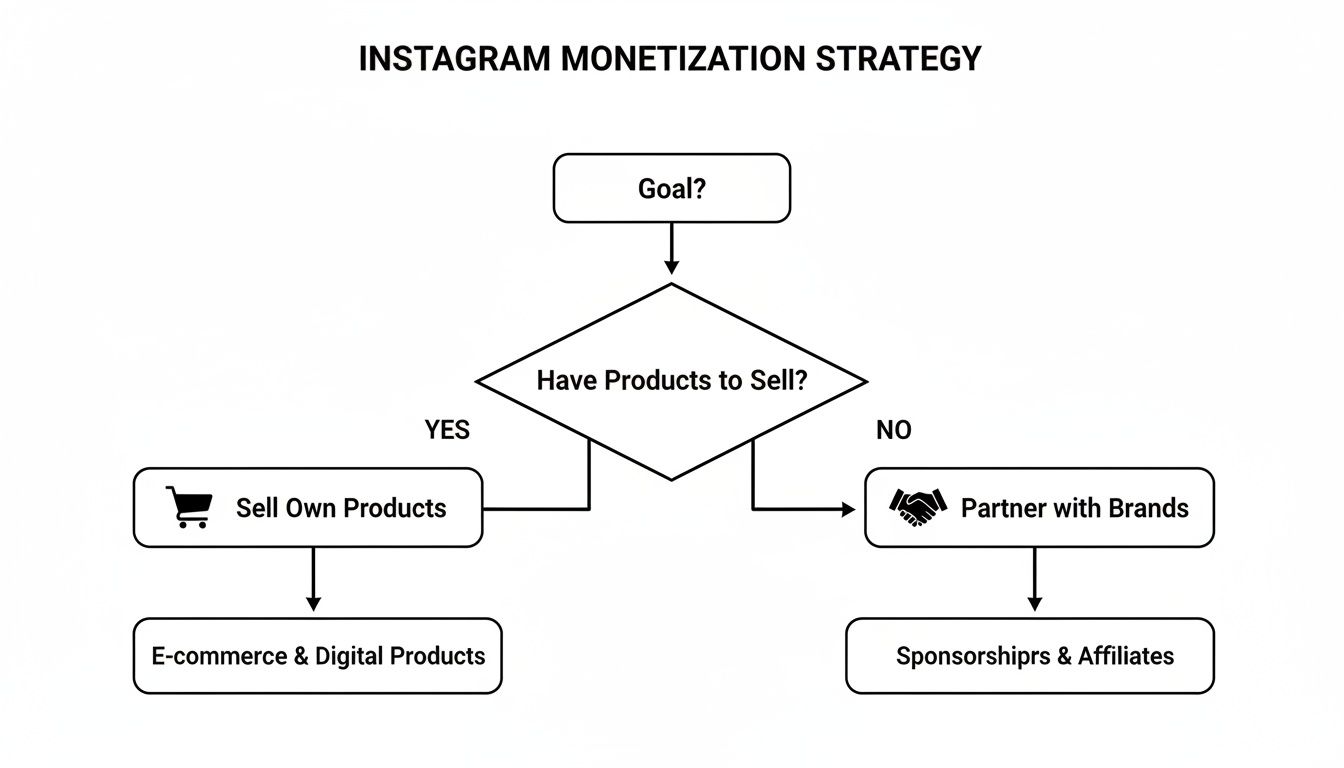
Whether you plan to sell your own products or partner with brands, the flowchart makes it clear: the foundational work of building a trusted audience is non-negotiable. Authority-building content is the common denominator for both paths.
To accomplish this, focus on educational formats that establish expertise:
- Multi-slide carousels: These are excellent for breaking down complex topics. Think "5 Mistakes to Avoid When Starting an E-commerce Business" or "A Step-by-Step Guide to Repotting Your Monstera."
- Educational infographics: Visual information is memorable. A well-designed infographic can quickly cement your credibility on a subject and is highly shareable.
- Tips & tricks visual posts: Quick, scannable advice is shareable and positions you as a helpful resource people want to return to.
Consistently creating professional, high-value visual content is time-consuming. This is where automation can be a strategic advantage. An AI agent like Postbae autonomously generates professional, industry-specific visual posts like carousels and infographics. This allows you to maintain a steady stream of authority-building content without needing to design it all manually, freeing you up to engage with the community you're building. Plus, you retain full editing control to customize every generated post.
The core principle is simple: Give value before you ask for a sale. Consistently provide educational content that genuinely helps your audience, and you will earn the trust required to monetize.
Building this foundation takes time and consistency, but it’s the only sustainable way to create a real income stream on Instagram. A loyal audience is your greatest asset. For a deeper dive, check out our guide on how to grow Instagram followers organically. An engaged follower base is the engine that will power every single monetization method you decide to pursue.
Nailing Sponsored Posts and Brand Collaborations
For many creators, landing the first brand deal feels like a major milestone. It’s validation that your creative work has commercial value. Sponsored posts are how you turn your content into income, but it takes more than a large follower count.
It’s about professionalism, strategic outreach, and knowing your worth. This is where you transition from being a creator to a business partner.
First, you have to look the part. Before you can attract brands, your profile needs to look professional. A polished presence signals to potential partners that you are reliable and can deliver high-quality work. Low-resolution photos and basic graphics can be an instant turn-off for serious brands.

Building Your Professional Toolkit
Think of your media kit as your creator résumé. It’s a concise document that shows a brand who you are, who your audience is, and why they should work with you. A great media kit is visually appealing and data-driven.
Here are the essential elements to include:
- A Quick Intro: A short bio explaining your niche and what makes your content unique.
- Audience Demographics: Key statistics like age, gender, and top locations of your followers. You can find this in your Instagram Insights.
- Key Performance Metrics: Be transparent with your numbers. Include your follower count, average engagement rate, post reach, and typical story views.
- Past Collaborations: Showcase your best work. Include screenshots and any performance highlights from previous brand deals.
- Services and Rates: Clearly list what you offer (e.g., dedicated post, multi-slide carousel, Reel, Story series) and your starting prices.
Creating high-quality, polished content is a massive signal to potential brand partners. It proves you’re a serious creator who can deliver an effective campaign that matches their own brand standards.
The opportunity is massive and growing. With 29% of users now buying products directly on Instagram, brands are investing heavily in creator partnerships. The earnings potential is significant: micro-influencers (10K-100K followers) can earn around $300 per deal, while top-tier creators can command $75,000 or more. You can dive deeper into these Instagram statistics on sproutsocial.com. The money is there if you position yourself correctly.
Finding and Pitching the Right Brands
The best brand deals feel authentic because they are. Don't just contact every brand with a marketing budget; focus on companies whose products you genuinely love and use. Your audience trusts your recommendations, and promoting something irrelevant can damage that trust.
Start by making a "dream list" of 10-20 brands you already use. These are your best targets because your enthusiasm will come through naturally.
Once you have your list, it's time to pitch. Avoid generic DMs. Do some research to find the email for their marketing or PR team and send a personalized pitch. Keep it short, powerful, and tailored specifically to them.
Here's a simple email structure that works:
- Subject Line: Make it attention-grabbing, like "Collaboration Idea: [Your Instagram Handle] x [Brand Name]".
- The Hook: Briefly introduce yourself and mention why you love their brand. Name-drop a specific product you use.
- The "Why": Explain why a partnership makes sense. Point to your audience demographics and show how they overlap with the brand’s ideal customer.
- The Big Idea: Propose a specific content idea. Instead of, "I'd love to collaborate," try: "I want to create a three-part Reel series showing how I use your [Product Name] in my morning routine."
- The Call to Action: Attach your media kit and suggest a brief call to discuss further.
The goal is to make it easy for them to say yes. Show them you've done your research, you understand their brand, and you have a clear vision for creating value. When you approach them with a professional toolkit and a strong pitch, your chances of landing lucrative brand deals increase significantly.
Driving Sales With Your Own Products and Services
Brand deals are great, but selling your own products is one of the most sustainable ways to make a living on Instagram. It gives you complete control over your income.
When you sell your own products or services, you turn followers into customers. It’s a reliable, scalable revenue stream that doesn't depend on another brand’s marketing budget. Whether it’s digital guides, physical products, or one-on-one coaching, this is how you build a real business using your Instagram account.
The potential is massive. Instagram is not just a social app; it's a commercial powerhouse that generated $66.9 billion in a recent year, nearly 40% of Meta's total revenue. With billions of people scrolling every month, the opportunity to turn your grid into a revenue source has never been greater.
Weaving Your Offers Into Your Content
A common mistake creators make is abruptly switching from "helpful content creator" to "salesperson." Your audience followed you for your personality and expertise, not for constant advertisements.
The key is to integrate your offers so seamlessly that they feel like a natural extension of your content, not a hard sell.
Instead of a post that just says, "Buy my new ebook!", create a post that solves a small problem your ebook also addresses. This "educate first, sell second" approach builds trust and demonstrates your product's value before you ask for the sale.
For example, a business coach could post a carousel on "Three Pricing Mistakes New Freelancers Make." The final slide can then subtly mention their comprehensive pricing workshop as the ideal solution for anyone who wants to learn more.
Automating High-Converting Visuals
This educational marketing approach demands a consistent flow of high-quality visuals. Creating professional-looking carousels, infographics, and tip-based posts that subtly promote your products is incredibly time-consuming.
This is where automation becomes a valuable tool. Using an AI agent like Postbae lets you maintain a constant stream of polished, authority-building content without spending hours on manual design. The system can autonomously create industry-specific educational visual posts—like carousels and listicles—that perfectly set the stage for your product or service.
You still get full editing control to ensure every post is on-brand, but the heavy lifting of creating the visual asset is handled for you. By automating visual creation, you free up time to engage with potential customers and close sales.
Key Takeaway: Your product-focused posts should still feel like your regular, value-packed content. Solve a small piece of your audience's problem for free, which naturally leads them to your paid solution for the bigger problem.
Creating a Clear Path to Purchase
Don't make your followers search for the "buy" button. Your Instagram bio is valuable real estate, and you need to use it effectively. To sell your own products, many creators explore examples of top creators using digital storefronts like Stan Store to create a simple, one-stop shop accessible from their bio link. These tools help you build a clean, mobile-friendly landing page for all your offers.
Additionally, you should use Instagram's own features:
- Instagram Shopping: Tag your products directly in posts and Stories. This lets people browse and buy without leaving the app, which reduces friction and can boost conversions.
- Story Links: Use a link sticker in your Stories to send followers directly to a product page. You can combine this with a poll or a Q&A sticker first to engage the audience before sharing the link.
- Content Repurposing: A single blog post or video can be repurposed into dozens of Instagram assets. For tips on how to do this efficiently, check out our guide on how to repurpose content for social media.
By combining valuable educational content with a simple purchasing process, you can build a powerful and profitable business on Instagram.
Get Paid with Affiliate Links and Instagram’s Own Tools
Relying on just one income stream can be risky. An algorithm change or a lost brand deal could impact your earnings. That’s why it’s important to diversify beyond brand deals and selling your own products.
This is where affiliate marketing and Instagram's built-in monetization tools can be valuable. They provide powerful ways to make money directly from your content and the community you’ve already built.
The Real Deal on Affiliate Marketing
Affiliate marketing is one of the most accessible ways to start earning money on Instagram. You earn a commission for recommending products you already use and love. There's no need to manage inventory or customer service.
However, authenticity is crucial. Your audience can recognize an inauthentic promotion. Success in affiliate marketing comes from being a trusted friend giving a recommendation, not a salesperson.
Your content needs to reflect that. Don't just post a link. Show the product in action and provide real value.
- Honest Reviews: Create multi-slide carousels or Reels that break down your genuine experience—the pros and cons.
- Problem-Solving Tutorials: Show people how to use the product to solve a real problem they have.
- "My Favorites" Lists: Include an affiliate product in a curated list of your go-to tools or items.
Finding programs is straightforward. You can check major affiliate networks or visit the websites of brands you love. Look for a "Brand Ambassador" or "Partner" program link in their footer. Commissions typically range from 5% to 30%, so your earnings are directly tied to the trust you've built. If you're weighing your options, understanding the nuances by comparing dropshipping and affiliate marketing can be helpful.
Using Instagram’s Built-In Money Makers
Instagram has started rolling out its own tools to help creators earn directly from their biggest fans. These features turn your followers from viewers into supporters. To get access, you'll need a Professional Account (Creator or Business) and must meet their eligibility requirements, which you can check in your Professional Dashboard.
Using Instagram's own tools creates a direct financial link between you and your audience. This strengthens your community and makes your income less dependent on unpredictable brands or algorithm changes.
Instagram Subscriptions
This feature is excellent for creating predictable, recurring revenue. Your most loyal followers pay a monthly fee for exclusive content and special recognition. You set the price, and they get access to content no one else sees.
Ideas for subscriber-only content that work:
- Behind-the-scenes content: Show them your creative process, including mistakes and lessons learned.
- Subscriber-only Q&As: Host Lives where you answer their specific questions.
- Early access: Let them be the first to see your new posts, videos, or product launches.
- Exclusive guides: Share your most valuable, in-depth knowledge with the people who are paying for it.
Instagram Badges and Gifts
Think of Badges as a virtual tip jar during your Instagram Live videos. Viewers can buy them to show support, and a heart icon appears next to their name in the comments. Prices range from $0.99 to $4.99, and you receive 100% of that revenue after app store fees.
Gifts work similarly but for your Reels. Followers can send you virtual "Stars," which translate into money. Each Star is worth $0.01. It might seem small, but for a Reel that performs well, it can add up.
To make these tools work, you have to actively encourage participation. Acknowledge your supporters by name during a Live. Recognize the top gifters. Create content that's so valuable people want to show their appreciation. Combining these native features with a solid affiliate strategy creates a more stable and diverse way to monetize your Instagram account.
Tune Your Content to Actually Convert and Grow
Creating great content is the first step. Ensuring it performs is what separates creators who are just posting from those who are profiting. Your content needs to be optimized for your audience and for the Instagram algorithm. That means focusing on formats that drive engagement and encourage people to take action.
Simply posting a nice picture with a caption is no longer enough. If you're serious about monetizing, you need a content strategy built around metrics that matter—like shares, saves, and how long people spend on your post.
Prioritize Formats That Actually Perform
Some content formats work better than others. They are designed to keep people engaged longer, which is what the algorithm favors. Multi-slide carousels, for instance, are excellent for this.
Carousels are the unsung heroes of Instagram monetization. While engagement rates on the platform have generally declined, these interactive posts keep users swiping, which signals to the algorithm that your content is valuable, resulting in more reach. This makes them a powerful tool for small businesses and creators trying to build authority by sharing knowledge—think quick tips, industry insights, or product breakdowns. Recent social media benchmark reports on socialinsider.io support this.
When you break down complex information into easy-to-digest, swipeable slides, you not only increase your "time on post" metric but also position yourself as an expert. This format is perfect for:
- Step-by-step guides that walk your audience through a process.
- Listicles that share valuable tips or resources.
- Product feature showcases that highlight benefits one slide at a time.
If you want to learn more about this powerful format, check out our full guide on how to create Instagram carousels that get results.
Automate the Quality and Consistency Grind
The challenge with high-performing content like carousels is that they take a significant amount of time to create. Trying to maintain quality and post consistently enough to satisfy the algorithm can lead to burnout.
This is where automation becomes a valuable tool. An AI-powered agent like Postbae can autonomously generate professional, industry-specific visual posts, including crucial multi-slide carousels and infographics. It handles the entire design process, from selecting the right content type to populating proven layouts with relevant information.
This means you can consistently produce the kind of authority-building content that attracts followers and brand deals without being tied to manual design work. You still have full control to edit every detail, but the initial creation is done for you.
The goal is to work smarter, not harder. By automating the production of your most vital content, you free up energy to focus on what really moves the needle: engaging with your community and refining your monetization strategy.
Write Captions That Actually Convert
Your visuals grab attention, but your caption helps close the deal. Every caption should have a clear purpose and a strong call-to-action (CTA). Don't assume your followers will know what to do next—tell them.
- Ask engaging questions to start a conversation in the comments.
- Encourage saves by telling them to "Save this post for later."
- Drive clicks by directing them to the "link in bio for the full guide."
- Promote shares with a simple "Share this with someone who needs it."
When you pair strong visuals with compelling, action-driven captions, you create a powerful system for turning casual followers into loyal customers and fans.
Got Questions? I've Got Answers
Navigating the world of Instagram monetization can feel confusing. There are many opinions, but clear answers can be hard to find. Let's address some of the most common questions creators and brands have.
How Many Followers Do I Need to Monetize My Instagram Account?
Forget the myth that you need 100,000 followers. There is no magic number. Monetization becomes a realistic option once you've built a community that trusts you, which can begin with as few as 1,000 highly-engaged followers.
For nano-influencers, this is typically the point where small brand deals or affiliate marketing become viable. What matters most isn't your follower count; it's your engagement rate and the authority your audience gives you. Some creators start selling their own digital products or services with an even smaller, but fiercely loyal, audience.
What Is the Easiest Way to Start Making Money on Instagram?
For most people starting out, affiliate marketing is the path of least resistance. It has a low barrier to entry because you don't have to create your own product or service. You simply earn a commission by recommending products you already use and genuinely support.
It’s a great way to explore monetization without compromising your authenticity. The next most accessible route is often landing small collaborations as a nano-influencer. Brands in this space are often more interested in your niche engagement than a massive follower count.
Can I Monetize an Instagram Account Without Showing My Face?
Absolutely. Some of the most profitable Instagram accounts are run by people who never show their face. These are often called "theme pages" or "niche accounts," and they focus on a specific interest like vintage cars, minimalist design, or crypto news.
The strategy is the same: build an engaged community around a single topic. For these accounts, the income typically comes from:
- Affiliate links for products relevant to the niche.
- Selling digital products like e-books, templates, or photo presets.
- Sponsored posts from brands looking to reach that specific audience.
For a faceless account, your visual content has to do all the work. High-quality assets like sharp infographics, data visuals, and educational carousels are critical for building authority and attracting followers.
Ready to create slick, authority-building visuals that attract followers and monetization partners—without all the manual work? Postbae is an AI agent that automatically generates professional social media graphics for you, from multi-slide carousels to industry insights. Start automating your content creation today at https://postbae.com.