How to Create Viral Content: A Practical Guide to Boosting Shares

Learn how to create viral content: discover proven tactics to boost shares using psychology, formats, and smart distribution.
Going viral isn't about getting lucky with the algorithm. It's about understanding what makes people tick.
The key is to create content that hits a nerve—something that sparks a powerful emotion, offers genuine value, or tells a story so good people feel an almost physical need to share it.
Decoding Virality: What Makes People Share
Before you can even think about creating viral content, you have to get inside the mind of your audience and figure out why they share things. It’s not random. There are deep-seated psychological triggers that compel us to hit that share button.
Chasing trends is a short-term game that'll leave you exhausted. Understanding human behavior? That’s the long game.
At its core, sharing is a social act. We share content that reflects who we are (or who we want to be), backs up our beliefs, or helps us feel connected to our tribe. It's less about your content and more about what sharing your content says about them.
The Power of High-Arousal Emotions
Think about the last thing you shared. Did it make you laugh out loud? Did it leave you in absolute awe?
Research has shown time and again that content sparking high-arousal emotions is way more likely to get shared. These aren't just mild feelings; they're the intense, jolt-you-awake emotions that stop the scroll cold.
- Awe and Wonder: Think of those jaw-dropping drone shots of a place you've never seen or a mind-bending scientific discovery.
- Laughter and Amusement: Funny memes and relatable comedy skits are the universal language of the internet. They create an instant bond.
- Surprise and Intrigue: Content that drops a shocking statistic or ends with an unexpected twist is pure gold. It grabs attention immediately.
- Inspiration and Hope: We all love an underdog. Stories of people beating the odds or achieving something incredible are powerfully motivating.
Sure, negative emotions like anger and anxiety can drive a ton of comments, but it's the positive, high-energy feelings that fuel widespread sharing. If you want to master this on fast-moving platforms, it’s worth studying the mechanics of how to create viral TikTok videos.
To really nail this, you have to understand the core drivers behind the impulse to share. It's not just about making good content; it's about tapping into fundamental human needs.
Key Psychological Triggers for Viral Content
| Trigger | Description | Example Content Type |
|---|---|---|
| High-Arousal Emotions | Content that elicits intense feelings like awe, laughter, surprise, or inspiration. | Breathtaking nature videos, hilarious memes, myth-busting Reels. |
| Social Currency | Content that makes the sharer look smart, funny, or in-the-know. | "Secret" life hacks, clever industry insights, contrarian takes on hot topics. |
| Practical Value | Content that is genuinely useful, solving a problem or teaching a skill. | Step-by-step tutorials, downloadable templates, informative carousels. |
| Storytelling | Content that follows a narrative arc, creating an emotional connection. | Customer success stories, behind-the-scenes journeys, case studies. |
These triggers are the building blocks of nearly every piece of viral content. By consciously weaving them into your strategy, you move from hoping for a hit to engineering one.
Building Social Currency
Everyone wants to look good online. We share things that make us seem clever, funny, or like we have insider knowledge. This is social currency.
When you create content that gives your audience a useful tip not everyone knows, a witty take on a current event, or a bit of "secret" information, you're handing them a gift. They can then share that gift to boost their own status among their friends.
The act of sharing becomes a tool for self-presentation. Your audience isn't just sharing your post; they are sharing a piece of their identity. Make them look good, and they will make your content travel.
Offering Practical Value and Telling Stories
Beyond emotion and ego, sometimes the simplest driver is the most powerful: practical value. Content that actually solves a problem, teaches a new skill, or offers a helpful shortcut is incredibly shareable. Who wouldn't want to pass along a resource that could genuinely help a friend? Digging into ways to increase social media engagement often comes back to simply being useful.
And finally, never, ever underestimate the power of a good story. Our brains are literally wired for narrative. A post that follows a clear story—with a relatable hero, a challenge, and a satisfying resolution—is far more memorable than a boring list of facts. Whether it’s a customer’s transformation or a peek behind the curtain of your brand's journey, stories create an emotional investment. They make people care enough to share.
Selecting High-Impact Formats for Maximum Reach
Once you've locked in the psychological triggers that make people share, the next question is simple: how are you going to package it? A brilliant idea stuffed into a boring, static image is a surefire way to get scrolled past.
On the flip side, even a simple tip can capture massive attention if you put it in a dynamic, engaging format. The goal here is to pick the content vehicles that both social media algorithms and actual humans love.
Why Multi-Slide Carousels Dominate
Multi-slide carousels are an absolute powerhouse on platforms like Instagram and LinkedIn. They consistently crush single-image posts for one simple reason: they increase dwell time.
Think about it. Every time someone swipes through your carousel, they're sending a direct signal to the algorithm that your content is valuable enough to stick around for. That one simple action can give your post a massive visibility boost.
Carousels are perfect for:
- Step-by-step guides: Breaking down a complex process into bite-sized, easy-to-follow slides.
- Educational listicles: Sharing a list of tips, tools, or industry facts that people will want to save.
- Storytelling: Taking your audience on a little journey with a clear beginning, middle, and end.
By spoon-feeding information in digestible chunks, you make it incredibly easy for your audience to absorb and—more importantly—to save for later. Encouraging saves is one of the most powerful signals of value you can send to the algorithm.
The Shareable Power of Infographics
Infographics are your secret weapon for turning dense data or complex ideas into visually stunning, easy-to-understand graphics. Their real strength is in making valuable information concise, which makes them insanely shareable.
People love sharing content that makes them look smart and in-the-know. Infographics deliver that social currency in a beautiful, ready-to-share package. An industry statistic that would be completely ignored in a wall of text becomes a compelling asset when it's designed well.
A marketing agency, for example, could transform a dry report on consumer behavior into a vibrant infographic showing the top three trends. Not only is it more engaging, but it’s far more likely to get saved and shared by other pros in the field. We dive deeper into this in our guide to creating effective visual content for social media.
This infographic below, for instance, perfectly visualizes the core triggers we talked about—showing exactly how emotion, value, and storytelling drive real engagement.
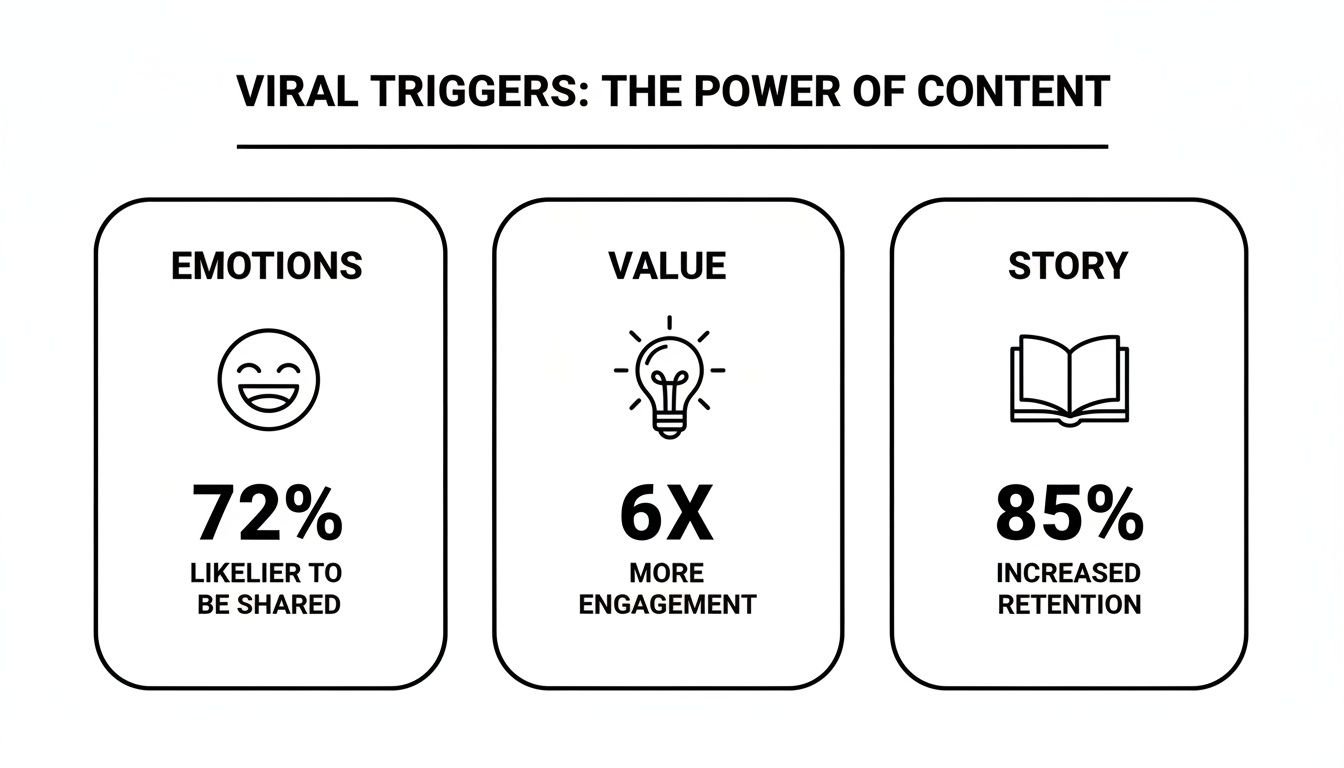
It’s a great example of how visuals reinforce the message: the best content connects by giving people something they can feel, use, or relate to.
Don't Overlook Short-Form Video
While graphics are crucial, it’s impossible to talk about modern virality without bringing up video. Short-form video is a juggernaut, generating 2.5 times more engagement than long-form content and being shared a wild 1,200% more than text and images combined.
Why does it work so well? Because algorithms on platforms like TikTok and Instagram Reels are literally designed to push quick, entertaining, or educational clips to huge new audiences. Discovery is built right into the format.
The biggest barrier to creating viral content isn't a lack of good ideas; it's the bottleneck of consistently producing high-quality visuals.
This is where automation becomes your strategic advantage. For a busy small business owner or a marketing agency juggling clients, manually designing carousels, infographics, and other proven formats is a massive time sink.
An AI agent like Postbae is built to solve this exact problem. It works on its own to generate these high-impact visual posts—from educational carousels to industry-specific infographics—without you needing to write a single prompt. The AI takes care of the research, writing, and professional design, filling proven templates with content relevant to your field.
This automated approach lets you consistently deploy the very formats known for driving reach, all while you keep full creative control. Every post is fully editable and customizable. By removing the design bottleneck, you can finally focus your energy on strategy and actually talking to your community.
Writing Scroll-Stopping Hooks and Compelling Copy
The most stunning visual in the world will fall completely flat if the message doesn't connect. Great graphics earn you a glance, but it's the copy—the actual words—that earns you the save, the share, and the follow.
Writing for social media isn't about crafting long, poetic essays. It’s about delivering a powerful punch in the few precious seconds you have to capture someone's attention.
The entire success of a post often hangs on that very first line. This is your hook. It's the digital equivalent of a firm handshake and direct eye contact. If it doesn’t immediately grab your reader, they will scroll right past, and all your brilliant content will go completely unseen.
Crafting Irresistible Hooks
Your hook has one job and one job only: stop the scroll. It needs to be magnetic, promising real value or sparking such intense curiosity that the reader feels like they have to know what comes next.
There are a handful of proven formulas that just work, time and time again. For instance, challenging a common belief is incredibly effective. A hook like, "Stop setting goals. Do this instead," immediately shatters expectations and makes people lean in to understand your alternative.
Another powerful move is to hit a specific pain point head-on. Imagine you're talking to a small business owner: "Feeling burnt out from creating content? Here are three ways to reclaim your time." That speaks to a real, felt problem and dangles an immediate solution—a potent combination for engagement.
Here are a few hook frameworks you can steal and adapt:
- The "Mistake" Hook: "The biggest mistake people make when [topic]."
- The "Secret" Hook: "The one thing nobody tells you about [industry]."
- The "Contrarian" Hook: "Why [common advice] is actually hurting your progress."
These work because they tap into core human drivers: curiosity, the desire for insider knowledge, and the fear of missing out (FOMO).
Writing Body Copy That Holds Attention
Okay, the hook did its job. Now what? The body copy needs to deliver on that promise, and it needs to do it quickly. This is where so many creators lose their audience, burying the lead in a wall of text. The key is to be concise and jam-packed with value, avoiding fluff at all costs.
Think of your body copy as a series of breadcrumbs leading the reader through your main point. Each sentence should flow logically into the next, building momentum and keeping them hooked. Use super short paragraphs—one to three sentences at most—to create white space and make your content feel less intimidating to read on a small screen.
Your copy should be a conversation, not a lecture. Write as if you’re explaining an idea to a friend over coffee. Use simple language, ask questions, and be direct.
Breaking up your text is also crucial for mobile readability. Use bullet points, numbered lists, and bold text to highlight the juicy takeaways. This makes your content skimmable, letting readers extract value even if they don't read every single word. This is especially vital for formats like multi-slide carousels, where each slide has to land a clear, concise point.
The Art of the Specific Call-to-Action
Finally, every single piece of content needs a job to do. Your call-to-action (CTA) is where you tell your audience what you want them to do next. Vague, passive CTAs like "link in bio" are basically a dead end. They rarely inspire anyone to do anything.
Instead, focus on engagement-driving CTAs that directly benefit both you and the reader. The best ones encourage behaviors that the algorithm loves, like sharing and saving.
Consider these much more effective alternatives:
- "Save this post for your next brainstorming session." (This positions your content as a resource and boosts a key engagement metric.)
- "Tag a fellow business owner who needs to hear this." (This sparks organic reach by getting users to share with their network.)
- "What’s your number one tip for [topic]? Drop it in the comments." (This kicks off a conversation and builds a sense of community.)
A strong CTA makes it crystal clear what you want the reader to do and gives them a compelling reason to do it. It transforms a passive scroller into an active participant—and that's the whole game when you're trying to create content that spreads.
Applying Essential Design Principles for Shareable Visuals
In a social feed where thumbs move at lightning speed, your visuals are everything. You could have the most mind-blowing copy in the world, but if it’s slapped onto a cluttered, unreadable graphic, it’s just noise. It’ll get scrolled past without a second thought.
Great design does more than just look pretty. It builds instant credibility and makes your message easy to digest—two things you absolutely need for your content to stand a chance of going viral.
The good news? You don't need a design degree to make this happen. A few fundamental principles are all it takes to elevate your visuals from amateur to authoritative. These aren’t abstract theories; they’re practical rules that guide the viewer’s eye and make your content feel professional.
Establishing a Clear Visual Hierarchy
Visual hierarchy is just a fancy way of saying you’re in control of what people see first, second, and third. It’s the art of arranging elements to scream, "Look at this first!" Without it, your graphic is a chaotic mess, and your audience won't know where to focus.
The easiest way to nail this is with size and weight. Your main headline should be the biggest, boldest thing on the screen. Everything else supports it.
- Headline: Make it the largest and heaviest font. This is your hook.
- Subheadings: Use a medium size to break up ideas.
- Body Text: Keep it small but perfectly legible for the details.
This structure makes your content instantly scannable, letting people grab the key takeaway in seconds. A well-organized visual is far more likely to be understood, saved, and shared.
The Power of White Space
One of the biggest mistakes non-designers make is cramming every single pixel with something. This creates visual anxiety and makes people want to scroll away. The fix is simple: embrace negative space, or "white space."
White space isn't wasted space; it's a powerful design tool. It gives your content room to breathe, improves legibility, and makes your entire graphic feel more professional and high-end.
Think of it like a pause in a conversation. It adds emphasis and clarity. By giving your text and images a little breathing room, you guide the viewer’s focus and keep them from feeling overwhelmed.
Maintaining Brand Consistency
Consistency is how you build recognition and trust. Your audience should know a post is yours before they even see your username. This isn't magic; it's the result of sticking to your brand's specific colors and fonts every single time.
Key Elements for Brand Consistency:
| Element | Purpose | Best Practice |
|---|---|---|
| Color Palette | Evokes emotion and creates brand association. | Stick to a primary palette of 2-3 main colors and 1-2 accent colors. |
| Typography | Establishes personality and ensures readability. | Choose one clear headline font and one simple body font. Avoid using more than two. |
This discipline creates a cohesive, professional feed that quietly reinforces your brand's authority over time.
Automating Professional Design with AI
Applying these principles to every single post takes a ton of time, especially if you’re a small business owner or a busy social media manager. This is where smart automation can be a strategic advantage.
An AI agent like Postbae is built to handle this work for you. It operates on its own to generate polished graphics, like multi-slide carousels and infographics, that already follow these best practices. The AI knows how to pick proven layouts, apply a clear hierarchy, and use spacing and typography correctly—all without you having to touch a design tool or write a single prompt.
This allows you to maintain a high-quality aesthetic consistently, which is a massive factor in building the trust your content needs to go viral. And since every single post is fully editable, you still have the final say. It’s the best of both worlds: hands-off automation with full creative control.
Automating Your Content Engine with AI
The single biggest hurdle in the race for virality is consistently creating high-quality, professionally designed visuals. It’s a massive challenge for small businesses, solopreneurs, and even marketing agencies. You might have a dozen great ideas, but the execution—the actual design and production of compelling graphics—is a notorious bottleneck.
This is where a modern, automated workflow stops being a "nice-to-have" and becomes a serious strategic advantage. Instead of sinking hours into a manual design tool, you can let AI handle the heavy lifting. This frees you up to focus on strategy and community engagement, not just production.
Moving Beyond the Manual Grind
The old way of creating content is slow and expensive. It involves brainstorming, research, writing copy, and then the most time-consuming part: designing a multi-slide carousel or an educational infographic. It’s a process that requires multiple skills and is incredibly difficult to scale.
An AI-powered workflow completely flips this model on its head. It automates the production of the very formats that are proven to perform well, getting you off the manual treadmill. We're not just talking about generating generic text captions; this is about producing complete, ready-to-post visual graphics tailored to your industry.
The goal of automation isn't to replace your strategy. It’s to execute it at a scale and quality that would be impossible to maintain manually. It’s about getting consistency without the burnout.
AI-powered content is quickly becoming a key ingredient for viral success, delivering real engagement without the grind. The data backs this up: 90% of businesses using generative AI report major time savings, and 73% see tangible lifts in engagement from AI-assisted posts. This trend is only getting bigger, with projections suggesting virtual influencers could become a $37.8 billion market by 2030.
How an AI Agent Streamlines Visual Production
Imagine having an AI agent that works autonomously in the background to build your social media presence. That’s the core idea behind a tool like Postbae. It was designed specifically for busy professionals who need to establish authority but don’t have the time or design skills to do it themselves.
Here’s how this hands-off approach actually works:
- No Prompts Needed: The AI agent works on its own, identifying relevant topics and content types for your industry. You don't have to feed it ideas every day.
- Authority-Building Focus: It specializes in creating educational content—the stuff that builds trust. Think industry insights, tip-and-trick carousels, and myth-vs-fact graphics.
- Professional Design, Automatically: The system intelligently matches proven template layouts with the generated content, ensuring every visual post is well-designed and follows best practices for hierarchy and readability.
A marketing agency, for example, can set up the AI to automatically create weekly carousels on new digital marketing trends. A small business owner can get daily visual posts explaining product benefits or sharing customer tips. If you want to explore AI's potential for generating other shareable visuals, you might even consider an AI meme generator to mix in some lighter content.
Maintaining Full Creative Control
One of the biggest fears with automation is losing your brand voice and control. But the best AI systems are designed to be a starting point, not a locked-in final product.
While Postbae’s agent creates complete graphics autonomously, every single element of every generated post is fully editable.
This means you get the speed and efficiency of AI production without sacrificing your brand’s unique identity. You can tweak the text, swap images, and adjust colors to perfectly match your style guide. It’s the ideal balance: an automated engine that pumps out high-quality drafts, combined with the human touch that ensures authenticity. You can learn more about how this works in our deep dive into AI content creation for social media.
Common Questions About Going Viral
Going viral can feel like catching lightning in a bottle. Even when you think you've got a killer strategy, questions always pop up. Let's tackle some of the most common ones from creators and brands trying to crack the code.
How Long Does It Take for Content to Go Viral?
There’s no magic timer. A post can ignite and blow up in a few hours, or it can be a "slow burn," smoldering for days or even weeks before the algorithm finds the perfect audience and dumps gasoline on it.
The first 24 to 48 hours are usually the most critical. This is when the platforms are watching for those early engagement signals—especially shares and saves. If a post gets a huge burst of activity right away, the algorithm sees it as valuable and starts pushing it to wider and wider circles.
But it’s best to avoid trying to time a single, overnight sensation. The real goal is to build a consistent engine for creating high-quality, share-worthy content. Virality is almost always a byproduct of consistency, not a one-time lottery win.
Can Any Type of Business Create Viral Content?
Absolutely. One of the biggest myths out there is that going viral is just for flashy consumer brands or comedy accounts. That's just not true. Any business, in any industry—yes, even "boring" B2B ones—can go viral because it all comes down to human psychology.
Virality isn't about what you sell; it's about the value you give away.
- A B2B software company could create a killer infographic that finally simplifies a complex industry process, making it an instant share for thousands of professionals.
- A local landscaping business might go viral with a ridiculously satisfying time-lapse of a messy backyard turning into a paradise.
- A financial advisor could drop a carousel that breaks down a confusing investment strategy into five simple, actionable slides.
The key is to stop thinking about selling your product and start thinking about serving your audience. When you give people something genuinely useful, entertaining, or inspiring, they can't help but share it.
What Metrics Should I Track to Measure Viral Potential?
Likes are for vanity. If you really want to know if your content has legs, you need to look at the metrics that show people are taking action.
The two most powerful signals of viral potential aren't likes or comments. They're shares and saves. These metrics scream to the algorithm that your content is so good, people are either showing it to their friends or bookmarking it for themselves.
Here's what you should be obsessed with:
- Shares: This is the purest form of virality. It’s a direct measure of how many people thought your content was good enough to personally vouch for it and send it to someone else.
- Saves: This is a massive signal of high-quality, evergreen value. A save tells the platform your content is a resource people want to come back to, which is a powerful trigger for discoverability.
- Comments: While not as direct as a share, a flood of comments means you’ve sparked a real conversation, which keeps your post alive and boosts its engagement score.
- Reach vs. Impressions: Keep an eye on the percentage of your reach coming from non-followers. When that number is high, it means the algorithm is successfully pushing your content to brand-new audiences. That's the start of something big.
How Does an AI Tool Help with Virality?
One of the biggest things stopping people from going viral is the sheer amount of work it takes to consistently create high-quality visuals. This is where AI tools give you a strategic advantage—not by faking virality, but by completely eliminating the production bottleneck.
This is exactly what tools like Postbae were built for. The AI agent automates the entire creative workflow for visual posts, specializing in the exact formats that are proven to go viral, like multi-slide carousels, detailed infographics, and valuable listicles.
It does the heavy lifting of ideation, copywriting, and professional design, so you can produce authority-building content at a scale that would be impossible for a human to manage alone. Every piece comes out polished, well-designed, and optimized to get engagement, which massively increases the odds of your content catching fire. By handing off the production, you get your time back to focus on strategy, distribution, and community—the human touches that turn a spark into a viral inferno.
Ready to stop the manual grind and start producing professional, authority-building visual content on autopilot? Postbae's AI agent works in the background to create industry-specific graphics, carousels, and infographics without you needing to write a single prompt. Get started with Postbae and reclaim your time.