How to Increase Social Media Engagement

Discover how to increase social media engagement with proven tactics, platform-specific tips, and practical steps to boost your brand's presence.
If you want to get more engagement on social media, you have to stop thinking about your content first. It sounds backward, but the key is flipping that script and adopting an audience-first mindset. It’s about creating a solid plan that’s tied to your actual business goals and knowing your audience so well that every post feels like it was made just for them.
Laying the Foundation for Higher Engagement
Before you even think about chasing likes, comments, and shares, you have to build a strong foundation. The brands with the best engagement aren't just getting lucky. Their success is the result of a deliberate strategy where every single post, story, and comment serves a purpose.
Without this groundwork, you're just throwing content at the wall and hoping something sticks. That leads to random results and a whole lot of wasted effort.
So, the first thing we need to do is get over vanity metrics. A huge follower count looks great on paper, but it's meaningless if none of those people are interacting with you or becoming customers. Instead, let's focus on goals that actually move the needle for your business.
Setting Meaningful Engagement Goals
Your social media goals need to be clear, measurable, and connected to real-world outcomes. Are you trying to build a die-hard community around your brand? Generate leads for your sales team? Or maybe establish yourself as the go-to expert in your niche? Each one of those goals demands a completely different approach.
Here are a few examples of business-focused goals that go beyond the surface:
- Build a Loyal Community: Instead of just "more comments," aim to increase your comment rate by 20% on posts that specifically ask for your audience's opinion. This gets a real conversation going.
- Generate Qualified Leads: Forget "more clicks." Track the click-through rates on posts that link to a free guide or a webinar sign-up. That's a tangible lead.
- Establish Industry Authority: Measure the number of shares and saves on your educational content. These metrics show that people find your stuff so valuable they want to come back to it or show it to others.
When you define what success actually looks like, you can build a plan that makes sense. It helps you measure what matters and stops you from pouring time and money into stuff that doesn't contribute to your bottom line. To get organized, you can grab our social media content strategy template; it’s a great starting point for mapping all this out.
Understanding Your Audience Deeply
Once you know what you're trying to achieve, you have to figure out who you're talking to. This is the most critical step. Creating content people actually want to engage with is all about knowing their pain points, what gets them excited, and what they're struggling with. A generic approach that tries to be for everyone ends up being for no one.
The most effective way to increase social media engagement is to know your audience so well that your content feels like a direct answer to their unspoken questions. It's about creating value, not just noise.
Start by building out detailed audience personas. And I don't just mean basic demographics like age and location. Go deeper. What are their biggest professional challenges? What do they do for fun? Where do they hang out online?
Ask yourself these kinds of questions:
- What problems are they trying to solve in their day-to-day lives?
- What kind of content are they already liking, saving, and sharing?
- What topics are they genuinely passionate about (even outside of your industry)?
- Which social media platforms do they actually use, and what are they using them for?
Using Social Listening for Insights
Social listening is your secret weapon for gathering these insights. It's basically digital eavesdropping—monitoring conversations and mentions related to your brand, your industry, and even your competitors.
By paying attention to what people are already talking about, you can spot trends, uncover pain points you didn't know existed, and find the perfect moments to jump into relevant discussions. This turns your content creation process from a guessing game into a data-backed strategy. For a deeper dive, this comprehensive guide to increasing social media engagement is worth a read.
Get this foundation right, and you'll ensure every piece of content you create has a clear purpose and a much, much higher chance of sparking the kind of engagement you're actually looking for.
Developing Content That Sparks Conversation
Alright, you've got your foundation set. Now for the fun part: creating content that actually stops the scroll. If you want to see your engagement numbers climb, you have to give people a reason to slam the brakes, think for a second, and actually interact.
This is where we move past posting just for the sake of it. The goal isn't just to be seen; it's to be remembered. That only happens when your content teaches someone something new, makes them feel understood, or just plain sparks their curiosity.
Crafting Irresistible Hooks
You’ve got maybe two seconds. That’s it. That’s the window you have to grab someone's attention before they flick their thumb and scroll past you forever. An irresistible hook—that first line of text or the initial visual—is what makes them pause.
Think of it as the headline for your post. If it’s weak, even the most mind-blowing content will get completely ignored.
Here are a few formulas that just flat-out work:
- Ask a provocative question: "Are you still making this common marketing mistake?" This creates an instant itch that the reader needs to scratch.
- Make a bold statement: "Most businesses are tracking the wrong social media metrics." This challenges what people think they know and makes them want to hear your take.
- Promise a clear benefit: "Here are three ways to save 5 hours on content creation this week." It’s a tangible solution to a real pain point. Simple. Effective.
The Power of Value-Driven Educational Content
The single fastest way to build authority and get people talking is by teaching them something. When you consistently share useful information, you stop being just another account trying to sell something and become a trusted resource. This is where high-quality visuals really come into play.
Posts that educate are way more likely to be saved and shared, which are powerful signals to the algorithm that your content is top-tier. A slick multi-slide carousel breaking down a complex topic will always outperform a simple text post. Always.
Consider these heavy hitters for your content lineup:
- Multi-slide carousels: Perfect for step-by-step guides, lists, or deep dives. They keep people swiping and engaged.
- Myth-vs-fact infographics: These are share magnets. They bust common myths and instantly position you as the expert in the room.
- Educational infographics: People love visuals that make complicated stuff easy to understand. Data, processes, frameworks—if you can visualize it, you can win with it.
- Tips & tricks visuals: Quick, actionable advice in a clean graphic? It’s a guaranteed "save for later" magnet.
Creating high-quality, authority-building visual content is often the biggest bottleneck for small businesses and agencies. It's time-consuming and requires design skills that not every team has.
This is exactly where automation can be a lifesaver. For small teams or slammed social media managers, designing professional graphics from scratch is a massive resource drain. An AI-powered agent like Postbae completely automates the production of these visual social media posts. It works autonomously to generate industry-specific carousels, infographics, and educational graphics—no prompts needed. This frees you up to focus on strategy while your feed stays packed with high-value visual content. And don't worry, you still have the final say; every generated post can be completely edited and customized.
Using Strong Calls-to-Action (CTAs)
Every single post needs a job to do. A Call-to-Action (CTA) is you telling your audience what you want them to do next. Without one, you’re just hoping they'll engage. You have to guide them. The trick is to make your CTAs feel natural, not needy.
Instead of just begging with a generic "comment below," frame your CTAs to get a real conversation started.
- Ask for specific input: Ditch "What do you think?" for "What’s one tool you can’t live without for [task]?"
- Encourage sharing experiences: Try something like, "Share your biggest win from last month in the comments!"
- Direct them to save: "Save this post to reference later when you're planning your content." This is a huge engagement signal, especially on platforms like Instagram.
When you nail this combo—a strong hook, valuable content, and a clear CTA—you create a post that doesn't just grab attention, it inspires action. For more inspiration, check out our guide on social media post ideas for businesses to help brainstorm some fresh angles. This is how you turn passive scrollers into an active, engaged community.
Mastering Platform-Specific Engagement Tactics
Every social media platform is its own little universe. Each has a unique audience, a mysterious algorithm, and a culture you need to understand. A strategy that absolutely crushes it on Instagram can fall completely flat on LinkedIn.
If you really want to boost your engagement, you have to stop treating all platforms like they're the same. It’s time to start tailoring your approach.
Think about it: what your audience wants to see on LinkedIn during their workday is worlds apart from what they’re scrolling through on TikTok to unwind at night. This is exactly why a one-size-fits-all strategy is a recipe for disaster.
Instagram: Where Value and Visuals Reign Supreme
Instagram is all about the visuals. Aesthetics and real value are king here. The algorithm is smart—it pushes content that gets a lot of saves, shares, and comments because those actions signal that a post is high-quality and worth showing to more people.
The content that performs best is designed to keep people on the app longer and get them to interact.
- Multi-slide carousels: These are absolute engagement goldmines. Use them for educational guides, breaking down tricky topics, or sharing listicles. The simple act of swiping keeps people on your post longer, and because they're packed with value, they get shared and saved like crazy.
- Reels: While video is a powerful tool, it's not the only way to win. Short-form video dominates the platform, but it's built for quick entertainment and discovery, making it perfect for reaching people who don't follow you yet.
- Interactive Stories: Use polls, quizzes, Q&As, and emoji sliders. They're a super easy way to get instant feedback and open up a direct line of communication with your followers.
To win on Instagram, your goal is to create visually stunning graphics that build your authority and make people want to hit that "save" button. Always pair your visuals with a clear call-to-action in the caption that tells people exactly what you want them to do.
LinkedIn: The Professional Playground
LinkedIn is the spot for B2B marketing, networking, and showing everyone you know your stuff. The audience here isn't looking for memes; they want industry insights, career advice, and content that helps them be better at their jobs. Engagement is all about professional value, not entertainment.
Platform-specific engagement rates are more important than ever for brands. For B2B marketers, LinkedIn is a powerful alternative to other platforms. We're seeing multi-image posts hit 6.6% engagement, native documents (like carousels) reach 5.85%, and video content pull in 5.6% engagement. These numbers show a clear shift in content strategy.
This chart breaks down which visual content types work best for building authority and driving real engagement.
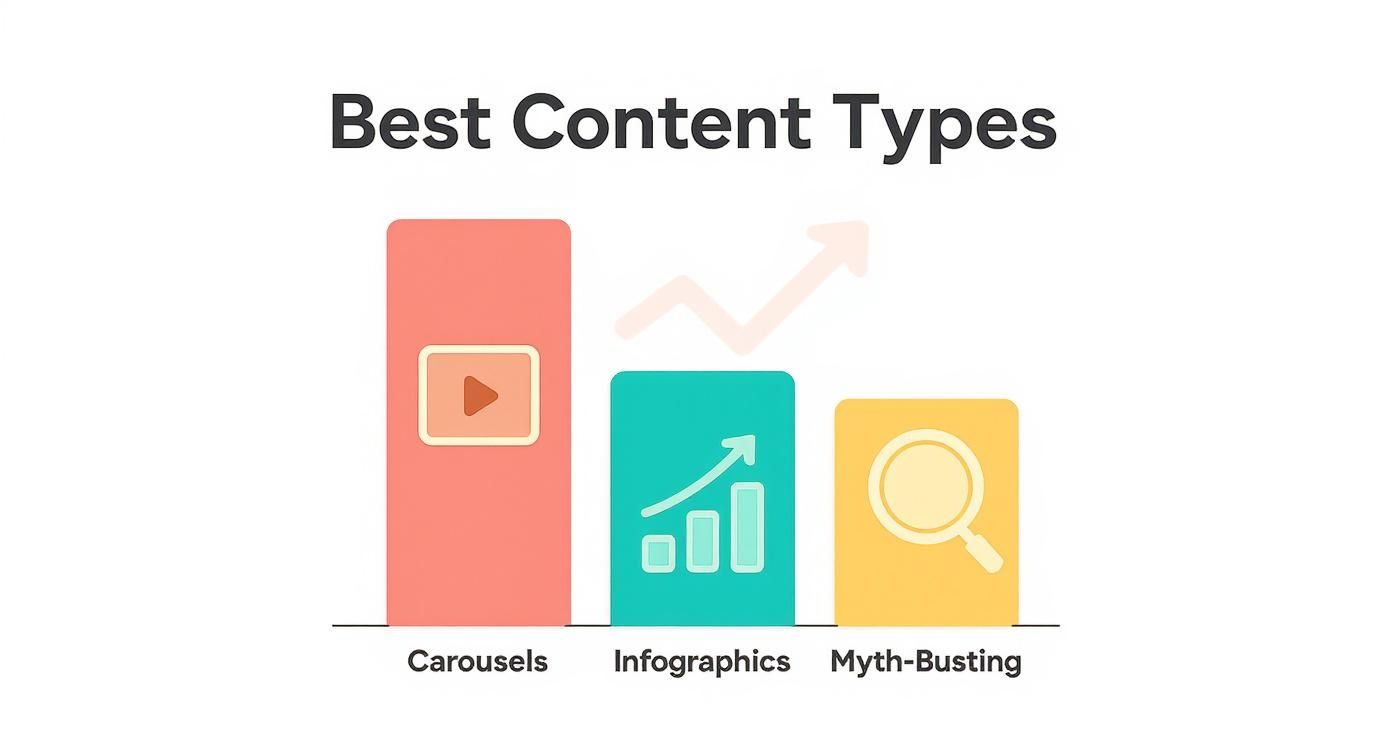
As you can see, carousels and infographics are heavy hitters. That’s because they package up valuable information into a digestible, shareable format that performs well on both professional and visual-first platforms.
Facebook: It's All About Community
Facebook isn't just a social network anymore; it's a powerful tool for building a community. Yeah, organic reach in the main feed can be a struggle, but Facebook Groups give you a direct line to your most dedicated fans.
The real magic on Facebook isn't just broadcasting your message. It's about starting conversations among your followers. When you build a community, engagement just happens naturally.
Create a group where your customers and fans can ask questions, share their wins, and connect with each other. This turns your brand from a faceless company into the host of a valuable industry hub. Use the group to share exclusive content, run polls, and get honest feedback from the people who matter most.
TikTok: Learn from the Trends
TikTok runs on fast-paced, entertaining, and trend-driven videos. Even if you're not a video creator, the core lesson from TikTok is the power of authenticity and cultural relevance.
The organic engagement on TikTok is just insane, with an average rate of 2.5% per post. For smaller accounts, that number can jump to an incredible 7.5%. This just goes to show how much the audience craves genuine, unpolished content.
You can apply TikTok's principles to your strategy on any platform: be authentic, join relevant conversations, and always prioritize providing value—whether you're educating or entertaining.
Here’s a quick look at how different content types perform across platforms, which can help you decide where to put your energy.
Engagement Rate Benchmarks by Platform and Content Type
This table compares average engagement rates for popular content formats across major social media platforms, highlighting where to focus your creative efforts.
| Platform | Content Type | Average Engagement Rate |
|---|---|---|
| Carousel | 3.15% | |
| Reel | 1.95% | |
| TikTok | Video | 2.50% - 7.50% |
| Multi-Image | 6.60% | |
| Document | 5.85% | |
| Group Post | 2.00% - 5.00%+ | |
| Video | 0.95% |
As the data shows, interactive formats like Carousels on Instagram and multi-image posts on LinkedIn are clear winners for driving interaction. The massive potential of TikTok and the focused community within Facebook Groups also stand out. This should guide your content creation, pushing you toward formats that naturally invite a response.
Ultimately, mastering each platform means getting inside the heads of its users and understanding what the algorithm wants to see. And of course, posting at the right time is a huge piece of the puzzle. Nailing the timing ensures your carefully crafted content gets seen by the most people. You can dive deeper into this with our guide on the best time to post on social media. By adapting your content to fit the vibe of each channel, you set yourself up for way more impact and engagement.
Building and Nurturing an Active Community
Here's a hard truth: great content gets a like, but a strong community earns loyalty. If you want to boost your engagement for the long haul, you have to stop just posting and start building actual relationships. Sky-high engagement isn't a fluke; it's what happens when a community feels seen, heard, and genuinely valued.
This means you need a mindset shift. Stop being a broadcaster and start being a host. Your job isn't just to talk at your audience. It's to create a space where they can talk with you and—just as important—with each other. When people feel like they're part of something, they stick around, they interact, and they become your biggest advocates.
Spark Conversations That Don’t Suck
The easiest way to get people talking is to ask a question. But the quality of that question is everything. Ditch the generic, dead-end questions like "What do you think?" and get specific. Get personal. Give people something to chew on.
Open-ended questions that invite stories or strong opinions are your best friend here.
Instead of: "Do you like our new feature?"
Try: "What's the most creative way you've used our new feature so far? We're dying to know."
Instead of: "What are your goals?"
Try: "What's one goal you're determined to crush this month, and what's the biggest obstacle in your way?"
See the difference? These kinds of questions make your followers actually stop and think, leading to way better comments and real discussions. Polls and quizzes on platforms like Instagram Stories or LinkedIn are also killer for quick, low-effort interactions that pull people in.
Responsiveness is Your Superpower
One of the biggest mistakes brands make is treating comments like a one-way street. When someone takes the time to leave a comment, they're opening a door. If you ignore it, you're slamming that door in their face.
Timely and authentic responses are non-negotiable. Aim to reply to comments and DMs as fast as you can. It shows your audience there's a real person behind the account who's actually listening and cares.
A timely, thoughtful reply to a comment does more than just acknowledge one person; it shows your entire audience that you are present and engaged. This public display of attentiveness encourages others to join the conversation.
And please, don't be a robot. Add some personality, ask a follow-up question, and show some genuine appreciation. This simple act of showing up consistently is what turns passive followers into an active community that actually feels connected to you.
Unleash the Power of User-Generated Content
User-generated content (UGC) is the ultimate cheat code for social proof and engagement. This is when your followers become your content creators, sharing their own photos, videos, or stories featuring your brand. UGC is gold because it's authentic, trustworthy, and shows real people loving what you do.
To get the UGC flowing, you have to make it easy and rewarding for your audience.
- Create a branded hashtag: Give your community a simple, memorable hashtag to slap on their posts about you.
- Run a campaign or challenge: Ask followers to share photos of them using your product in a cool setting or completing a specific task. Make it fun.
- Feature your followers: Regularly reshare the best UGC on your feed, stories, or in your newsletter. That recognition is a massive motivator and makes your community feel like rockstars.
The way people consume content has totally changed. Today, 43% of social media users follow at least one brand, proving they're hungry for content that connects. With the average person scrolling for over two hours a day, the brands that build real communities are the ones that win. You can discover more insights about current social media statistics to get a better handle on these shifts.
Analyzing Performance and Optimizing Your Strategy
Posting great content is only half the battle. You can have the most beautiful graphics and the wittiest captions, but if you're not paying attention to what happens after you hit "publish," you're just throwing stuff at a wall and hoping it sticks.
If you actually want to grow, you have to know what's working, what's bombing, and why. This isn't about getting buried in spreadsheets. It's about creating a simple feedback loop that turns every post—good or bad—into a lesson that makes your next one better. Without this, you're just guessing.
Moving Beyond Vanity Metrics
Likes and follower counts feel good. But they don't pay the bills and they rarely tell the whole story. True engagement comes from actions that show someone is genuinely connecting with what you've made.
To really get what's going on, you have to track the right social media engagement metrics.
Here's what to obsess over instead of likes:
- Share Rate: This is the ultimate compliment. It means someone found your content so valuable they were willing to stake their own reputation on it by sharing it with their network. It's pure gold for organic reach.
- Save Rate: On platforms like Instagram, a save is a massive signal to the algorithm. It tells the platform, "Hey, this is high-quality stuff people want to come back to." It’s basically a vote of confidence.
- Comment Volume and Quality: Are people just dropping fire emojis, or are they starting actual conversations? Thoughtful comments and real discussions are a sign you're not just posting content; you're building a community.
- Click-Through Rate (CTR):: If your post has a link, this is your moment of truth. Did anyone actually care enough to take the next step? This metric cuts through the fluff and tells you if you’re driving real action.
Tracking these numbers gives you a much clearer picture of what your audience actually values, not just what they'll double-tap on while scrolling.
Using Native Analytics to Your Advantage
You don't need fancy, expensive software to start digging into your data. Every single major platform—Instagram, Facebook, LinkedIn, you name it—has free, built-in analytics dashboards that are packed with useful info.
Make it a weekly habit to pop into these dashboards. Look for patterns in your best-performing posts. Ask yourself these questions:
- What was the format? (Was it a carousel, an infographic, a video?)
- What was the topic?
- What kind of hook did I use in the first line?
- When did I post it?
Spotting the common threads here is how you build a profile of a "winning" post for your specific audience. This data-driven approach takes all the guesswork out of what you should be creating next.
A Simple Framework for A/B Testing
Once you have a baseline of what works, you can start making it even better. A/B testing is just a fancy way of saying you're trying two different things to see which one gets better results. It's simple, but it’s incredibly powerful.
The goal of testing isn't to find one perfect formula that works forever. It's about creating a habit of continuous learning. Small, consistent improvements are what lead to massive gains over time.
You can test just about anything. For example:
- Visuals: Does a minimalist graphic get more saves than a bold, colorful one?
- Post Times: Does posting at 9 AM get more comments than posting at 5 PM?
- CTAs: Does asking a direct question get more replies than telling people to "save this post"?
The key is to change only one thing at a time so you know exactly what made the difference. Run your test, check the numbers, and apply what you learned. This little loop is how you turn good engagement into great engagement, one post at a time.
Your Toughest Social Media Engagement Questions, Answered
Alright, so you've got a plan. But then the real world hits. Suddenly, you're staring at a negative comment, wondering if you should post for the third time today, or just boost the damn thing and hope for the best.
Let's cut through the noise. These are the questions that come up time and time again.
How Often Should I Actually Be Posting?
This is the classic "how long is a piece of string?" question. There’s no magic number. Posting too much burns out your audience (and you). Posting too little makes you invisible. It’s a balancing act, and every platform has a different rhythm.
Here’s a realistic starting point, based on what's working right now:
- Instagram: Aim for 3-5 solid feed posts a week. Fill the gaps with daily Stories. That way, you’re always present without spamming people's feeds.
- Facebook: For most businesses, once a day is plenty. If you're running an active Facebook Group, you can definitely post more in there to keep the conversation flowing.
- LinkedIn: Think quality over quantity. 2-4 high-value posts a week is the sweet spot for most B2B folks. Consistency here trumps everything.
- X (formerly Twitter): It's a firehose. You can post anywhere from 1-5 times a day, especially if you're jumping into real-time trends and conversations.
But here's the real secret: your analytics are the ultimate truth-teller. If you ramp up your posting and see engagement-per-post plummet, you've found your audience's limit. Back off and let the data guide you.
What Do I Do About Negative Comments?
First, take a breath. A negative comment isn't the end of the world. In fact, it’s an opportunity. Ignoring it is the worst thing you can do. Getting defensive is the second-worst. Handled right, a complaint can actually build more trust than a thousand positive comments ever could.
Here’s a simple playbook that works every time:
- Acknowledge and Validate: Don't argue. Just show them you're listening. A simple, "Thanks for the feedback, I can see why you're frustrated," works wonders. It de-escalates the situation immediately.
- Take it Private: If it’s a specific customer service issue, offer to solve it in DMs or email. "Can you DM us your order number so we can look into this for you?" This shows everyone watching that you're taking action without airing dirty laundry.
- Offer a Solution (Publicly): Even if you take it to DMs, close the loop publicly. A quick reply like, "Glad we could get this sorted for you in DMs!" shows accountability.
Responding to negative feedback with confidence and transparency is a massive trust signal. It tells your entire audience that you're not afraid of criticism and that you genuinely care about getting things right.
Unless a comment is straight-up spam or abusive hate speech, don't delete it. A timeline scrubbed clean of any criticism looks fake. A timeline with well-handled complaints? That looks human.
Should I Just Pay to Boost My Posts?
Throwing money at a post without a plan is like setting cash on fire. Paid ads are an accelerator, not a magic wand. They should amplify what’s already working, not try to save what isn’t.
Think of paid ads as a tool for very specific jobs. Use them when you want to:
- Amplify Your Greatest Hits: Got a post that’s organically crushing it with saves and shares? That’s the one to put money behind. You already have proof that people love it; now, pay to show it to more of the right people.
- Reach a Super-Specific New Audience: This is where ads shine. Need to get in front of 35-year-old female accountants in Ohio who love dogs? Organic reach can’t do that. Paid ads can. It's perfect for generating leads or cracking into a new market.
- Promote Something Time-Sensitive: A product launch, a flash sale, a webinar sign-up... when you need eyeballs right now, paid ads give you the immediate visibility that the algorithm might not.
The best strategies don't choose between organic and paid—they blend them. Create amazing organic content consistently, then use paid ads strategically to pour gasoline on the fire.
Tired of the design grind? Postbae is an AI agent that ditches the prompts and just works. It autonomously creates professional, on-brand visual posts for your industry. Get stunning carousels, infographics, and more without lifting a finger. See how at https://postbae.com.