How Much Does Social Media Management Cost? A Clear Breakdown

Discover how much does social media management cost with a clear breakdown of agency, freelancer, and AI tool pricing to help you budget confidently.
When you start looking into social media management, the first question is always the same: how much is this going to cost?
The answer? It can range from $50 an hour for a specialist to well over $5,000 a month for an agency that handles everything. The final number really boils down to what you actually need—the scope of the work, how many platforms you’re on, and how much strategic heavy lifting you expect them to do.
Understanding the Social Media Management Price Tag
Figuring out how much social media management costs feels complicated because "management" is such a slippery term. Are you just paying someone to schedule a few posts a week? Or are you investing in a full-blown strategy with content creation, daily community engagement, and deep-dive analytics? The answer completely changes the price tag.
Your investment is also tied to your business goals. For most small businesses, a realistic budget falls somewhere between $500 and $5,000 per month. Newcomers or smaller shops usually land in the $500-$2,500 range for solid, foundational support. Larger companies with more complex needs? They’re often looking at $5,000-$15,000+ for multi-channel strategies that drive serious growth. You can get more great insights on current social media pricing trends from the team at WebFX.
Social Media Management Options at a Glance
To make this a little less murky, let's break down the most common ways to get your social media managed. Each option strikes a different balance between cost, expertise, and how hands-on you want to be.
Here's a quick look at the main players in the game.
| Management Option | Typical Monthly Cost | Best For |
|---|---|---|
| Freelancer | $500 - $2,500+ | Startups and small businesses needing specialized skills for 1-2 platforms or specific projects. |
| Marketing Agency | $2,500 - $10,000+ | Established businesses seeking a comprehensive, outsourced solution with a full creative and strategic team. |
| In-House Team | $4,000 - $8,000+ | Larger companies requiring deep brand integration, daily engagement, and complete control over their social presence. |
| AI Tools | $30 - $300 | Small businesses and creators looking to automate specific tasks like visual content creation affordably. |
This table gives you a ballpark, but the real decision comes down to what you're trying to achieve.
Key Takeaway: The "right" price isn't just a number; it's a reflection of the value and results you expect. A lower price might cover basic visibility, while a higher investment should deliver measurable growth, lead generation, and a tangible return on your investment.
Choosing your path is all about your specific goals, what you can handle internally, and your budget. For a small business owner, a freelancer or a smart AI tool might be the perfect mix of quality and affordability. For a company that’s scaling fast, the firepower of an agency or a dedicated in-house manager is probably essential.
Key Factors That Influence Social Media Pricing
Ever wondered why one social media manager quotes a few hundred dollars a month, while another asks for several thousand? It’s the first question most business owners have, and it’s a good one. The price tag isn't arbitrary—it’s a direct reflection of the value, expertise, and specific services you’re actually getting.
A provider quoting $1,000 and another quoting $10,000 aren't selling the same thing. They're offering completely different levels of strategic depth and hands-on work. Once you understand what goes into that final number, you can evaluate proposals like a pro and find a fit for your budget and goals.
Let's pull back the curtain on the biggest factors that move the needle on cost.
Scope of Services
This is the big one. The single biggest driver of cost is the scope of work. "Social media management" is a massive umbrella term. It can mean anything from simply scheduling a few posts a week to running a full-funnel marketing operation designed to generate leads and sales.
A low-cost plan might just cover the basics to keep your profiles from looking like a ghost town. A premium package, on the other hand, is a deep partnership.
Here’s how the services typically stack up:
- Basic Package: Think of this as maintenance mode. It often includes scheduling pre-written content, writing simple captions, and posting to one or two platforms. The goal is maintaining a presence, not necessarily driving explosive growth.
- Mid-Tier Package: Now we're getting strategic. This usually adds content strategy, creating basic graphics, community engagement (actually replying to comments and DMs), and monthly performance reports to show you what's working.
- Comprehensive Package: This is the all-inclusive, hands-off solution. It covers everything from the mid-tier plus paid ad management, deep analytics with ROI tracking, video content production, and proactive campaigns built to grow your brand.
Platform and Channel Complexity
Not all social platforms are created equal, and the cost to manage them reflects their unique demands. Managing a single platform is always going to be more affordable than juggling three or four. The which platforms also matters a ton.
For example, a professional network like LinkedIn demands well-researched, long-form content and targeted industry chatter. That takes time and a specific kind of expertise. In contrast, a visual-first platform like Instagram lives and dies by high-quality graphics and video.
A multi-platform strategy means your content has to be tailored for each channel’s audience and format, which adds layers of complexity—and cost.
A provider should be able to justify their pricing based on the specific strategies required for each platform. Simply reposting the same content everywhere is a red flag that you might be overpaying for a low-effort service.
Content Creation and Production Value
What you post is just as important as where you post it. The type of content you need is a huge piece of the monthly cost, and it scales directly with the complexity and quality of what’s being made.
- Text-Only Updates: The most basic and affordable type of content.
- Custom Graphics: This involves creating branded templates, infographics, and eye-catching visuals. It requires design skills and software, which bumps up the price.
- Video Production: This is the most resource-intensive content, from short-form Reels and TikToks to longer educational videos. The choice between hiring professional editors versus using smarter solutions is a major factor, as this guide on AI Video Tools vs Professional Editors explains.
This flowchart gives you a great visual for how costs often scale based on the provider and the size of the business, which naturally reflects different levels of service and complexity.
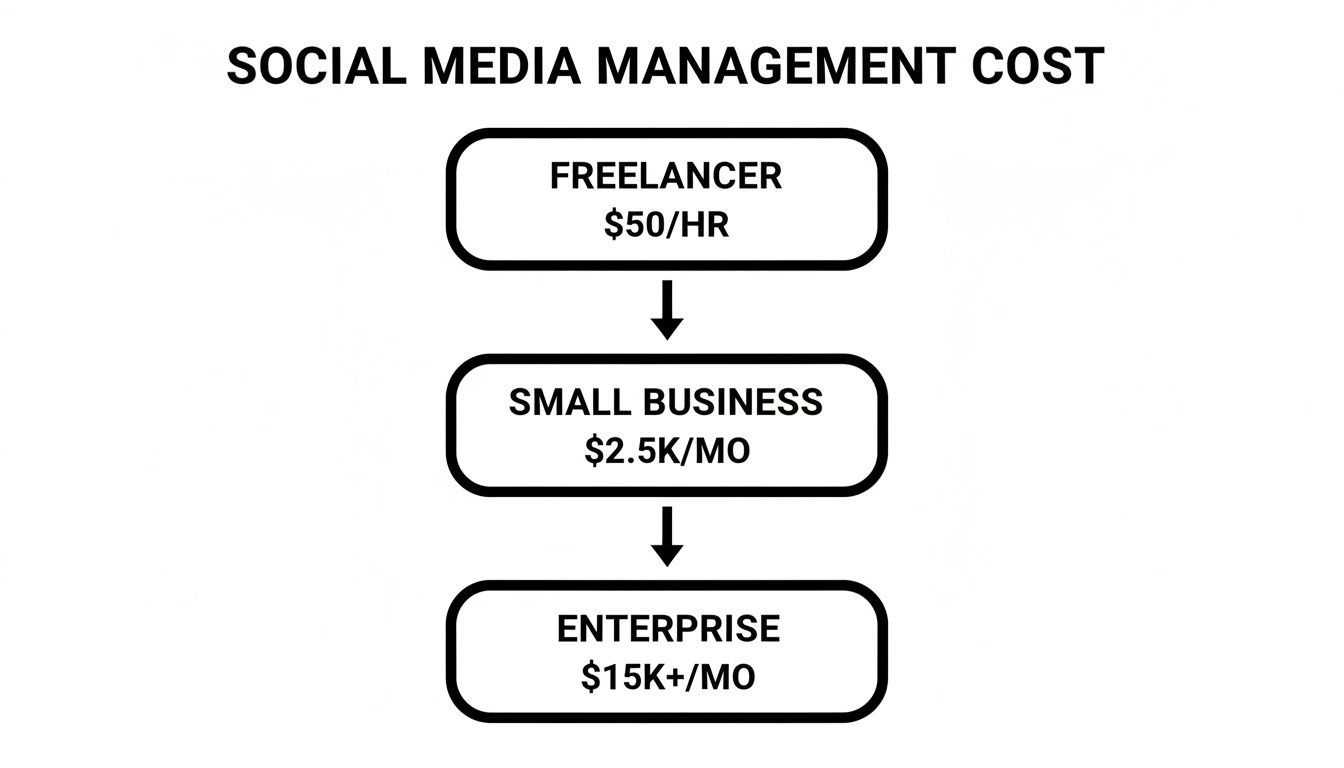
As you can see, an entry-level freelancer might charge hourly for specific tasks, while packages for small businesses and enterprises are priced monthly to cover a much broader scope of services and ongoing strategic support.
Choosing Your Management Model: Freelancer vs. Agency vs. In-House

You've got a handle on the moving parts that influence social media costs. Now comes the big question: who's actually going to do the work?
This is one of the most important calls you'll make. Deciding between a freelancer, an agency, or an in-house hire isn't just about the monthly bill. It shapes your day-to-day involvement, your brand's voice, and the entire strategic direction of your social media.
Each path offers a unique mix of cost, control, and expertise. Let's break down the three main models to figure out which one makes the most sense for your business right now.
The Freelance Social Media Manager
Hiring a freelancer is often the go-to first step for small businesses and startups. It’s a smart way to get specialized skills without the heavy commitment and overhead of a full-time employee. Think of it as bringing in a specialist on your terms.
Freelancers are pretty flexible with how they charge:
- Hourly Rates: Perfect for one-off tasks or a bit of consulting. Expect to pay anywhere from $20 to $150 per hour, depending on their experience.
- Per-Project Fees: This is for a defined task with a clear finish line, like creating a content calendar for the next quarter or running a single campaign.
- Monthly Retainers: The most common setup. You pay a fixed fee each month for an agreed-upon set of tasks, usually ranging from $500 to $2,500+.
The biggest win with a freelancer is getting direct access to an expert. You can find someone who lives and breathes LinkedIn for B2B leads or a creative genius who’s a master of Instagram Reels. The flip side? Their availability can be limited since they're usually juggling a few other clients.
The Full-Service Marketing Agency
Bringing on a social media agency is like outsourcing your entire social media department. It's the comprehensive, "get-it-done-for-me" solution for businesses ready to scale up and who need a whole team of pros.
An agency brings a multi-disciplinary team to the table—you're not just hiring a manager, but gaining access to strategists, copywriters, graphic designers, ad specialists, and data analysts.
This collective brainpower is what you're really paying for. Agency retainers are a bigger investment, typically starting around $2,500 and climbing to $10,000 or more per month. But for that price, you get a complete strategic package.
They handle everything from the big-picture planning and campaign execution down to the nitty-gritty analytics and reporting. For a business that wants a truly hands-off solution that drives real results, the higher cost can deliver a serious return. To get a better feel for how they structure their fees, our guide on marketing agency pricing models is a great place to start.
The In-House Manager or Team
Hiring a dedicated employee to manage your social media in-house gives you the ultimate level of control and brand alignment. This person is completely immersed in your company culture, which makes them perfectly suited to create authentic content and engage with your community in real-time.
But this model also comes with the highest fixed cost. The price of an in-house manager is way more than just their salary.
Let's do the real math on the annual cost:
- Average Salary: A social media manager's salary can fall anywhere between $50,000 to $80,000+ a year.
- Benefits and Taxes: Tack on another 25-30% of their salary for things like health insurance, retirement plans, and payroll taxes. That's an extra $12,500 to $24,000.
- Tools and Software: You'll need subscriptions for scheduling, analytics, and design tools, which can easily add $1,000 to $5,000 per year.
- Training and Development: To keep their skills sharp, plan for another $1,000+ annually for professional development.
All in, the true annual cost for one in-house manager lands somewhere between $64,500 and $110,000+. That breaks down to roughly $5,375 to $9,167 per month. It's the most expensive route, for sure, but that deep integration and instant responsiveness can be priceless for larger companies with complex needs.
So, how do these three options stack up head-to-head? Each has its sweet spot depending on your budget, goals, and how hands-on you want to be.
Cost and Benefit Analysis: Freelancer vs. Agency vs. In-House
| Factor | Freelancer | Marketing Agency | In-House Manager |
|---|---|---|---|
| Typical Monthly Cost | $500 - $2,500+ | $2,500 - $10,000+ | $5,300 - $9,200+ |
| Expertise | Specialist in 1-2 areas (e.g., content, specific platform). | Team of specialists (strategy, ads, design, copywriting). | Generalist with deep brand knowledge. |
| Flexibility | High. Easy to scale services up or down as needed. | Moderate. Usually requires longer-term contracts (6-12 months). | Low. Full-time commitment with hiring/firing complexities. |
| Control & Integration | Moderate. Works as an external partner but can be closely managed. | Low. You're outsourcing strategy and execution; less day-to-day control. | High. Fully integrated into the team and company culture. |
| Scalability | Limited by one person's capacity. | High. Agencies are built to scale with your business needs. | Moderate. Scaling requires hiring more team members. |
| Best For | Startups, small businesses, or those needing specific skills. | Established businesses ready for aggressive growth and a hands-off approach. | Larger companies with complex needs and a desire for deep brand control. |
Ultimately, there’s no single "best" answer—only the best fit for your business. A startup might get incredible value from a nimble freelancer, while a company aiming for rapid market expansion will benefit from an agency's firepower. And for a brand where the community interaction is everything, nothing beats having someone in-house.
Exploring AI Tools as a Cost-Effective Solution

While hiring people is the traditional route, a fourth option has completely changed the game, especially for small businesses and startups. AI-powered tools are rewriting the rules around how much social media management costs by offering a powerful, affordable alternative.
These tools are built to handle some of the most tedious and expensive parts of social media, making a professional presence possible without the hefty monthly fees. They essentially democratize high-level social media by tackling critical tasks for a tiny fraction of the price.
Automating the Toughest Part: Visual Content Creation
One of the biggest line items in any social media budget is creating a steady stream of high-quality visuals. This is exactly where AI tools are making the biggest splash.
Think about what it takes to create a professional-looking carousel, infographic, or listicle. It’s a mix of research, copywriting, and design skills. That multidisciplinary process is precisely why good visual content costs so much and takes so long to produce.
AI tools are designed to solve this exact problem, automating the entire workflow from a blank slate to a finished graphic. This lets businesses produce authority-building content that would otherwise eat up a designer's time or a huge chunk of an agency's retainer.
By automating visual production, AI tools completely flip the cost dynamic. You're no longer paying for hours of manual labor. Instead, you're paying a small monthly fee for an automated system that delivers consistent, high-quality results.
For businesses looking to really stretch their budget, looking into the best free social media management tools can be a great way to find other cost-effective solutions for tasks like scheduling.
How an AI Agent Like Postbae Works
A perfect example of this new wave is Postbae, an AI agent that fully automates the creation of visual social media posts. It was built from the ground up for small business owners, agencies, and creators who need to look professional but don't have the time or design skills.
Unlike a generic design tool, Postbae works in the background on its own. You don't even have to feed it prompts. The AI agent intelligently generates visual content specific to your industry, ready to go for platforms like Instagram, Facebook, and LinkedIn.
Here’s a peek at how it works:
- Autonomous Ideation: The AI researches what's relevant in your industry and comes up with topics for educational, authority-building content.
- Content Generation: It then populates professional templates with relevant content for posts like tips, industry facts, or multi-slide carousels.
- Visual Design: Finally, the system designs the graphics programmatically, matching the text with professionally designed layouts that are proven to work.
The result? A library of ready-to-use visual graphics that build your expertise and keep your audience engaged. For a low monthly fee of around $30, businesses get the kind of visual firepower that would typically run hundreds or even thousands of dollars from a freelancer or agency.
Maintaining Control While Cutting Costs
A common worry with automation is losing your creative touch. But modern AI tools are built with this in mind. With a tool like Postbae, for instance, every single post the AI creates is fully editable.
This gives you the best of both worlds: the raw efficiency of automation, plus the ability to tweak every detail to perfectly match your brand's voice and style. You get the speed of AI without giving up creative ownership.
This unique blend of affordability, automation, and control makes AI tools a seriously compelling fourth option alongside freelancers, agencies, and in-house teams. For more ideas on what's possible, you might want to check out our guide on the best AI social media post generators. They offer a practical way to get a high-end social media look without the high-end price.
How to Calculate Your Social Media ROI
Good social media isn't an expense; it's an investment. But to really understand its value, you have to look past the likes and followers. The real question is how those surface-level numbers are turning into actual business results—things like website traffic, new leads, and sales.
Calculating your Return on Investment (ROI) is how you connect the dots between what you spend on social media and what you get back. It’s the framework that turns your budget from a guessing game into a predictable engine for growth.
Moving Beyond Vanity Metrics
The very first step in measuring real ROI is to stop obsessing over vanity metrics. These are the numbers that look impressive but don't actually tell you if your business is healthier.
- Likes and Reactions: Great for a quick pulse check on audience interest, but they don't directly equal sales.
- Follower Count: A massive audience is nice, but a smaller, highly engaged audience that actually buys from you is far more valuable.
- Impressions and Reach: Knowing how many people saw your post is a start, but it doesn't tell you if they did anything about it.
Instead, the goal is to shift your focus to actionable metrics. These are the numbers that tell a story about customer behavior and, ultimately, revenue.
Key Metrics for Measuring Real ROI
To get a true picture of your ROI, you need to track metrics that have a clear financial impact. Think of these as the bridge between your social media activity and your bank account.
- Website Clicks and Traffic: How many people are actually leaving the social platform to check out your website? This is a huge indicator of genuine interest.
- Lead Generation: How many people filled out a contact form, signed up for your newsletter, or downloaded a guide? These are direct business opportunities.
- Conversion Rate: What percentage of those website visitors or new leads became paying customers? This is the bottom-line measure of success.
- Cost Per Lead (CPL): How much are you spending to get each new lead? This helps you understand how efficient your campaigns are.
A simple formula to get started is: (Revenue from Social Media - Total Social Media Cost) / Total Social Media Cost x 100 = Social Media ROI %. This gives you a clear percentage that shows how much you're earning back for every dollar spent.
Organic Content vs. Paid Advertising ROI
It’s also crucial to understand that organic content and paid ads play different roles and have different ROI expectations. Organic content is a long game—it builds trust, authority, and community. Paid ads deliver immediate, targeted reach.
Research shows that paid social media advertising averages $65 per lead, while organic content marketing can cost around $95 per lead. The platform you choose matters immensely, too. Facebook can be a cost-effective option for generating leads, with rates between $5.83-$21.98 per lead. In contrast, LinkedIn is a premium B2B platform where costs can range from $15-$350 per lead.
And don't forget the format—video ads on social media tend to deliver 48% higher engagement than static images. You can discover more insights about social media cost per lead to help fine-tune your ad spend.
A Practical Framework for ROI Calculation
Let's walk through a quick example for a small business to see how this works in the real world.
Imagine a small e-commerce brand spends $1,500 per month on social media management and content creation.
- Track the Source: Using tools like Google Analytics (with UTM codes attached to their links), they can see exactly how much website traffic is coming from their social channels.
- Measure Conversions: They find that their social media efforts generated 30 sales last month, and the average order value was $100.
- Calculate Revenue: The total revenue they can directly attribute to social media is 30 sales x $100 = $3,000.
- Calculate ROI: Now, they plug the numbers into the formula: ($3,000 Revenue - $1,500 Cost) / $1,500 Cost x 100 = 100% ROI.
In this scenario, for every dollar they invested in social media, they got two dollars back. This clear, positive ROI completely justifies their monthly spend and makes a strong case for potentially increasing the budget.
For a deeper dive into this topic, you might be interested in our guide on how to measure content marketing ROI.
Making the Right Choice for Your Business
You've seen the models, crunched the numbers, and weighed the potential ROI. Now it’s time to make a decision that actually fits your business—not someone else's.
Choosing the right social media management solution isn’t about picking the cheapest or the most decked-out option. It's about finding the perfect fit for your specific goals, budget, and—most importantly—your own time and energy.
This last step is all about a clear-eyed self-assessment. By asking the right questions, you can move from theory to a practical, actionable plan that sets your business up for real results.
Define Your Primary Business Goal
Before you pick a partner or a tool, you have to know what you're actually trying to do. What does "success" on social media even look like for you? Your main objective will steer this whole decision.
- Brand Awareness: If your goal is simply to get your name out there and maintain a presence, a lower-cost freelancer or a smart AI tool might be all you need to maintain a consistent presence.
- Lead Generation: Need social media to be a reliable pipeline for new leads? You’ll need a more strategic approach. This usually points toward an experienced freelancer or a specialized agency that lives and breathes conversion-focused content.
- Community Building: For businesses that run on customer interaction and loyalty, an in-house manager or a deeply engaged freelancer who can become the voice of your brand is almost always essential.
- Direct Sales: Driving e-commerce sales requires a whole different level of strategy involving killer product visuals, targeted ads, and a sharp eye on analytics. This is where agencies or skilled in-house teams really earn their keep.
Evaluate Your Internal Resources
Next up, take an honest look at your two most precious resources: time and money. Your internal capacity is just as critical as your business goals when it comes to picking the right path.
A classic mistake is underestimating the time it takes to manage a freelancer or review an agency's work. Be brutally honest about how hands-on you can truly be. This will help you choose a solution that slots into your workflow, rather than blowing it up.
Ask yourself these gut-check questions:
- What is my realistic monthly budget? Knowing this number cold will immediately slash your options down to a manageable few.
- How much time can I actually sink into social media each week? If your time is next to zero, a hands-off agency or an automated tool like Postbae might be a much better fit than trying to micromanage a freelancer.
- Do I have any in-house skills I can lean on? If you're a great writer but a terrible designer, an AI tool that handles the visuals can fill that gap perfectly and affordably.
By getting crystal clear on your goals and your resources, you build a simple framework for your decision. This ensures the solution you pick not only fits your budget but becomes a genuine asset that helps your business grow.
Frequently Asked Questions
When you start digging into social media management costs, a lot of questions come up. It's totally normal. Let's clear up some of the most common ones so you can feel confident about your next move.
What Is a Reasonable Budget for a Small Business?
For most small businesses, a reasonable budget lands somewhere between $500 and $2,500 per month. This is the sweet spot for getting skilled help from a freelancer or a focused agency on one or two of your most important platforms.
At the lower end, around $500-$1,000, you're looking at foundational support—think content scheduling and keeping an eye on comments. As you push closer to $2,500, the service gets more robust, bringing in content strategy, custom graphics, and detailed monthly reports to really build a foundation for growth.
Do Management Fees Include My Ad Spend?
No. Your management fee and ad spend are almost always two separate things. Think of the monthly retainer as paying for the expert's brain and time—their strategy, content creation, and campaign management.
The ad spend is the money you set aside to pay the platforms directly (like Meta or LinkedIn) to actually run your ads. Your manager will handle that budget for you, but it's a completely separate line item you'll need to account for.
How Can I Reduce Costs Without Sacrificing Quality?
Cutting costs isn't about going cheaper; it's about getting smarter with your resources. One of the best ways to do this is to use AI tools for the repetitive, time-consuming tasks, especially when it comes to creating visuals.
Instead of paying an hourly rate for every single graphic, an AI agent like Postbae can generate a steady stream of professional, authority-building visual posts for a flat monthly fee. This frees up your budget to invest in high-level strategy or community management while your visual presence stays top-notch. You still get full editing control, giving you the perfect blend of automation and brand oversight.
How Long Until I See Results from My Investment?
That really depends on what "results" means to you. If you're looking for initial traction—things like more engagement and follower growth—you'll likely start seeing that within the first 1 to 3 months as a new strategy finds its footing.
But for the bigger business goals, like lead generation and a solid return on investment (ROI), you need to play the long game. It usually takes 6 to 12 months of consistent, strategic work to build a presence that reliably brings in customers and adds to your bottom line.
Ready to create a high-end social presence without the high-end cost? Postbae is an AI agent that autonomously generates professional visual social media posts for your business, no prompts required. Get the output of a creative team for a fraction of the price. Learn more about Postbae and start building your authority today.