A Complete Guide to Marketing Agency Pricing Models

Discover the best marketing agency pricing models for your business. We compare retainers, project-based, and performance-based fees to help you maximize ROI.
Choosing the right pricing model is one of those make-or-break decisions for any marketing agency. Get it right, and you build a healthy, profitable client relationship. Get it wrong, and you're setting yourself up for scope creep, resentment, and a race to the bottom. The usual suspects are monthly retainers, project-based fees, and the ever-elusive performance-based model.
Understanding Your Agency Pricing Foundation
The foundation of any good agency-client relationship is a pricing model that makes sense for both sides. It needs to align incentives, protect your profitability, and be crystal clear. There's no single "perfect" model; the right choice depends entirely on the situation.
You have to consider the type of service you're offering, how mature the client's business is, and your own agency's workflow. For instance, a startup in need of consistent social media content is a textbook retainer client. But a large corporation launching a new website? That points to a project-based fee. Nailing these distinctions is crucial.

Core Pricing Models At A Glance
Before we dive deep, let's get a quick snapshot of how these models stack up. Each one shifts the risk around—sometimes it’s on the client, sometimes it’s all on you.
A retainer, for example, gives your agency predictable cash flow. The catch? You have to constantly prove your worth, month after month, or the client will start questioning that invoice. On the flip side, performance-based pricing offers a massive potential upside, but you carry all the risk. If a search engine algorithm update tanks a campaign, you could end up working for free.
Here’s a quick comparison to see how the most common models measure up.
Marketing Agency Pricing Models at a Glance
This table breaks down the basics: where each model shines, who holds the risk, and how you'll likely bill for it. It's a solid starting point for figuring out what structure fits the job.
| Pricing Model | Best For | Client Risk | Agency Risk | Billing Cycle |
|---|---|---|---|---|
| Monthly Retainer | Ongoing, long-term relationships (e.g., SEO, content) | Medium | Low | Monthly |
| Project-Based | Clearly defined, one-off projects (e.g., website design) | Low | Medium | Milestones / Upfront |
| Performance-Based | Campaigns with easily trackable metrics (e.g., PPC) | Low | High | Post-Results |
| Hourly Rate | Consulting, small tasks, or undefined scopes | High | Low | Weekly / Bi-Weekly |
Think of this as your cheat sheet. Each model tells a different story about the client partnership you’re trying to build.
The best agencies don’t just set prices; they design them. Your pricing tells the client how confident you are, what you believe your work is worth, and whether you see them as a partner or just another project.
The Strategic Importance of Your Choice
Your pricing strategy isn't just about revenue; it frames the entire client relationship. Bill by the hour, and you might accidentally encourage slow work. Pitch a value-based model, and you position yourself as a strategic partner who’s all about results. It’s a powerful psychological signal.
This is especially true for agencies looking to scale. Many are adding things like white label social media services to create recurring revenue without bloating their payroll. That kind of offering slots perfectly into a retainer or fixed-fee structure, building long-term stability.
Ultimately, you want a model that reflects the value you deliver and fuels your agency's growth. The next sections will pull apart each of these models, giving you the playbook to build a pricing strategy that’s both flexible and profitable.
Decoding the Monthly Retainer Model
The monthly retainer is the bedrock of most long-term agency relationships. It's a recurring fee for ongoing services, turning what could be a series of choppy, one-off projects into a smooth, strategic partnership.
For an agency, this model is a great benefit for cash flow. Knowing exactly how much revenue is coming in each month makes financial forecasting, hiring, and resource planning much less stressful. For the client, it means they have an expert team available, ready to jump on opportunities without drafting a new contract every time.

Structuring a Successful Retainer
Not all retainers are created equal. The successful ones are built on a foundation of clarity, spelling out exactly what the client gets for their monthly payment. A solid agreement is your best defense against "I thought that was included" conversations down the road.
You'll generally see two main types of retainers:
- Fixed-Scope Retainer: This is the most common approach. The monthly fee covers a specific, pre-defined list of deliverables. For example, a client pays $3,000 per month for 12 social media posts, two blog articles, and one email newsletter.
- Value-Based Retainer: This is less about counting deliverables and more about hitting goals. The fee is tied to the strategic value the agency brings, like measurably increasing market share or improving brand sentiment over six months. It’s trickier to define but can lead to much deeper partnerships.
No matter which path you choose, the service-level agreement (SLA) is non-negotiable. It has to clearly state the maximum number of hours, deliverables, or revisions included. Without it, you risk the partnership becoming unprofitable.
Common Pitfalls and How to Avoid Them
While retainers offer stability, they come with their own set of traps. The most infamous is scope creep, where clients slowly start asking for more work than what was agreed upon. A quick "can you just..." here and there can erode your profit margins without a firm contract and clear communication.
Another challenge is proving your worth during a slower month. A client might look at an invoice and start wondering what they're paying for if they don't see a flurry of new activity. This is where consistent, proactive communication is your lifeline. You have to constantly show the work being done behind the scenes and connect it back to their goals.
A retainer isn't just a payment; it's a pact. It signals a commitment from both sides to invest in a long-term strategy, moving beyond short-term tactics to build sustainable growth.
To keep the partnership healthy and profitable, agencies need to be diligent about a few things:
- Define Deliverables Explicitly: Your contract should leave zero room for interpretation. List every single service, from content creation and ad management down to the format of the monthly report.
- Establish Communication Protocols: Set clear expectations for meetings, response times, and reporting frequency from day one. This builds trust and prevents misalignment.
- Track Performance Metrics: Use data to prove your impact. Connect every activity back to the key performance indicators (KPIs) that the client's leadership cares about.
For agencies handling social media, modern tools can make retainers significantly more profitable. For instance, an agency can use a platform like Postbae to automatically generate high-quality visual social media graphics like carousels and infographics. This reduces the manual labor needed to meet monthly deliverables, freeing up your team to focus on high-value strategy and client relationships. This efficiency boost means you can deliver more value without increasing your overhead, making the partnership a clear win for the client.
When to Use Project-Based and Fixed-Fee Pricing
Let's talk about projects with a clear finish line. Unlike an ongoing retainer, project-based and fixed-fee pricing is built for assignments with a defined beginning, middle, and end. Think a full website redesign, a complete branding package, or a targeted three-month ad campaign launch.
For clients, the appeal is predictability. They know the exact cost upfront, which eliminates the budget anxiety that can come with hourly billing. For you, the agency, this model gives you better control over profit margins—if you scope the project accurately from the start.

The Mechanics of Scoping for Profitability
The success of any fixed-fee project lives and dies by your proposal. This document is your first line of defense against scope creep, where small, unbilled requests slowly erode your margins. A solid proposal leaves no room for misinterpretation.
To build a project that’s profitable, your proposal has to nail down these specifics:
- Every Single Deliverable: List exactly what the client is getting, from the number of social media graphics to the specific sections of their new website.
- A Clear Timeline with Milestones: Break the project into phases with firm deadlines. This keeps both your team and the client accountable.
- Defined Revision Rounds: Specify how many revisions are included for each deliverable (e.g., "two rounds of revisions on all logo concepts"). Anything beyond that limit should trigger a change order and an additional invoice.
Without this level of detail, you risk underestimating the effort involved, which can turn a project that looked great on paper into a financial loss.
How Automation Maximizes Fixed-Fee Margins
Fixed-fee pricing is a game of efficiency. The faster and more cost-effectively your agency can deliver high-quality work, the healthier your profit margin. This is where automation tools become a critical operational advantage.
Take visual social media content, a common deliverable in project-based marketing packages. Manually creating dozens of graphics, carousels, and infographics consumes a tremendous amount of design and copywriting hours—all of which you have to account for in that fixed price.
An AI-powered agent like Postbae changes this equation. It automates the production of professional visual social media posts, generating industry-specific carousels and infographics without requiring user prompts. This significantly reduces the labor hours needed to fulfill project deliverables.
For agencies running this model, the benefits are immediate. By automating these time-intensive production tasks, you can:
- Protect and Increase Profit Margins: Lower your internal cost of production while keeping your project fee competitive.
- Reduce Project Risk: Minimize the chance that an unforeseen design challenge will impact your budget.
- Deliver Faster: Shorten timelines and improve client satisfaction by delivering high-quality visual assets more quickly.
- Reallocate Resources to Strategy: Free up your team to focus on high-value work like campaign strategy and performance analysis instead of routine production tasks.
Ultimately, automation makes fixed-fee projects more profitable and less risky. With tools like these, you also retain full editing control over every generated graphic, ensuring the final output is perfectly on-brand for your client.
Industry Adoption of Fixed-Fee Models
This shift toward predictable pricing isn't just a trend; it's a market-wide movement. Fixed-fee models have become a go-to approach for digital marketing agencies. Research shows that this structure, which involves estimating project costs and adding a margin, is now the most common way agencies price their services. This popularity reflects a demand for more transparency and better risk management from both clients and agencies.
Currently, 65% of surveyed agencies price their services in the $150-$224 hourly range when calculating their fixed fees, with 30% specifically targeting the $175-$199 sweet spot. To get a deeper look at this shift, you can read the full research about agency pricing structures.
Let's Talk Performance-Based Pricing
Performance-based pricing is the ultimate "bet on yourself" model. It’s high-risk, high-reward. The deal is simple: your agency's pay is tied directly to the results you generate—cost-per-lead, a percentage of revenue, or a bonus for hitting a specific KPI.
On paper, it’s a perfect alignment. When the client makes money, you make money. Everyone wins.
This is an easy sell to clients because it shifts the risk entirely onto your shoulders. They only pay for measurable results, which feels safer than investing in a retainer and hoping for the best, especially if they've been burned before.
The Double-Edged Sword of "Aligned Incentives"
While that shared-success model sounds great, it puts your agency in a vulnerable position. Your team could run an excellent campaign, drive thousands of ideal customers to a client's website, and then... nothing. Zero sales. Why? Perhaps the client’s checkout page is broken, or their sales team is underperforming.
In that scenario, you did your job perfectly but get paid little, if anything at all. That is the risk of performance-based pricing.
Suddenly, you're at the mercy of a dozen things you can't control:
- Market Shifts: The economy slows, and consumer spending declines.
- Competitor Actions: A rival launches a massive ad campaign and overshadows your efforts.
- Client-Side Failures: An understaffed sales team or a poorly designed landing page hurts conversions.
- Platform Changes: A search or social media algorithm update instantly impacts your campaign.
Because of this uncertainty, performance pricing is a significant gamble. It makes financial forecasting difficult and can harm your cash flow. It’s no surprise that agencies are constantly exploring different agency pricing strategies to find a balance between risk and reward.
Knowing When to Go All In (And When to Fold)
Not every service is suitable for a performance model. It only works when the line between your action and the client's result is short, direct, and clearly measurable.
The more steps, variables, or people between your work and the final sale, the riskier it is to accept a pure performance-based deal.
Here’s where it makes sense and where it’s a high-risk endeavor:
- Good Fit (PPC Management): This is the classic example. Metrics like cost-per-click (CPC), cost-per-acquisition (CPA), and return on ad spend (ROAS) are tracked precisely and are almost entirely under your control.
- Poor Fit (Brand Awareness): How do you measure the immediate cash value of "brand sentiment" or "top-of-mind awareness"? It's a long-term play, and attributing a sale to it is difficult.
- Poor Fit (Long-Term SEO): SEO takes months, even years, to deliver results. Success depends on hundreds of factors, many outside your control. Trying to prove that a blog post from month two led to a sale in month nine is nearly impossible.
The Hybrid Model: A Balanced Approach
For most agencies, a 100% performance model is too risky. The smarter, safer play is the hybrid model. It combines the stability of a retainer with the upside of a performance bonus.
Here's how it works: you charge a smaller monthly retainer to cover your basic costs. Then, you layer a performance bonus on top that kicks in when you achieve specific, pre-agreed KPIs.
For example, you might charge a $2,500 monthly base retainer plus a 10% commission on all sales generated above a certain baseline. This setup ensures the client is invested while giving you a predictable revenue floor. It’s a responsible way to bet on your agency's performance.
How Automation Flips Agency Profitability and Pricing on Its Head
Intelligent automation isn't just another tool—it's fundamentally rewriting the cost structure for marketing agencies. This shift is opening the door to pricing models that are more flexible and profitable than traditional approaches.
For decades, agency pricing has been tied to one thing: labor. The hours it takes strategists, copywriters, and designers to complete the work. Automation breaks that connection.
When you can automate routine tasks—especially the notoriously time-consuming work of creating high-quality visual content for social media—the entire profitability equation changes.
Shifting from Hours to Outcomes
Platforms that automate the creation of assets like multi-slide carousels or infographics dismantle the logic behind hourly billing and fixed-fee projects. By reducing the time it takes to produce deliverables, agencies can protect and increase their profit margins.
Consider the impact:
- On Fixed-Fee Projects: An agency can now deliver a full social media content package in a fraction of the time. What was once a break-even service can become a highly profitable one.
- On Monthly Retainers: Automation lets you deliver more value for the same retainer fee. This strengthens client relationships and boosts retention without increasing your overhead.
Automation reframes your value proposition. You're no longer selling hours clocked; you're selling efficiency, speed, and strategic outcomes. The conversation shifts from the labor you put in to the results you deliver.
This newfound efficiency lets you offer more competitive pricing to attract new clients or transition to value-based models where your fees are tied directly to strategic goals, not your team's timesheets. You can find more strategies for scaling your services in our guide to marketing automation best practices.
The Role of AI in Content Production
Tools like Postbae are at the forefront of this movement. It is an AI-powered agent that works autonomously to generate professional, industry-specific visual posts for platforms like Instagram and Facebook. It handles the entire creative workflow—from research and copywriting to the final graphic design—without requiring a single user prompt.
This isn't about replacing your talented team. It’s about providing them a powerful tool to automate repetitive, low-margin production tasks.
By doing that, you free up their most valuable resource: time. Instead of sinking hours into designing graphics with a manual tool, your team can focus on what clients truly pay for—high-level strategy, deep campaign analysis, and building strong relationships.
Every graphic it generates is fully editable, so your agency retains complete creative control to ensure the final output perfectly matches the client's brand.
Of course, beyond optimizing pricing, agencies must manage their finances effectively. For more on that, check out this guide to improving cash flow for Australian agencies. Ultimately, bringing automation into your workflow makes your agency more scalable, profitable, and focused on the strategic work that matters most.
A Framework for Selecting Your Pricing Model
Picking the right pricing model isn't a one-time decision. Sticking to a single, rigid structure is a recipe for leaving money on the table or deterring great clients. The smart move is to have a flexible playbook, letting you adapt to the client, the service, and your own agency's goals.
Think of it like a quick diagnostic for every new opportunity. By asking a few key questions upfront, the right model usually becomes clear.
Key Diagnostic Questions
Before you draft a proposal, run through these questions. They'll help you define the scope and protect your agency from unnecessary risk.
- Is the scope locked in or open-ended? If you're building a website, there's a clear start and finish. That points to project-based pricing. But for something ongoing like SEO or social media management, a monthly retainer makes sense for everyone.
- How much control do we have over the outcome? If you're running a PPC campaign, you can directly influence leads and sales, making performance-based models an option. But if your job is top-of-funnel content to build brand awareness, your impact is further from the final sale. A retainer or project fee is much safer.
- What does the client really want—predictable costs or shared risk? Some clients need to know exactly what they're spending each month. A fixed fee is perfect for them. On the other hand, a startup might be willing to share the upside for a lower initial cost, opening the door for a performance deal.
As you build out your agency's pricing, checking out resources on crafting a robust pricing model for a service-based business can provide solid ideas.
Applying the Framework with Scenarios
Let's see how this works in the real world.
Scenario 1: The Early-Stage Startup
A new B2B SaaS startup needs a solid social media presence to build authority, but their marketing budget is tight and unpredictable.
- Scope: Definitely ongoing and likely to change.
- Control: You control the content and posting schedule, but not direct sales.
- Client Goal: They want consistency without a huge upfront payment.
- Best Fit: Monthly Retainer. It gives them a predictable cost they can budget for and gives you the stability to execute a long-term strategy that gets results.
Scenario 2: The Established E-commerce Brand
A successful online store is launching a new product line. They need a dedicated landing page, an email campaign, and a full set of social media graphics.
- Scope: Very clear. It starts when you kick off the project and ends when the launch assets are delivered.
- Control: High control over the deliverables, less over the final sales numbers.
- Client Goal: They need a single, all-in price for the entire launch package.
- Best Fit: Project-Based Fee. This is a perfect match. The scope is well-defined, and the client gets the cost certainty they need to budget for the launch. If you're looking for more ways to grow your service offerings, check out our guide on how to scale content marketing.
This infographic breaks down how automation can completely change the game, cutting down hours and costs to increase your profit margins.
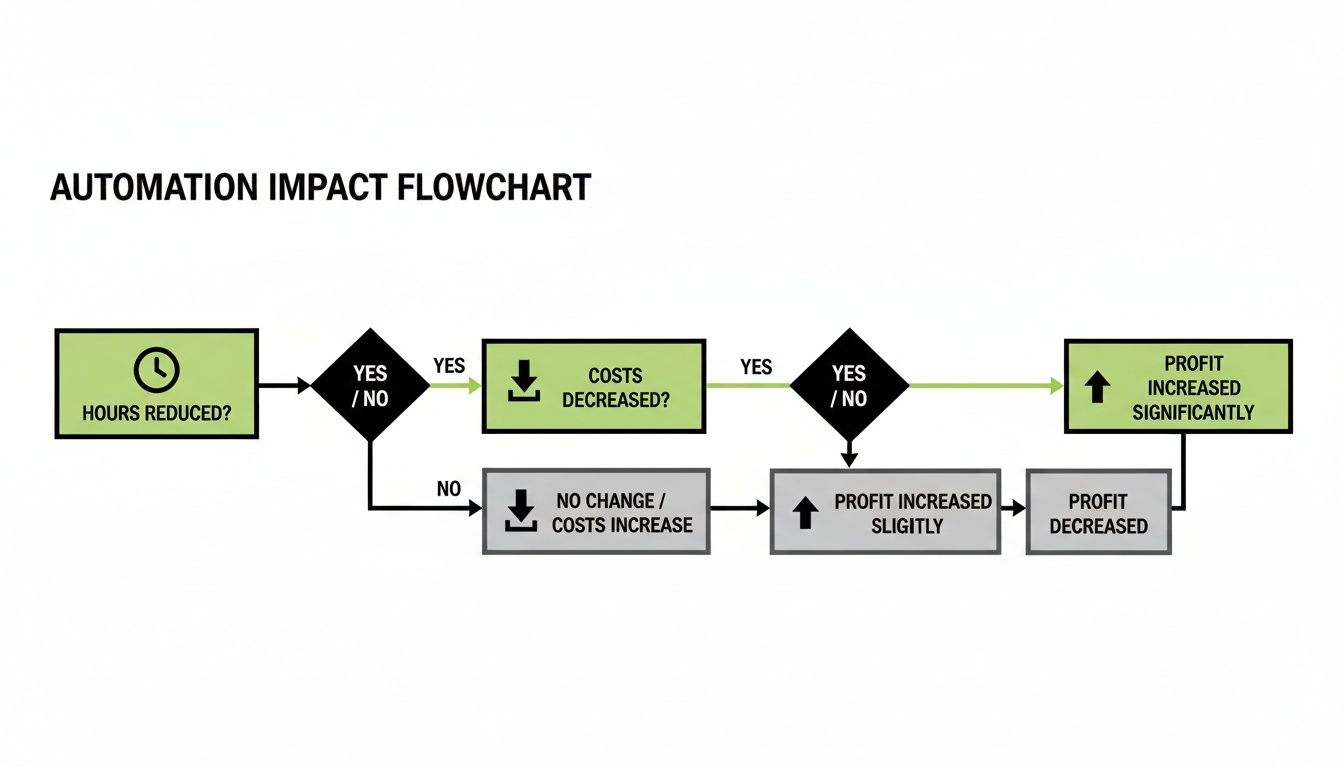
It’s clear: when you reduce the manual hours you pour into projects, your operating costs drop. That money goes directly to your bottom line, making every project more profitable.
A Few Lingering Questions on Agency Pricing
Figuring out pricing always brings up a few questions for both agencies and clients. Getting these sorted out early saves everyone headaches and is key to building partnerships that last.
Here are the questions that pop up most often.
How Do You Actually Stop Scope Creep?
Scope creep is a silent killer of agency profits. It starts with "just one more little thing" and ends with your team working weekends for free. The only solution is a strong contract and addressing it before it becomes a problem.
Your agreement needs to spell out exactly what's included: every deliverable, the number of revisions, and all other details. The second a client asks for something extra, you have to flag it immediately. It's not about being difficult; it's about explaining that the request is outside the current scope and sending over a simple change order with the added cost.
Protecting your agency isn't about saying no. It's about respecting your team's time and keeping the project profitable. Healthy client relationships are built on clear boundaries.
Is It Okay to Switch a Client to a New Pricing Model?
Yes, and you absolutely should when the time is right. As a client's business grows, their needs change. The key is to pitch the change as a direct result of their success.
For instance, a client who started with a small, one-off project might now be large enough that a monthly retainer would save them money and get them better results. You have to frame it as a win for them. Show them the data from your work together and explain how the new model delivers more value or makes their costs more predictable. It's a strategic upgrade, not just a price change.
What Makes a Good Pricing Agreement?
A fair deal is all about clarity and ensuring everyone wins. There should be no gray areas. Both you and the client should walk away from the table feeling like you received great value.
Any solid agreement has these points locked down:
- A Crystal-Clear List of Deliverables: No vague promises. What are you actually delivering?
- Success Metrics: How will you both know if this is working? Define the KPIs.
- Payment Terms: When are invoices sent? When are they due?
- Communication Plan: Set expectations for meetings, reports, and check-ins.
- An Exit Clause: Fair terms for how either party can end the partnership if needed.
Nailing these details upfront builds the trust you need for a partnership that goes the distance.
Ready to slash the time you spend on content production and boost your agency's profitability? Postbae is an AI agent that automatically generates professional, ready-to-post visual social media content, freeing up your team to focus on high-level strategy. See how it works at https://postbae.com.