A Guide to Automated Social Media Posting

Discover how automated social media posting can save you time, maintain consistency, and grow your brand. Learn the strategies and tools you need.
Think about your social media presence like a garden. You could go out every single day and water each plant by hand. It's a constant, time-consuming chore. Or, you could install a smart irrigation system that gives everything exactly what it needs, right on schedule.
Automated social media posting is that irrigation system for your brand.
It’s not about pumping out robotic, soulless content. It’s about being strategic—planning, creating, and scheduling your posts ahead of time. This flips social media management from a reactive, daily grind into a proactive, organized system. The real goal here is to build a consistent and active online presence without being chained to your phone 24/7.
The Two Sides of Modern Automation
Real, effective automation isn't just about scheduling. It actually covers two different—but equally critical—parts of the social media workflow: visual content creation and content distribution.
Automated Content Distribution: This is what most people think of. You use a scheduler to handle the publishing part. You create your posts, load them into a tool, and it fires them off at the perfect times you’ve picked. This keeps your feed active.
Automated Content Creation: Now, this is where things get really interesting. This layer of automation tackles the single biggest headache for most people: actually producing the content. We're talking about AI agents that generate the posts themselves. Some tools might just generate text captions, but more advanced platforms like Postbae autonomously create professional visual graphics—think multi-slide carousels, educational infographics, and listicles that are actually tailored to your industry.
When you combine both creation and distribution automation, you get a complete system. An AI agent generates high-quality visual posts, and a scheduler makes sure they get published consistently. It’s like having a powerful, hands-off social media engine working for you around the clock.
This isn't a futuristic concept; it's quickly becoming standard practice. Marketing departments everywhere have caught on, with about 83% using automation tools to manage their social media. The teams that adopt these systems see significant results, like an average engagement bump of 20-30% per post and cutting down the time spent on content by up to 30%.
For a deeper look at how to get the most out of these tools, check out these strategies for boosting your strategy with automated social media posting.
What's the Real Payoff of Automating Your Social Media?
Automating your social media isn't just about saving a few minutes here and there. It's about fundamentally changing how you work. It’s the difference between constantly feeling like you're drowning in a sea of daily posts and having a predictable growth engine humming in the background.
Forget the buzzwords. Let's talk about the four core advantages you get when you stop posting manually and start working smarter.
The Gift of Radical Time Savings
This is the one you feel immediately. The daily grind of creating, tweaking, and posting content is a massive time sink, especially for small business owners or marketing agencies. In fact, marketers report they can slash the time they spend creating content by up to 30% with the right tools.
This isn't just about being more efficient; it's about what you do with that reclaimed time. Instead of being tied to a design tool, you can finally focus on the tasks that actually grow your business.
Strategize Effectively: Step back, look at what’s working, and plan your content for the long term.
Engage Authentically: Spend your time in the comments and DMs, building real relationships with your followers.
Focus on Growth: Concentrate on sales, partnerships, and other high-impact business activities.
For instance, a tool like Postbae takes this even further by automating the visual creation itself. Its AI agent works autonomously in the background, creating professional graphics like educational carousels or myth-vs-fact posts. You end up with a steady stream of ready-to-post visuals, saving you from the "what do I post today?" headache. You can then fully edit these posts and schedule them with your preferred tool.
Building Unbreakable Consistency
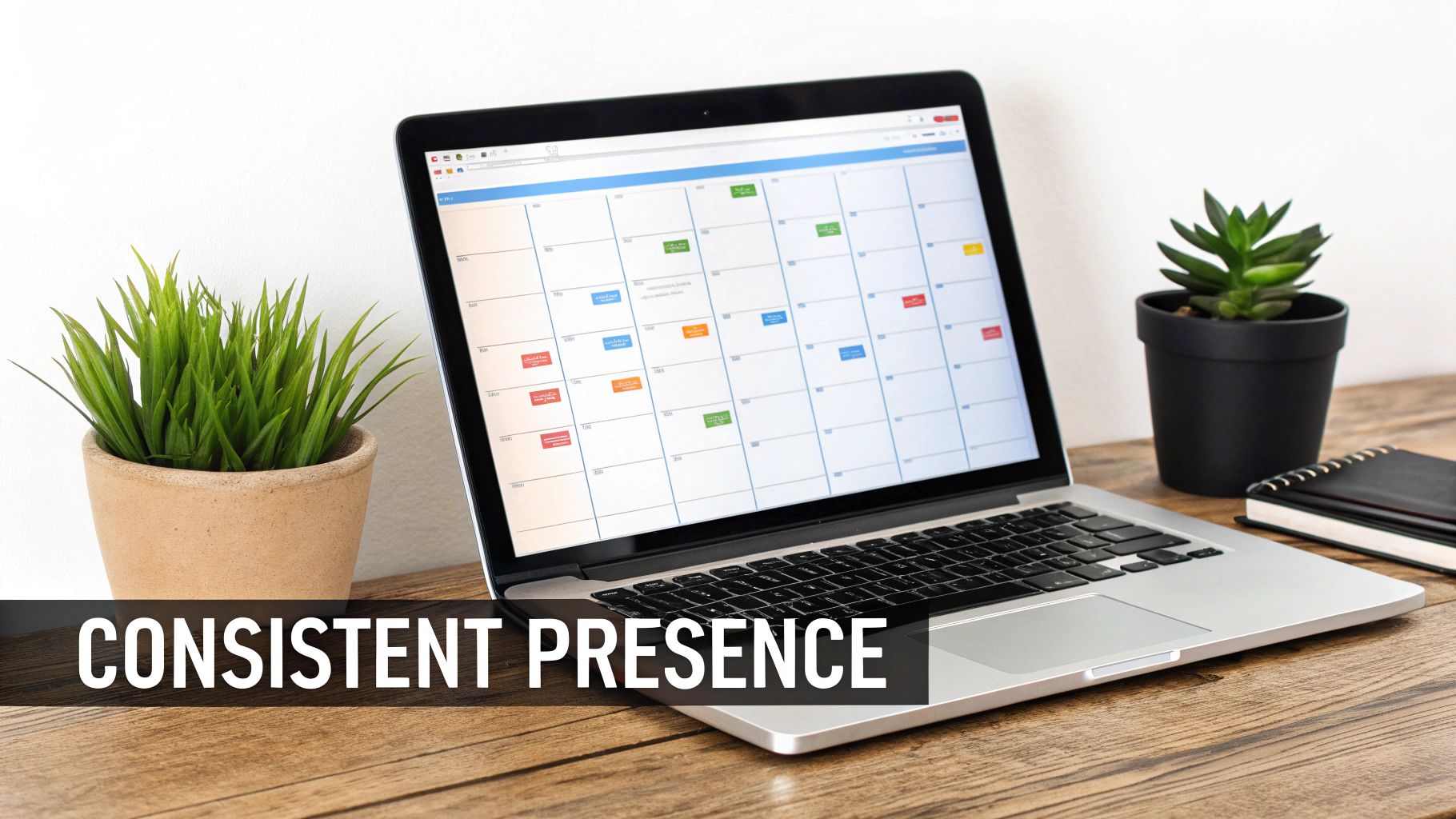
An "always-on" social media presence isn't just nice to have; it builds trust. When your audience knows you'll show up with valuable content every day, they're more likely to follow, engage, and remember you when they need what you're selling. Automation is your key to achieving this.
By preparing your content ahead of time, you guarantee your profiles stay active and engaging—even when you're busy, on vacation, or simply uninspired. This consistency signals reliability and professionalism to your audience.
An automated system ensures you hit your ideal posting cadence without fail. This consistency not only keeps you top-of-mind with your audience but also aligns with social media algorithms, which tend to favor active and reliable accounts.
Unlocking Effortless Scale
As your business grows, your social media to-do list expands. Juggling multiple platforms, rolling out new campaigns, or managing more clients can quickly become overwhelming. An automated workflow, however, is built to scale right alongside you.
Instead of your workload doubling with every new platform or client, your system can absorb the extra volume. You can manage multiple client accounts using the same core process you use for one. For agencies and social media managers, this is how you scale profitably without burning out your team.
Gaining a Clear Strategic Advantage
Finally, and this is the big one, automation pulls you out of reactive daily chaos and lets you think strategically. When you're not scrambling to find something to post right now, you can work in focused, productive bursts.
Plan Ahead: Think in terms of monthly or even quarterly content calendars.
Batch Your Work: Dedicate a block of time to creating or reviewing a week's worth of content. It’s infinitely more efficient.
Analyze Performance: With your content planned out, you can step back and analyze the data to make smarter decisions for the future.
This proactive approach turns your social media from a daily chore into a strategic asset that's aligned with your big-picture business goals.
Choosing the Right Social Media Automation Tools
Jumping into social media automation can feel overwhelming. The key is to understand that it's not about finding one magical tool that does everything. It's about building a "stack" of tools that solves your specific problems, from idea generation to publication.
Most tools fall into one of three main categories. Once you understand these, you can build a workflow that saves you time, keeps you consistent, and helps you grow without burnout.
Think of it like this: your tools form a production line. Each one handles a specific part of the process, turning manual work into a smooth system that gets results.
Schedulers and Publishers
This is the category everyone knows. Tools like Buffer and Hootsuite are the logistics managers of your social media. They handle the when and where of your content.
You feed them your finished posts, tell them when to go live, and they handle the rest. They’re perfect for:
Staying consistent across Instagram, Facebook, LinkedIn, and other platforms.
Posting at optimal times so your audience actually sees your content.
Managing multiple accounts from one dashboard, which is essential for agencies or anyone running more than one brand.
A scheduler is your distribution engine. It doesn't create anything, but it ensures your hard work gets seen at the right moment.
Content Curation Tools
Schedulers handle distribution, but what about when you have nothing to post? That’s where curation tools come in. They help you find interesting content from other people to share with your audience.
These tools scour the web for relevant articles, blog posts, and industry news that your followers will find useful. It's a quick way to fill gaps in your content calendar and position yourself as a go-to resource in your niche without having to create every single piece of content from scratch.
AI-Powered Visual Content Creators
This is where the process becomes truly automated. The first two categories help you manage and distribute content you already have. This third category tackles the biggest bottleneck: what to post in the first place.
Most tools still require you to manually design every single graphic before you can even think about scheduling it. That’s often the most time-consuming part of social media management.
This is where a tool like Postbae comes in. It's not a scheduler. It’s an autonomous AI agent designed to do one thing: fill your content library with professional visual social media posts.
Here’s how it slots into your workflow:
It autonomously generates visuals. Postbae works in the background, generating graphics tailored to your industry. You don't even have to write a prompt.
It provides content variety. It doesn't just make single images. Think multi-slide carousels, educational infographics, listicles, and myth-vs-fact posts—all designed to establish you as an expert.
You retain full control. The creation is automatic, but you can edit everything. Tweak the text, swap images, and change colors. You can fully customize every post to perfectly match your brand before sending it to your scheduler.
By automating the visual design process, Postbae feeds your scheduler with the high-quality assets it needs to do its job. It’s a completely different approach to content creation. To see how this fits into the bigger picture, check out this guide on picking the right social media content creation tool.
This is no longer just a "nice-to-have" feature. With digital ad spend projected to hit $276.7 billion by 2025, the internet is only getting more crowded. Having a reliable content engine is how you stand out. In fact, some studies show up to 50% of marketers now automate their social media management because they know it's the only way to keep up.
Comparing Social Media Automation Tool Categories
To make it even clearer, let's break down how these different tool types stack up against each other. Each one plays a unique role, and the best setups usually involve a mix of at least two categories.
| Tool Category | Primary Function | Key Use Case | Example Tools |
|---|---|---|---|
| Schedulers & Publishers | Post distribution and timing | Maintaining a consistent posting cadence across multiple social platforms. | Buffer, Hootsuite, Sprout Social |
| Content Curation Tools | Discovering third-party content | Finding relevant industry news and articles to share with your audience. | Feedly, Curata, BuzzSumo |
| AI-Powered Visual Content Creators | Autonomous visual asset generation | Automatically creating a library of ready-to-use graphics, carousels, and infographics. | Postbae |
Ultimately, the goal isn't just to automate for the sake of it. It’s about building a smart system where AI handles the heavy lifting (like visual design), schedulers manage the logistics, and you get to focus on the human parts of social media—like engaging with your community.
Building a Winning Automated Posting Strategy
A powerful tool without a smart strategy is just noise. Effective social media automation isn't about "set it and forget it." It’s about building a deliberate system where every single post serves a purpose, turning automation from a simple time-saver into a growth engine for your brand.
First things first, you need to anchor everything to specific, measurable goals. Are you trying to boost brand awareness, drive traffic to your website, generate leads, or build a community? Your answer here shapes every piece of content you create and schedule. Without a clear goal, you're just posting into the void.

Nail Down Your Audience and Content Pillars
Once you know your "why," you have to figure out your "who." Deeply understanding your target audience is non-negotiable. What are their pain points? What kind of content do they actually find valuable? When are they most active online? Answering these questions lets you stop guessing and start creating content that resonates.
With your audience in mind, you can build your core content pillars. Think of these as the main topics or themes your brand will consistently own. They're the foundational columns holding up your entire content strategy.
Educational Content: This is where you teach your audience something useful. Think tips, how-to guides, industry insights, or myth-busting infographics. This is how you build authority and trust.
Engaging Content: This content is designed to start a conversation. This includes polls, questions, behind-the-scenes glimpses, or featuring user-generated content. Its main job is to build a community that cares.
Promotional Content: This is important, but it should be used sparingly. This pillar includes posts about your products, services, sales, or special offers. The goal here is direct conversion.
A great rule of thumb is the 80/20 rule: 80% of your content should be educational or engaging (giving value), while only 20% should be promotional (asking for something). This balance keeps your audience from feeling like they're just being sold to all the time.
Build a Balanced Content Calendar
Okay, you've got your pillars. Now you need to organize everything into a content calendar. This is the command center for your entire automated posting strategy, giving you a clear view of what you're posting, where, and when.
This is much more than just a schedule; it's a strategic blueprint. It helps you visualize your content mix, making sure you have a healthy balance of different pillars across all your platforms. It also lets you plan for holidays, major events, or product launches well in advance, eliminating last-minute panic. For a deep dive on this, check out our guide to building a marketing content calendar.
Streamline Your Content Creation Workflow
The final piece of the puzzle is creating an efficient workflow to actually produce the content for your calendar. For most small businesses and agencies, this is the biggest bottleneck.
Batching is your best friend here. Instead of creating one post at a time, block off a chunk of time to create a week's or even a month's worth of content at once. This practice significantly improves focus and efficiency.
This is also where AI tools can seriously lighten the load. For example, an autonomous AI agent like Postbae can handle the heavy lifting of visual design. It works in the background, generating a steady stream of professional visual content—like slick multi-slide carousels or educational infographics—that fits your industry.
This allows you to batch your "creation" process by simply reviewing and customizing the graphics Postbae generates. Since you have full editing control, you can quickly tweak them to fit your brand's voice and then drop them right into your scheduler. It creates a seamless system: visual content is produced efficiently, planned strategically, and then distributed consistently through automation.
How to Keep Your Social Media Human
One of the biggest concerns about social media automation is that it will drain the personality from your brand. It’s a valid worry. Nobody wants to follow an account that feels like it’s run by a cold, distant robot.
The solution isn’t to avoid automation, but to use it intelligently. The best approach is a hybrid strategy that provides efficiency without sacrificing genuine, human connection.
Think of automation as the foundation of your social media presence. It handles the steady, reliable content—scheduling your weekly tips, educational carousels, and industry insights. This is what keeps your brand consistent, even when you're focused on other work.
Embrace the Hybrid Approach
The real magic happens when you build on that automated foundation with real-time, spontaneous engagement. Your scheduled posts keep the lights on, freeing you up to focus on the human interactions that actually build a community.
This hybrid model boils down to two key practices:
Automate the Predictable: Use automation for your core content pillars. These are the educational, authority-building posts that form the backbone of your strategy.
Handle Engagement Manually: Use the time you save to engage like a real person. This means replying to comments, personally answering your DMs, and participating in trending conversations relevant to your niche.
This approach gives you the best of both worlds. Your audience gets consistent value from your planned content, and they also get to interact with the real person behind the brand.
Review and Refine AI-Generated Content
AI is becoming a huge part of the modern workflow. By 2025, an estimated 65% of marketers plan to use AI for at least half of their social media posts. The challenge isn't just using these tools, but using them in a way that doesn’t sound generic, especially when audiences crave more authentic content. You can learn more about AI’s role in social media management and see how other marketers are adapting.
This brings us to the final, most critical step: review and refinement. Automation should be your starting point, not the final word.
Your unique brand voice, personality, and nuanced understanding of your audience are irreplaceable. Automation gives you speed and scale, but your human touch makes it resonate.
Take a tool like Postbae. It works as an AI agent to autonomously generate professional visual content, like multi-slide carousels and myth-vs-fact infographics, without requiring prompts. While this automates the heavy lifting of creating graphics, it keeps you in the driver's seat.
Postbae gives you full editing capabilities for every single visual it creates. This is where you inject your personality—tweak the messaging to match your tone, adjust the colors to fit your brand, and swap images to make it feel authentically you. This final review step transforms an efficient process into an authentic one, proving that automation and a human touch can—and absolutely should—work together.
Automating Your Visual Content Creation Process
For most people, the biggest challenge in social media isn't scheduling—it's the never-ending need to create high-quality visuals. Every. Single. Day.
This is where the real innovation in automated social media posting is happening now. It's a shift from just handling the publishing to tackling the production. While schedulers answer the "when," a new wave of AI tools is finally answering the "what," hitting the content creation bottleneck right where it hurts.

Beyond Scheduling to Autonomous Creation
Imagine an AI that doesn't just sit there waiting for you to upload a finished graphic. Instead, it actively works in the background, almost like a junior designer on your team. This is the whole idea behind an AI agent like Postbae, which is built to autonomously generate professional visual posts for you.
You don't start with a blank canvas and spend hours dragging and dropping elements. You give Postbae a simple, one-time setup—your industry, your brand style—and it works on its own.
It quietly produces a steady stream of ready-to-use visuals, like:
Multi-slide educational carousels that unpack complex ideas.
Myth-vs-fact infographics to bust industry misconceptions.
Visually sharp listicles and quick-tip graphics.
"Did-you-know" fact cards for sharing industry insights.
This isn't about replacing your scheduler. It's about feeding it. You get a constant supply of high-value visual posts that your scheduler can then push out, creating a complete and efficient workflow.
The real power here isn't just saving time; it's eliminating the most creatively draining part of the job. Instead of staring at a blank design tool, you get to spend your energy on strategy and engaging with your audience.
Who Is This For?
This kind of visual automation is ideal for small business owners, marketing agencies, and content creators who need to build authority in their space but don't have a dedicated design team. It solves the constant struggle of producing graphics that grab attention and build trust.
The best part? You're not trading quality for speed. An AI like Postbae generates content that feels native to your industry, not generic. Plus, it gives you full editing capabilities, so you always have the final say. You can tweak the words or adjust the design to make sure it perfectly matches your brand's unique voice. Our deep dive on AI social media content creation explores this in more detail.
And this is just for static visuals. If you're looking to branch out, other tools are doing the same for video. A good look at the best AI video generators can show you what's possible when you want to expand your content toolkit even further.
Got Questions About Automating Social Media? You're Not Alone.
Jumping into social media automation feels like a big step, and it's smart to have questions. Everyone does. Will it make you sound like a robot? Is it actually going to save time? Let’s tackle the big ones so you can move forward with confidence.
Will Automation Kill My Engagement?
Only if you use it improperly. This is the biggest fear, but it's totally avoidable.
Engagement only drops when people use automation as an excuse to “set it and forget it,” turning their profile into a broadcast-only channel. The professional approach is a hybrid one: automate the consistent, planned content (like your weekly tips or educational carousels) and use the time you save to engage with people manually.
Think about it. You’re freeing up hours you used to spend designing or scheduling so you can actually reply to comments, answer DMs, and join conversations. This strategy almost always boosts engagement, because you’re showing up consistently and you’re still there to be human.
What's the Difference Between a Scheduler and an AI Visual Creator?
This is a very important distinction, especially now. They perform two completely different jobs.
A scheduler (think Buffer or Hootsuite) is a distribution tool. Its only job is to publish content you’ve already made at a time you’ve already picked. It’s a delivery truck.
An AI visual creator like Postbae is a content creation tool. Its job is to produce the actual visuals—the graphics, carousels, and infographics—for you. It’s the factory that makes the products the truck delivers.
So, you’d use something like Postbae's AI agent to autonomously create a slick, multi-slide carousel. Then, you'd either post it yourself or load it into a scheduler to go live next Tuesday at 10 AM. One makes the content, the other posts it.
What's a Good Balance Between Automated and Manual Posts?
A solid rule of thumb to start with is the 80/20 rule. It’s an effective recipe for a feed that feels both reliable and authentic.
Plan to prepare about 80% of your posts in advance. This is your core content—the educational material, the evergreen tips, the value pillars that build your authority. This is your foundation.
Then, save the other 20% for manual, in-the-moment content. This is where you share behind-the-scenes stories, react to breaking news in your industry, or feature great user-generated content. It keeps spontaneity alive.
Is Social Media Automation a Good Fit for My Small Business?
Yes, it’s practically made for small businesses.
Solopreneurs, startups, and creators are almost always short on two things: time and design resources. Automation isn't just a convenience; it's a massive equalizer. It lets you maintain a professional, active presence that can compete with larger brands—without needing a big team or extensive design skills.
Tools that automate the visual creation process are especially valuable for small businesses. They directly address the design bottleneck that prevents so many entrepreneurs from posting the kind of high-quality, authority-building content they know they should be.
Ready to stop staring at a blank canvas wondering what to post? Postbae is an AI agent that works autonomously to create a nonstop stream of professional, on-brand visual posts for you. Eliminate the design work and build your authority on autopilot. Start automating your visual content with Postbae.