A Guide to Social Media Content Creation Tools

Discover the right social media content creation tool for your brand. This guide covers key features, AI automation, and how to choose the best option.
What exactly is a social media content creation tool?
Stripped of marketing jargon, it's a platform designed to help you create content that looks and sounds like your brand. The primary goal is to make the daily task of managing social media feeds faster and easier, transforming a relentless chore into a manageable strategy.
What Do These Tools Actually Do?
A good content tool acts as your creative sidekick. It’s built to solve one of the biggest challenges for any modern business: the never-ending need for fresh, professional-looking content to post online.
If you're a small business owner, part of a marketing agency, or a solo content creator, you know the difficulty. Pumping out high-quality content day after day without a large in-house design team can feel overwhelming. These tools are meant to bridge that gap.
But not all tools are created equal. The market is fragmented. You have manual design platforms, which are great if you have the time and design skills to adjust every detail. Then there are AI writing assistants, which are excellent for generating captions but cannot create the visuals for you.
This is where a new category is emerging: autonomous AI agents. These are not just assistants; they function more like production partners. Advanced systems like Postbae are focused on automating the creation of the visual content itself.
From Helper to Creator: The Role of Automation
Instead of just providing templates, an autonomous agent does the heavy lifting for you. It can generate complete, ready-to-post visual graphics from scratch. This includes content like:
- Multi-slide educational carousels
- Eye-catching listicle graphics
- Myth-vs-fact style infographic posts
- Tips and tricks visual posts
This represents a significant shift—moving from tools that help you create to tools that create for you. It’s what the market has been demanding. The digital content creation space is growing rapidly, expanding from $32.28 billion to $36.38 billion in just the last year.
Analysts project it will reach $69.80 billion by 2030, with software tools commanding 73.1% of that revenue. You can explore the full data on the digital content creation market to see the scale of this trend.
That growth is a clear signal. It shows how much businesses are relying on tools to stay efficient and maintain a powerful, authoritative voice online without burning out.
What To Actually Look For in a Content Creation Tool
When you're evaluating a social media tool, the features list can be filled with technical jargon. The real question isn't what the features are, but what they allow you to do. The best tools go beyond letting you place text on an image; they're built to save you time, keep your brand looking sharp, and help you produce great content consistently.
This space is expanding quickly. Currently, the market for these tools is valued at USD 7.6 billion and is on track to reach USD 29.5 billion by 2035. What’s driving this growth? Mostly small and medium-sized businesses, which are set to account for 61.8% of the market's revenue. They need powerful, efficient ways to get their message out. You can get more details on the growth of the SME market segment if you're interested in the specifics.
This high demand is pushing developers to build smarter tools. When you're choosing one, knowing the essential features of tools like Postflow is key to making a good decision.
The Non-Negotiable Creative Features
First, any tool worth considering must master the basics of design and branding. These are the fundamentals for looking professional and consistent online.
- A Strong Template Library: You need access to a wide range of professionally designed templates. This is a significant time-saver, providing a solid starting point for everything from infographics to announcements instead of starting from a blank canvas.
- Deep Customization: Templates are a great start, but you need to be able to modify them to fit your brand. Full control over fonts, colors, layouts, and images is crucial to ensure your content reflects your brand, not the tool's.
- Brand Kits: This feature is incredibly useful. A good tool will let you save your brand's logos, color palettes, and specific fonts in one place. It makes designing much faster and guarantees every post is on-brand, regardless of who on your team creates it.
Where AI Truly Makes a Difference
This is where things get interesting. The term "AI-powered" is used everywhere, but its meaning varies. Some tools offer AI assistants that suggest a headline or a caption, which is helpful but not transformative. Others require you to write a detailed text prompt to get a basic image back, which can feel like another task.
A new wave of AI is completely different. We're talking about autonomous AI agents that don't just "help"—they do the heavy lifting for you, from start to finish.
This is a major shift in how content is produced. An autonomous AI agent, like the one in Postbae, works in the background without needing you to provide prompts. It learns about your industry, identifies high-performing content types, and then automatically generates entire visual graphics for you—think multi-slide educational carousels or myth-vs-fact posts, completely done.
And the best part? You remain in control. The agent handles the production work, but every single post it creates is fully editable. This isn't just about a tool that helps you create; it's about a tool that creates for you.
Comparing Different Types of Content Creation Tools
Not all social media content creation tools are the same. The market is filled with platforms, and if you’re not careful, you might end up with multiple subscriptions that don’t solve your core problem: producing a steady stream of quality content.
Let's clarify the options. Most tools fall into a few distinct categories. Identifying your biggest bottleneck—whether it’s design, writing, or publishing—will help you find the right solution.
Manual Design Platforms
These are your digital canvases, the original graphic design tools. Think of platforms like Canva or Adobe Express. You get a blank canvas (or a template) and complete control over every pixel. You manually drag, drop, resize, and recolor everything to build your visuals.
This is great if you have a dedicated designer or enjoy the creative process. However, it is a significant time commitment. Every post requires you to find assets, adjust layouts, write copy, and meticulously check for brand consistency. It’s hands-on, which means it’s slow.
AI Writing Assistants
Next are the AI wordsmiths like Jasper or Copy.ai. These tools are fantastic for overcoming writer's block. Need ten different caption ideas in thirty seconds? Done. How about a blog post draft or some ad copy? They can handle it.
But there's a limitation: they only handle the text. An AI writer won't create the eye-catching carousel or the slick infographic that stops the scroll on Instagram or LinkedIn. You still have to take that well-crafted copy and put it into a separate design tool.
Social Media Schedulers
Schedulers are the logistics managers of your content. Tools like Buffer or Later are excellent at one thing: publishing your finished content at the right time. You can load up your queue for the week or month, and they’ll handle the rest.
They are essential for maintaining consistency. But a scheduler is just that—a scheduler. It doesn't create anything. You still have to produce all your graphics and write all your captions before you can schedule them.
To make sense of these different functions, here’s a quick breakdown of how these tool types compare.
Comparison of Social Media Content Creation Tool Types
| Tool Category | Primary Function | Workflow | Best For |
|---|---|---|---|
| Manual Design Platforms | Hands-on graphic creation | Start from scratch or template; manually design each post | Designers and teams with ample time and creative resources |
| AI Writing Assistants | Text and copy generation | Generate captions and drafts; requires separate design tool | Marketers and creators looking to overcome writer's block |
| Social Media Schedulers | Automated content publishing | Upload finished content and schedule it for later publication | Anyone managing a content calendar who needs to post consistently |
| Automated Visual Agents | Autonomous visual post generation | AI creates ready-to-post graphics; user reviews and edits | Small teams and agencies needing high-quality visuals without the manual work |
This table highlights the gaps in the typical workflow. You either create the visuals manually, write the copy separately, or just schedule what you already have. But what if one tool could handle the hardest part for you?
This is where the evolution of AI in content creation becomes compelling. We're moving past simple assistants.
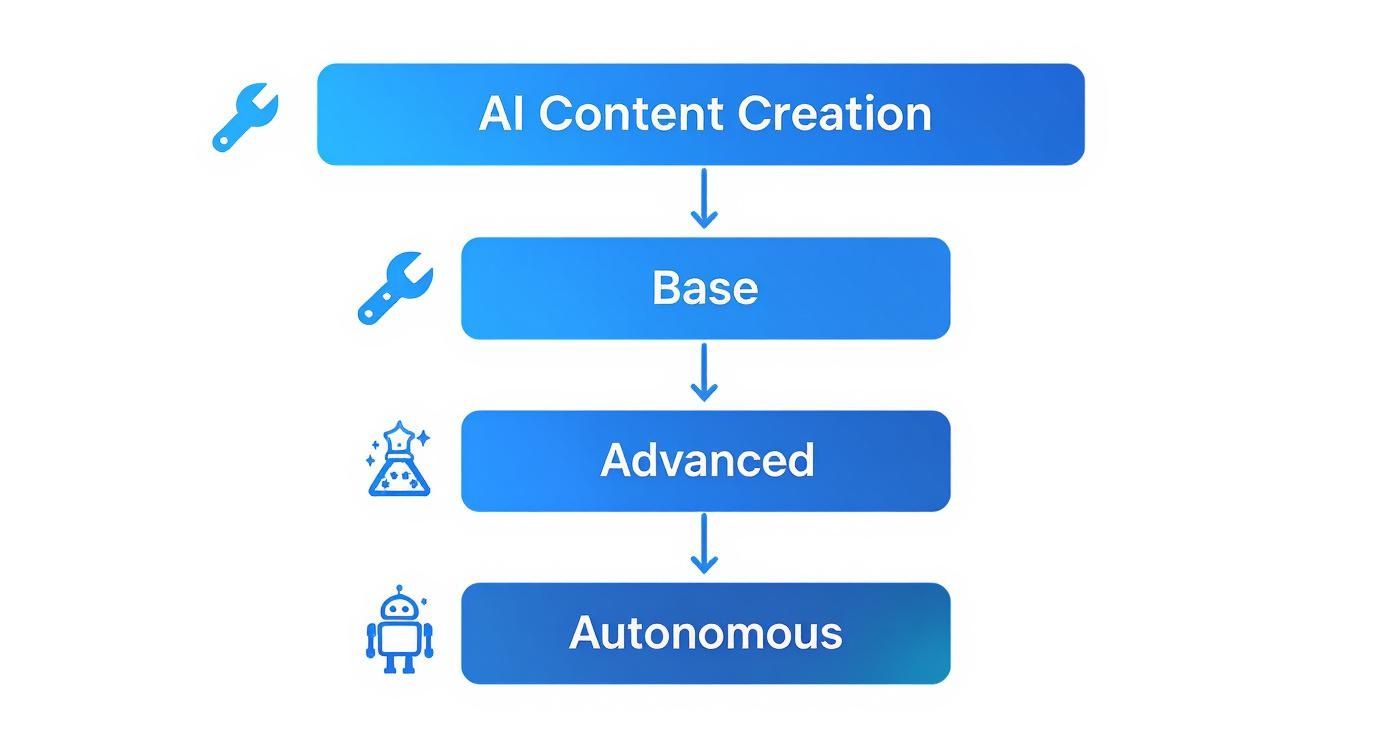
The diagram shows a clear progression. The most sophisticated tools aren't just helping you do the work—they're doing the heavy lifting for you.
Automated Visual Content Agents
This is the newest category, and it addresses a major pain point. An automated visual content agent, like Postbae, is built to eliminate the design bottleneck. Instead of giving you a canvas and a toolbox, it autonomously generates entire, professional-looking visual posts for you.
The key difference is this: these tools don't just suggest ideas. They produce the final product—multi-slide carousels, data-driven infographics, engaging listicles—without you having to do any manual design work or even provide text prompts.
The AI works in the background, creating industry-specific visual content that’s ready for you to review and approve. Of course, everything it generates is fully editable and customizable, but that initial, time-consuming creation process is completely automated.
This fills a massive need for small businesses, solopreneurs, and marketing agencies that require a steady stream of high-quality visuals but lack the time or design expertise to produce them consistently.
How AI Is Automating Visual Content Creation
AI for social media has evolved far beyond generating captions. We are now in an era where AI is fundamentally changing how visual content is made, transforming your social media content creation tool from a simple helper into a creative partner that handles the production for you.
This is a significant shift, especially considering the creator economy. That market is projected to reach USD 1,143 billion by 2034, growing at a compound annual rate of 25.6%. What’s driving that growth? Tools that allow creators and small teams to produce high-quality work efficiently. For small businesses, this means accessing design capabilities that were previously only available to large corporate marketing departments.
Beyond Prompts to Full Autonomy
Imagine an AI that doesn't just wait for you to tell it what to do. Instead, it learns your industry, identifies trending content formats, and then designs professional graphics filled with relevant information—all on its own. That's the difference with an autonomous AI agent like Postbae.
This type of system works in the background, producing high-value visual content tailored to your business. It specializes in authority-building content that educates and engages your audience, such as:
- Multi-slide carousels that break down complex topics.
- Myth-vs-fact infographics to clarify common misconceptions in your niche.
- Educational listicles with a unique graphic for each point.
- "Did you know?" fact cards that deliver quick, memorable insights.
This isn't about replacing creativity; it's about eliminating the repetitive tasks of content production. It frees you up to focus on strategy and audience engagement while the tool manages the day-to-day visual creation.
Automation Without Sacrificing Control
A common concern with automation is losing control. No one wants their social media to look generic or robotic. The best tools are designed to give you the final say. While an agent like Postbae handles the initial creation, every single element of the posts it generates is fully editable and customizable.
This is the key distinction: The AI acts as an efficient production assistant, not the final creative director. You can still tweak the copy, swap images, adjust colors to match your brand guide, and modify layouts until every post feels 100% you.
This combination of autonomous creation and complete user control is highly effective. It gives small businesses the output of a full-time design team for a fraction of the cost. A professional, consistent online presence is now more accessible than ever.
If you're looking to explore what's available, reviewing the best AI content creation tools can provide a good overview. For a deeper understanding of how this technology works, our guide on AI for social media content creation is a great resource.
How to Choose the Right Tool for Your Business
Selecting the best social media tool isn't about finding the one with the most features; it’s about finding the one that solves your biggest problem. The "best" tool is different for everyone, so let's determine what you actually need.
Start with the basics. What is your monthly budget? How large is your team, and what are their design capabilities? Answering these questions will help narrow down the options and prevent you from investing in an overly complex tool you won't use.
Pinpoint Your Primary Bottleneck
Now for the most important question: what is your primary content goal? What is the one task that consumes the most time or causes the most frustration? Is it writing witty captions, or is it the time-consuming process of designing professional-looking graphics every day?
Be honest with yourself here. Where does your workflow break down? If captions are your main challenge, an AI writer might be the solution. But if your team is spending hours in design software only to produce average visuals, a text generator won't solve your real problem.
Your biggest pain point determines your best solution. If producing a consistent stream of high-quality visual content is your main struggle, then an automated visual creation agent is the most logical and impactful choice.
For many small businesses and agencies, the visual side of content creation consumes the most time and slows momentum. This is exactly where a tool like Postbae can help. It was built specifically for teams whose main bottleneck is producing graphics like multi-slide carousels, listicles, and educational infographics.
By autonomously generating these visual posts for you, it delivers the impact of a full-time social media designer for just $30 per month. This makes it possible to build an authoritative, professional presence on platforms like Instagram and LinkedIn without a large budget. Once your visuals are handled, you can focus on strategy and community engagement. For more on that, check out our guide on how to measure social media engagement.
Putting Your New Tool into Action
Choosing a new social media tool isn't about getting the most features. It’s about solving a specific problem that is consuming your time.
Perhaps you're constantly fighting the clock, your design skills aren't where you want them to be, or you’re running out of fresh ideas. The right tool is the one that directly addresses your biggest bottleneck.
So far, we've covered the entire landscape. Manual design platforms like Canva offer total creative freedom but demand a significant time investment. AI writers are great for creating captions but can't produce the visual post for you. And schedulers are just the final step—you still need to bring the finished content.
What to Do When Visuals Are the Problem
For many small businesses, agencies, and solo creators, the most persistent challenge is the demand for a constant stream of professional-looking visuals. This is where an autonomous AI agent becomes more than a convenience; it's a logical solution.
If your main struggle is producing high-quality graphics—like educational carousels, myth-vs-fact posts, or sharp infographics—then a tool that automates that specific task will provide the most value.
An autonomous agent fundamentally changes your workflow. Instead of manually creating every single post from scratch, you're reviewing and approving a ready-made flow of professional designs. That shift alone can free up hours every week.
"Automated" does not mean robotic or off-brand. A modern tool like Postbae generates industry-specific visual posts on autopilot, but every graphic is fully editable and customizable. You never lose creative control. It's your brand, your final decision. Want to learn more? Check out our guide on how to create social media content.
By delegating the demanding design work, you can focus your energy on activities that grow your business—engaging with your audience, building a community, and making connections. It's time to see how an autonomous AI agent can give you back your time.
Got Questions? Let's Talk.
We understand. When you hear "AI content creation," several questions might come to mind. Let's address some of the most common ones.
Creation Tools vs. Schedulers
What's the difference between a content creation tool and a social media scheduler?
They are two different specialists on the same marketing team.
A creation tool, like Postbae, is your in-house visual producer. Its primary job is to create the actual content you post—the graphics, multi-slide carousels, and educational infographics that capture attention.
A scheduler, on the other hand, is the project manager. It takes the finished graphics and handles the logistics—publishing them to your accounts at the optimal time. Schedulers are focused on distribution, not creation.
The Role of AI in Design
Does this mean AI is going to replace human designers?
Not at all. A common misconception is that AI is a replacement for creativity. In reality, it acts as a powerful force multiplier for your creative team.
An autonomous AI agent can handle repetitive design tasks, like creating multiple versions of a "tip of the day" post or laying out a 7-slide listicle. This is production work that can consume hours.
This frees up your human designers to focus on high-level strategy, brainstorm original brand campaigns, and perform complex creative work that requires a human touch. The AI manages the production line, while the designer directs the creative vision.
User Control Over AI Content
How much control do I have over what the AI generates?
You have complete control. This is not a black box where you simply hope for the best.
While the AI automates the initial creation of a visual post, every single element is under your command. You can edit the text, swap images, change colors, and adjust the layout until it's perfect. The AI provides a significant head start, but you always have the final say to ensure it is 100% on-brand.
Industry-Specific Content Creation
Can these tools create content that's relevant to my niche industry?
Yes. This is where modern AI excels. The advanced agents in a tool like Postbae are trained on diverse sets of industry data, which allows them to understand the specific language, trends, and visual styles of different sectors.
So whether you're in real estate, SaaS, or wellness, the AI can generate high-quality visual content that speaks the language of your audience. It helps you sound less like a generalist and more like the go-to authority in your field.
Ready to stop spending hours on manual design work? See how Postbae can autonomously generate professional, industry-specific visual content for your business.