A Guide to Outsourcing Social Media Management

Thinking about outsourcing social media management? This guide covers the pros, cons, costs, and how to choose the right partner for your business.
So, what does "outsourcing social media management" actually mean?
Put simply, it's the decision to bring in outside help—whether that's a person, a team, or even a specialized tool—to run your social media. It's about handing off tasks like content creation, strategy, and community management so you can get back to what you do best: running your business. The end game is to get better results than you could ever manage alone with limited time and resources.
Why Smart Businesses Outsource Social Media

Keeping up with social media feels like a full-time job because, well, it is one. For any growing business, the constant grind of creating fresh content, engaging with your audience, and staying on top of trends can pull your focus away from core operations. This is exactly why outsourcing social media has evolved from a simple cost-cutting trick into a powerful strategy for growth.
Today, there’s a whole ecosystem of solutions out there, with something for every budget and need. You can go a few different routes:
- Full-Service Agencies: These teams handle everything from high-level strategy to the day-to-day posting.
- Skilled Freelancers: Perfect for when you need specialized expertise, like a killer copywriter or a savvy ads manager.
- Innovative AI Agents: These tools can automate the most time-consuming tasks, like creating professional visual content on autopilot.
The Strategic Advantage of Outsourcing
One of the biggest wins is gaining access to an expert-crafted, effective social media marketing strategy built for growth. Instead of guessing what might work, you're partnering with professionals who live and breathe social media trends, algorithm updates, and content best practices.
This isn't just a niche trend; it's a massive market. The global social media management outsourcing market hit USD 7.26 billion in 2024 and is on track to explode to USD 22.75 billion by 2034. That rapid growth just goes to show how much value businesses are placing on professional social media support.
By handing over these responsibilities, you free up your internal team to laser-focus on product development, customer service, and the million other things that only you can do. It’s about getting superior marketing results without the headache and overhead of hiring, training, and managing an in-house team.
Weighing the Benefits and Potential Drawbacks

Handing over the keys to your social media accounts is a big move. It’s not just about offloading tasks; it’s a strategic decision that can free up your time and seriously fuel growth.
However, it's not a one-size-fits-all solution. To do it right, you need to go in with your eyes wide open, understanding both the incredible upsides and the potential headaches. Getting this balance right is the difference between a productive partnership and a frustrating experience.
The Advantages of Outsourcing
So, what’s the big appeal? Why do so many businesses choose to bring in outside help? It usually boils down to a few powerful benefits that you feel almost immediately.
- Access to Specialized Expertise: You're not just hiring someone to post for you. You’re getting a whole team's worth of skills—strategists, copywriters, designers, and data analysts who live and breathe this stuff. They’re already on top of the latest algorithm changes and content trends so you don’t have to be.
- Significant Time Savings: This is the big one for most founders and marketers. Imagine getting all those hours back that you used to spend brainstorming content, creating graphics, and replying to DMs. That’s time you can pour back into product development, sales, or just running your business.
- Cost-Effectiveness: Hiring a full-time, in-house social media manager is expensive. You've got salary, benefits, payroll taxes, plus the cost of software and training. Outsourcing often gives you access to a wider range of skills for less than the cost of a single senior hire.
- Improved Content Quality: A professional team has the tools and talent to create a steady stream of high-quality, on-brand content. This isn't just about looking good; it's about building a professional presence that your audience trusts.
Key Insight: Outsourcing isn't just about delegation; it's about upgrading your capabilities. You're not just offloading work—you're importing a specialized skillset that can directly drive business growth and build your brand authority.
Potential Challenges to Consider
Of course, it's not all sunshine and viral posts. Bringing an external partner into the fold comes with its own set of hurdles you need to be prepared for.
One of the most common worries is losing your authentic brand voice. Can an outsider really sound like you? It's a valid concern. If they don't take the time to deeply understand your company's personality, values, and quirky way of talking, your posts can end up feeling generic or, worse, completely off-brand.
Communication can also be a sticking point. You need a rock-solid process for approving content, giving feedback, and reviewing performance reports. Without a clear system, wires get crossed, deadlines get missed, and frustration builds.
Finally, there’s data security. You’re granting someone access to your company’s social accounts, which is a big deal. A reputable agency or freelancer will have clear security protocols, but it’s something you absolutely need to discuss and feel comfortable with before signing anything.
Pros vs. Cons of Outsourcing Social Media
To make it simple, let's break down the core trade-offs. Weighing these points against your specific business needs will help you see if outsourcing is the right move for you.
| Benefit | Potential Drawback |
|---|---|
| Instantly gain a team of experts with diverse skills. | Risk of a generic or inconsistent brand voice. |
| Frees up significant time for core business activities. | Can be challenging to manage communication and workflows. |
| More cost-effective than hiring a full-time employee. | Potential data security risks if not managed properly. |
| Access to professional tools and analytics software. | Less direct control over day-to-day social activities. |
| Scalable support—easy to increase or decrease efforts. | Partner may not have deep, niche industry knowledge. |
| Objective, outside perspective on your strategy. | Onboarding takes time and effort to get them up to speed. |
Thinking about these challenges ahead of time isn't meant to scare you off. In fact, it's the opposite. By anticipating these potential issues, you can ask the right questions, set clear expectations, and build a much stronger, more successful partnership from day one.
What Social Media Tasks Should You Outsource?
Deciding to bring in help for your social media doesn't mean you have to hand over the keys to the entire kingdom. In fact, the most successful setups are often hybrids—you delegate the tasks that are either eating up your time or require a special skill set, while keeping the core voice and final say in-house.
This approach lets you reclaim hours of your week without that nagging feeling of losing control. The trick is to get brutally honest about what activities are draining your resources and which ones could truly benefit from an expert's touch. By breaking it all down, you can build an outsourcing plan that fits your business perfectly.
Strategic and High-Level Planning
These are the big-picture tasks, the foundation of your entire social media presence. They take serious research and expertise to get right, which is exactly why they're perfect candidates for outsourcing. An outside perspective here can be invaluable.
- Content Strategy and Calendar Planning: An external partner can dive deep into your audience analytics, see what your competitors are doing right (and wrong), and build a content calendar that's more than just random posts. This ensures everything you publish is consistent, purposeful, and actually moving you toward your bigger marketing goals.
- Performance Reporting and Analytics: Staring at a spreadsheet full of metrics can feel like trying to read another language. Outsourcing this gives you access to someone who not only speaks that language but can translate it for you. They'll tell you what's working, what's a waste of money, and deliver clear reports that guide your next moves.
Daily and Repetitive Tasks
This is the nitty-gritty, the day-to-day work that keeps your channels alive and kicking. While it's all essential, it's also incredibly time-consuming. These tasks are prime for delegation.
Outsourcing the daily grind is often the first step businesses take. It frees up your team from reactive, in-the-weeds work, allowing them to focus on bigger, revenue-generating projects.
Some of the most commonly outsourced daily tasks include:
- Community Management and Engagement: This is all about responding to comments, answering DMs, and actively engaging with your followers. An outsourced manager can be your brand's eyes and ears, making sure your community feels heard and valued—often around the clock. This is how you build loyalty.
- Content Scheduling and Publishing: It sounds simple, but managing a consistent posting schedule across multiple platforms requires meticulous organization. Handing this off means your content goes live at the perfect time, every time, without you ever having to think about it.
Specialized and Creative Functions
Some parts of social media require specific creative or technical skills that most small businesses just don't have in-house. These are high-value functions where a seasoned professional can deliver polished results far more efficiently than you could internally.
A huge one here is visual content creation. We're talking about everything from designing sharp single-image graphics and infographics to multi-slide carousels. Instead of wrestling with design tools for hours, you can hand it off to a specialist who pumps out a steady stream of professional, on-brand visuals. To get a better sense of this, you can learn more about the full scope of a social media manager's responsibilities and how they tackle these creative jobs.
Another key area is paid ad campaign management. Running effective social media ads is a science. It involves nailing audience targeting, optimizing budgets, and constantly A/B testing—a complex process that's best left to someone who lives and breathes this stuff daily.
How to Choose Your Outsourcing Partner
Picking the right partner is hands-down the most important decision you'll make when you outsource your social media. This choice dictates everything from the quality of your content to the results you see in your analytics. It's a big deal.
Today, you’ve got three main types of help to choose from: full-service agencies, specialized freelancers, and a new breed of AI agents. Understanding the difference is key.
You don't have to go all-in on just one, either. Many brands mix and match, building a custom "stack" of services that fits their budget, workflow, and goals perfectly. Let's break down the options.
Full-Service Agencies
Think of a social media agency as an entire marketing department you can rent. They bring a whole team to the table—strategists, copywriters, designers, ad specialists, you name it. It's a comprehensive, all-in-one approach.
This is the go-to option for established businesses that want a truly hands-off solution and have the budget for it. If you need complex campaigns run across multiple platforms and want a polished, cohesive presence without lifting a finger, an agency is your answer.
Independent Freelancers
Hiring a freelancer is a more flexible and often much more affordable route. They usually specialize in one or two key areas, like copywriting, community management, or running paid ad campaigns.
This makes them perfect for startups and small businesses. Got a solid strategy but your content visuals are lacking? Hire a freelance designer. Need someone to handle DMs and comments? A community manager is your person. Freelancers let you plug specific skill gaps in your team without the hefty price tag of a full agency retainer.
The Modern AI Agent Model
A new player has entered the game, blending smart automation with high-quality creative work. AI agents like Postbae have emerged to tackle one of the biggest, most time-consuming parts of social media: visual content creation.
Unlike a human who needs briefs and feedback, Postbae's AI agent works autonomously in the background to generate professional-grade visual posts for your brand. It specializes in creating authority-building educational content like carousels, infographics, and industry tips—all without you having to type a single prompt. Because every post it generates is fully editable, you always have the final say and maintain complete creative control.
Key Takeaway: An AI agent is the perfect sidekick for a human manager or agency. It automates the demanding work of visual design, freeing up your strategic partner to focus on the tasks that really move the needle: engagement, strategy, and growth.
This little decision tree can help you figure out where your time is really going and which tasks are ripe for outsourcing.
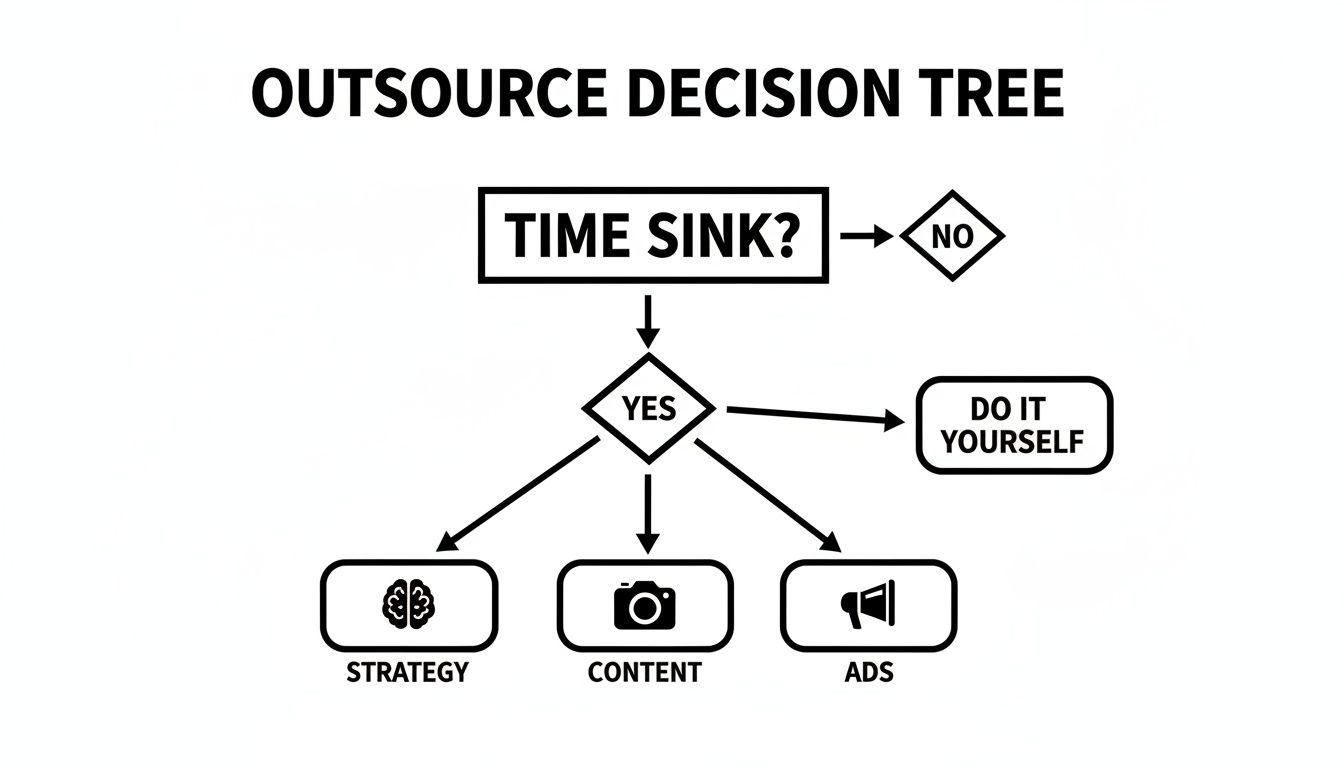
As the chart shows, content, strategy, and ads are typically where outsourcing delivers the biggest bang for your buck in time saved. For agencies trying to grow, learning about white label social media services can be a powerful way to offer more to clients without ballooning your payroll.
By combining these different models, you can build a social media machine that’s powerful, efficient, and ready to scale.
How to Budget and Measure Your ROI
Let's talk money. Shifting the conversation from cost to value is the key to getting outsourcing right. It's easy to get fixated on the monthly invoice, but the real measure of success is the return you get on that investment.
Figuring out what to spend—and what you should expect in return—is where strategy meets reality.
The price tag on outsourcing can swing wildly depending on who you hire. A freelance social media manager might run you anywhere from $500 to $2,500+ a month for part-time help. A full-service agency, on the other hand, typically starts around $3,000 per month and can climb much higher, which reflects their team-based approach and broader scope.
Then you have specialized AI tools. An AI agent like Postbae, which automates the heavy lifting of creating professional visual content, offers remarkable value at just $30/month. This allows you to handle one of the most time-consuming creative tasks for a tiny fraction of what a human designer would cost, freeing up your budget for things like strategy or community management.
Moving Beyond Cost to Track True ROI
Measuring success isn't just about counting likes and followers. True ROI is tied directly to your business goals, and understanding how social media contributes is essential for proving marketing ROI from your efforts.
To get a real sense of the value you're getting, start by tracking a few key performance indicators (KPIs) that connect social media activity to tangible business outcomes.
- Engagement Rate: This metric (likes, comments, and shares divided by followers) is a fantastic pulse check. It tells you how well your content is actually connecting with your audience. High engagement is a great leading indicator of brand loyalty.
- Website Referral Traffic: Jump into your web analytics and see how many visitors are clicking through from your social channels. This directly measures social media's power to drive people to your digital storefront.
- Leads Generated: Keep an eye on how many people fill out contact forms, sign up for your newsletter, or download a resource they found through your social profiles. This KPI bridges the gap between social activity and your sales funnel.
- Conversion Rate: This is the big one—the ultimate measure of ROI. It tracks how many of those leads from social media actually turn into paying customers.
Research shows that businesses see an average 22% jump in brand engagement and website traffic within just six months of outsourcing social media. This really highlights the direct impact professional management can have on your bottom line.
By focusing on these metrics, you build a clear business case for your investment. Suddenly, social media isn't just a "nice-to-have" expense—it's a measurable growth engine for your company.
If you really want to get into the details on this, check out our deep-dive guide on how to measure content marketing ROI.
Setting Your New Partner Up for Success

Choosing the right partner is only half the battle. How you bring them into your world determines whether the relationship thrives or fizzles out. A rushed or vague onboarding process is a recipe for mismatched expectations and off-brand content.
Think of a structured onboarding process as a compass. It ensures your new partner understands your brand from the inside out. This initial investment of time builds a foundation of clarity and prevents misunderstandings before they can even start.
Building Your Onboarding Checklist
Treat the first few weeks as a knowledge transfer. Your goal is to give your new partner everything they need to become a true extension of your team. This means providing both the tools and the context to do their job right.
An effective onboarding should always include these core components:
- A Comprehensive Brand Guide: This is non-negotiable. Your guide should detail your brand voice, tone, visual identity (colors, fonts), and key messaging. Include examples of on-brand and off-brand content to make the guidelines crystal clear.
- Clear Goals and KPIs: Don't make them guess what success looks like. Define your primary social media objectives—whether it's increasing website traffic, generating leads, or boosting engagement—and the specific key performance indicators you'll use to measure progress.
- Secure Access to Tools: Grant necessary access to your social media accounts, analytics platforms, and any other software they'll need. Use secure password management tools to share credentials safely.
A strong partnership is built on shared understanding. The more context you provide upfront about your audience, goals, and brand personality, the faster your outsourced partner can start delivering content that truly resonates.
Establishing a Rhythm for Collaboration
Once the foundational pieces are in place, it's time to establish clear workflows for communication and content approval. This prevents bottlenecks and ensures you always have the final say.
Your collaboration framework should define:
- Communication Channels: Decide whether you'll use email, a project management tool like Asana, or a shared Slack channel for day-to-day communication.
- Regular Check-ins: Schedule weekly or bi-weekly calls to review performance, discuss upcoming content, and provide feedback.
- Content Approval Process: Create a simple, documented process for reviewing and approving content before it goes live. This protects your brand's quality and consistency.
Got Questions About Outsourcing? We've Got Answers
Stepping into the world of outsourcing your social media always brings up a few last-minute questions. It’s a big decision. Let's tackle some of the most common concerns business owners have before they make the leap.
"Will I Lose Control of My Brand's Voice?"
This is probably the biggest fear, and it’s a valid one. But the key is to remember: you delegate tasks, not control.
A good partner doesn't just start posting blindly. The whole point of a proper onboarding process is to soak up your brand’s unique identity. You’ll hand over brand guidelines, have kickoff meetings, and set up an approval workflow that puts you in the driver's seat. They become an extension of your team, not a replacement.
Think of them as a talented actor who has studied your script. They're delivering the lines, but the words and the tone are all yours.
"Isn't Outsourcing Just the Same as Using a Scheduling Tool?"
Not at all. That's like comparing a hammer to a full construction crew.
A scheduling tool like Buffer is a simple utility. It’s a piece of software that automates the timing of your posts. While helpful, it’s just one small part of the puzzle.
Outsourcing social media management, on the other hand, covers the entire strategic lifecycle. This includes high-level strategy, content creation, audience engagement, running ad campaigns, deep-diving into analytics, and constantly refining the approach for better results. It’s the difference between having a tool and having an expert brain driving real business growth.
The right outsourcing partner doesn't just schedule posts; they manage a strategic function of your business. Their focus is on hitting growth and engagement goals that a simple scheduler can't even comprehend.
"Can I Just Outsource the Visuals?"
Absolutely. In fact, a hybrid model is one of the smartest ways to get started. This is a very popular and effective strategy.
It lets you hand off the most specialized or time-consuming tasks while your in-house team keeps its hands on what they do best. For instance, you could keep your community manager focused on engaging directly with customers in the comments and DMs, while an autonomous AI agent handles all your visual post creation in the background.
This approach automates the production of professional graphics, multi-slide carousels, and infographics. You get back countless hours that used to just disappear into manual design work, freeing your team up to focus on what really moves the needle.
Ready to automate the most time-consuming part of social media? Postbae autonomously creates professional, authority-building visual posts for your business, so you can focus on growth. Start automating your visual content today.