Lead Generation for Small Business: A Modern Playbook for Growth

Discover a modern playbook for lead generation for small business that attracts more customers and drives scalable growth.
If you’re pulling your hair out trying to generate leads for your small business, you’re not the only one. Many small businesses use old-school, interruptive tactics that just don't connect with modern customers. Success today isn't about chasing people down; it's about attracting them with genuinely useful, educational content that solves their problems.
Why Old-School Lead Generation Is Killing Small Businesses
For decades, getting leads meant blasting your message out to the world—cold calls, junk mail, and ads that got in everyone's way. This "interruption" model worked back when businesses held all the cards and controlled the information.
But today, the customer is 100% in charge.
They do their own research, on their own time, across a dozen different channels before they even think about talking to a salesperson. For a small business with a limited budget, this changes everything.
Outbound is expensive and inefficient. You’re spending precious time and money yelling into a crowded room, just hoping the right person happens to overhear you. It’s a fast way to burn through your resources without getting the qualified leads you actually need to grow.

The Inbound Pivot: Be the Answer, Not the Annoyance
The fix is a strategic shift to inbound marketing. Instead of pushing your message out, you pull customers in. You do this by creating helpful content—blog posts, guides, social media graphics—that directly addresses their questions and biggest headaches.
An inbound strategy is all about building trust and positioning yourself as an authority first. When people see you as a reliable source of information, they’re much more likely to choose you when they’re finally ready to buy. This builds a sustainable pipeline of leads who are already warmed up to what you offer.
This approach completely flips the script. You go from being an interruption to being a valuable resource. The numbers back this up. In fact, content marketing is 3x more effective at generating leads than traditional outbound tactics. Think about that. Businesses using educational posts and infographics see triple the results of those still stuck on cold calling. That's a massive advantage for a small team.
You can dig into more lead generation statistics to see just how big the gap has become.
Your Game Plan: The Lead Generation Funnel
A solid inbound strategy is built around a marketing funnel. It’s a simple way to visualize the journey someone takes from first hearing about you to becoming a paying customer. While funnels can get complicated, a simple model for small businesses has three core stages:
- Top of Funnel (TOFU) - Awareness: This is where you cast a wide net. Your goal is to attract a broad audience by creating content that tackles the general problems your ideal customer is dealing with. Think blog posts, social media graphics, and short videos.
- Middle of Funnel (MOFU) - Consideration: You’ve got their attention. Here, prospects are actively looking for solutions. You offer them something more in-depth—like an ebook, a webinar, or a checklist—in exchange for their contact info. This is the moment a website visitor becomes an actual lead.
- Bottom of Funnel (BOFU) - Decision: In this final stage, your leads are ready to make a decision. Your content here needs to prove why you’re the best choice. This includes case studies, free trials, or consultations that seal the deal.
Once you understand this framework, you can create targeted content for each stage, guiding leads through the process without ever feeling like a pushy salesperson. This playbook is designed to walk you through building this exact system for your business.
First Things First: Set Clear Goals and Define Your Ideal Customer
Before you spend a single dollar or a single minute chasing leads, you need a destination. Firing up campaigns without clear objectives is like setting sail without a map—you'll feel busy, but you won't get anywhere that actually matters. The entire foundation of a successful lead generation strategy starts by defining exactly what winning looks like for your business.
Vague goals like "get more leads" are not useful because you can't measure them. Instead, use SMART goals: Specific, Measurable, Achievable, Relevant, and Time-bound. This isn't just corporate jargon; it's a framework that turns fuzzy daydreams into a concrete battle plan.
For example, a weak goal is "increase website traffic." A SMART goal is "Acquire 50 qualified leads per month through our social media channels within the next quarter." See the difference? This target is specific (50 qualified leads), measurable (you can count them), achievable (it's a realistic number), relevant (it supports business growth), and time-bound (next quarter).
Go Beyond Vague Targets
Setting SMART goals does more than give you a number to chase. It forces you to think backward and map out the entire process. To hit that magic number of 50 leads, you suddenly have to ask the right questions.
- How many website visitors do we need? If your landing page converts at 5%, you'll need 1,000 visitors to get those 50 leads.
- Where will those visitors come from? Now you're thinking like a marketer. Maybe you aim for 600 from Instagram, 300 from LinkedIn, and 100 from an email blast.
- What content will attract them? This forces you to get specific about the posts, guides, or offers you need to create to drive that traffic.
Just like that, your vague wish has transformed into a structured, multi-channel campaign with clear, actionable steps. This kind of clarity is absolutely essential for making smart decisions and not wasting your limited time and money.
Define Your Ideal Customer Profile
Okay, so you know what you want to achieve. The next critical question is who you want to reach. You simply cannot generate good leads without a crystal-clear picture of your Ideal Customer Profile (ICP). This isn't just a list of demographics; it's a detailed portrait of the perfect customer for your business—the one who gets the most value from what you offer and, in return, provides the most value to you.
An ICP goes beyond basic data like age and location. It digs into psychographics—the motivations, headaches, and behaviors that drive their decisions.
A well-defined ICP is your north star for every single marketing activity. It ensures every piece of content, every ad, and every channel you choose is laser-focused on attracting the right people and actively repelling the wrong ones.
To build an ICP that works, you need to get inside their head. Ask yourself questions that reveal what's really going on:
- What are their biggest professional pain points? What problem are they trying to solve?
- What goals are they trying to achieve? How can your product help them succeed?
- Where do they spend their time online? Are they deep in LinkedIn threads, scrolling through Instagram, or reading specific industry blogs?
- What kind of content do they find valuable? Do they want quick tips, deep-dive guides, or video tutorials?
Answering these questions helps you craft messaging and offers that resonate, not just sell. A crucial part of this is knowing how to create buyer personas that are built on real data and customer interviews, not just your own assumptions. When you combine razor-sharp goals with a precise ICP, you’re not just hoping for leads anymore—you're building a machine designed to attract them.
Alright, you’ve nailed down your goals and you know exactly who you’re talking to. Now for the next step: where do you actually find these people?
As a small business, you can't be everywhere at once. Your budget and your time won't allow it. Smart lead generation isn't about blasting your message across every channel available. It's about picking a handful of platforms where your ideal customers are already active and mastering them.
Your Ideal Customer Profile (ICP) is your treasure map here. If you’re selling high-ticket B2B software, spending your ad budget on TikTok is likely not the best use of resources. Likewise, if your product is a visually stunning piece of custom jewelry, a text-heavy email campaign isn't going to be as effective.
The point is to be strategic. You want a few channels that work together, each playing to its strengths. This is where the foundation you've built comes into play.
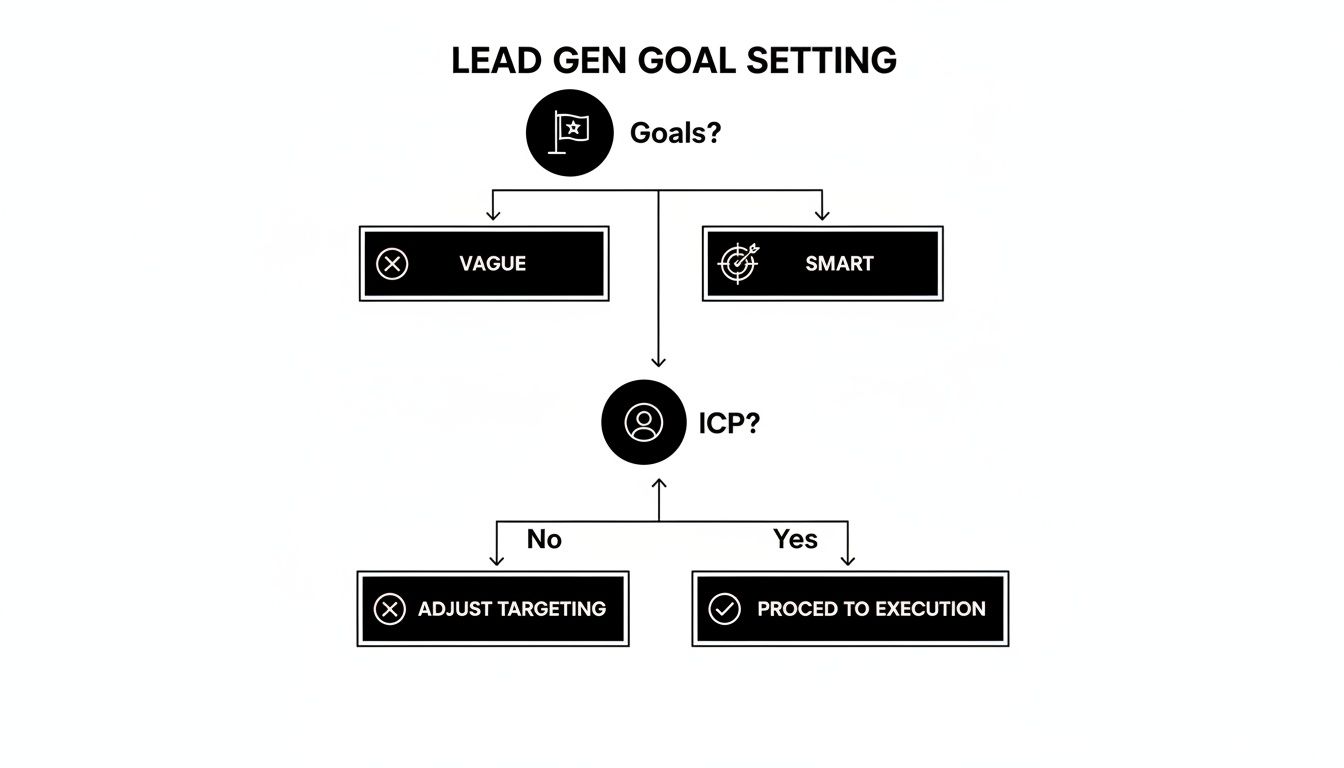
Starting with clear goals and a locked-in ICP means you're not just throwing darts in the dark. You're showing up where it actually counts.
Your Digital Storefront: Organic Social Media
For most small businesses, organic social media is a primary channel. It’s a low-cost way to build a real community, show off your brand’s personality, and drive people back to your site. But not all social platforms are created equal.
- LinkedIn: This is the undisputed champion for B2B. If you’re a consultant, run a service-based business, or target any kind of professional, this is your playground. The goal here is all about authority. Think industry insights, deep-dive articles, and case studies that prove you know your stuff.
- Instagram: A visual-first powerhouse, Instagram is king for B2C businesses whose products look amazing in photos and videos. This includes fashion, food, home decor—anything that can be made desirable with a single image. It’s perfect for building a brand identity.
- Facebook: With its massive, diverse user base, Facebook is still a workhorse for both B2B and B2C. Its superpower lies in building tight-knit communities through Facebook Groups and its features for targeting local customers.
The key to winning on social? Consistency. You have to show up with a steady stream of valuable content to stay on people's radar. For a deeper dive, check out our guide on social media marketing for small business.
The Channel You Actually Own: Email Marketing
Social media is fantastic, but you're essentially building your presence on rented land. One algorithm change and your reach can decrease overnight.
Email is different. Your email list is an asset you own. That makes it one of the most reliable, powerful channels for turning lukewarm leads into loyal customers.
Email lets you build a direct line to your audience, sending personalized content straight to their inbox. It's the perfect place for newsletters, special offers, and guiding people from "just looking" to "ready to buy."
The real power of email isn’t just blasting out messages—it's segmentation. When you group subscribers based on their interests or how they've interacted with you, you can send them hyper-relevant content that makes them feel seen. The result? Engagement and sales increase.
For example, a brand-new subscriber gets a welcome sequence that tells your story. A long-time customer might get an exclusive sneak peek at your next product launch. You just can't get that personal on any other channel.
The Accelerator: Paid Advertising
Organic growth is a slow burn. It works, but it takes time. When you need to get leads in the door now, paid advertising is your accelerator.
Platforms like Google Ads and Meta (Facebook & Instagram) let you put your message in front of exactly the right people with impressive precision.
With paid social, you can target people based on their demographics, interests, and even their online behavior. Selling custom hiking gear? You can serve ads directly to people who follow pages like National Geographic and REI.
Google Ads is all about intent. You're reaching people at the exact moment they're typing "best waterproof hiking boots for women" into the search bar. This is a very warm lead.
The catch is that it costs money. To make it work, you have to stay on top of your budget, test everything constantly, and know your numbers cold—especially your cost per lead.
The Underdog: Strategic Partnerships
Don't sleep on the power of collaboration. This is where you team up with another, non-competing business that serves the same kind of audience you do. Think joint webinars, a co-authored guide, or even just a simple cross-promotion on Instagram.
This move gives you instant credibility and access to a whole new audience that already trusts your partner. It's one of the most cost-effective ways to get high-quality leads in the door. If you’re in the B2B space, digging into some powerful B2B lead generation strategies can give you a ton of ideas on this front.
Deciding where to focus can feel overwhelming, so here’s a quick breakdown to help you prioritize.
Comparing Lead Generation Channels For Small Businesses
| Channel | Best For | Typical Cost | Effort Level |
|---|---|---|---|
| Organic Social Media | Building brand awareness, community, and top-of-funnel traffic. | Low | High & Consistent |
| Email Marketing | Nurturing leads, building relationships, and driving conversions. | Low to Medium | Medium |
| Paid Advertising | Generating leads quickly and targeting specific demographics. | Medium to High | High (Requires testing) |
| Partnerships | Accessing new, relevant audiences and building authority. | Low | Medium |
Ultimately, you're not looking for one magic channel. The sweet spot is finding a mix that works for your specific business—a cohesive system that attracts, nurtures, and converts your ideal customers again and again.
How to Create High-Converting Landing Pages and Offers
Getting traffic to your website is great, but it’s only half the battle. All the attention in the world won’t grow your business if you can't turn those visitors into actual leads. This is where your conversion assets—your offers and landing pages—become the most important part of your lead generation for small business strategy.
These are the tools that bridge the gap between a curious browser and a qualified prospect. They need to be sharp, compelling, and perfectly aligned with what your ideal customer needs.

Crafting Irresistible Lead Magnets
A lead magnet is that free, valuable resource you offer in exchange for someone’s contact info—usually just an email address. It’s the handshake that starts the relationship. But to work, your lead magnet has to solve a specific, nagging problem for your ideal customer.
Generic offers get ignored. Your offer needs to be so good they feel like they’re getting an amazing deal just for typing in an email.
Here are a few types of lead magnets that consistently perform well:
- Checklists: These are easy to digest and provide immediate, actionable value. An event planner could offer a "10-Point Venue Inspection Checklist." People love ticking boxes.
- Templates: Give your audience a shortcut to success. A marketing agency might offer a "Monthly Social Media Content Calendar Template." You’re saving them hours of work.
- Ebooks or Guides: These position you as an authority. A financial advisor could create a guide titled "The Small Business Owner's Guide to Retirement Planning."
- Webinars or Video Trainings: Perfect for showing off your expertise and building a more personal connection. People buy from people they know, like, and trust.
The key is to make it insanely relevant. If your blog post is about bookkeeping mistakes, your lead magnet should be a "Bookkeeping Best Practices Checklist," not some generic business guide. Context is everything.
The Anatomy of a High-Converting Landing Page
Once you have a great offer, you need a dedicated place to show it off. That place is a landing page—a single, focused webpage with one job: get the visitor to take a specific action.
A landing page is not your homepage. It has no navigation menu, no links to other parts of your site, and absolutely zero distractions. Every single element is designed to drive one outcome.
Your landing page has one job. Don't give visitors a dozen different things to click. A focused page with a single call-to-action can see conversion rates jump by 266% because it eliminates decision fatigue and guides the user straight to the prize.
To build a page that converts, you need to nail these core components:
- A Killer Headline: It’s the first thing people see. It has to grab their attention and communicate the benefit of your offer. It should answer their unspoken question: "What's in it for me?"
- Clear, Concise Copy: No one has time for a wall of text. Use short paragraphs, bullet points, and bold text to quickly explain the problem you solve and how your lead magnet is the solution.
- Compelling Visuals: Show, don't just tell. Include a high-quality image of your lead magnet, whether it's a mockup of an ebook cover or a screenshot of your template in action.
- A Simple Form: Only ask for what you absolutely need. For most lead magnets, a name and email are plenty. Every extra field you add is another reason for them to abandon the form.
- A Powerful Call-to-Action (CTA): This is the finish line. Use strong, action-oriented language. Ditch the boring "Submit" and try something like "Get My Free Checklist!" or "Download the Guide Now."
The Power of a Strong Call to Action
Your Call to Action (CTA) isn't just for landing pages. It’s a critical piece of the puzzle you should be using everywhere—on your website, in your blog posts, at the end of your emails, and all over your social media.
A great CTA is the nudge that moves a potential customer from passively consuming your content to actively engaging with your brand. It tells them exactly what to do next. Whether you want them to download a guide, book a consultation, or subscribe to your newsletter, your CTA needs to be impossible to ignore.
Make your CTAs pop with contrasting colors and get specific with the text. A vague "Click Here" is far less effective than "Get Your Free Marketing Plan." By mastering these three elements—the offer, the landing page, and the CTA—you build a reliable engine that consistently turns traffic into tangible leads for your business.
Using Visual Content to Attract and Nurture Leads
You’ve got the killer offers and the sharp landing pages. Now what? You need a reliable way to get eyeballs on them, and that's where high-quality visual content becomes your secret weapon, especially for top-of-funnel lead generation.
In a feed packed with distractions, a text-only update is easy to miss. A professionally designed graphic, on the other hand, is a scroll-stopper. It grabs attention, communicates value, and instantly positions your brand as a credible authority. This isn't just about posting pretty pictures; it’s a strategic game of visual storytelling designed to pull in your ideal customer.

Authority-Building Post Types That Actually Generate Leads
The point of social media is to provide so much value that following you becomes a no-brainer. That’s how you build the trust you need to eventually guide someone from your profile to your landing page.
Certain visual formats are absolute gold for this:
- Educational Carousels: These multi-slide posts are perfect for breaking down complex ideas into simple, digestible steps. You get to teach your audience something useful, proving your expertise one slide at a time.
- Quick-Tip Listicles: Everyone loves a good list. A clean graphic sharing "5 Mistakes to Avoid When..." or "3 Quick Tips For..." is super shareable and instantly useful. It makes your brand the go-to helpful resource.
- Data-Driven Infographics: Turning juicy stats or industry insights into a simple infographic makes complex data easy to digest. This type of content establishes you as a knowledgeable expert.
The problem? Creating a steady stream of this content is a massive bottleneck for most small business owners. It takes research, writing, and the biggest time-suck of all—design.
Automating Visual Content to Save Time
This is where automation becomes essential for scaling your lead generation for small business. Marketers using automation drive 451% more qualified leads. When you consider that 80% of B2B social media leads come from LinkedIn, the pressure to show up consistently with high-quality visuals is immense. Automating the creation of these assets bridges that gap.
This is exactly why Postbae was created. It's an AI-powered agent built specifically to automate the creation of professional visual social media graphics.
The big difference? Unlike manual design tools, Postbae works autonomously in the background for you. It needs zero prompts—the AI agent researches your industry, finds relevant topics, and automatically generates complete, ready-to-post visual social media posts.
Postbae is focused on the authority-building content that nurtures leads most effectively. It creates multi-slide carousels, educational infographics, and engaging listicles tailored to your business. You get a constant flow of high-quality, industry-specific graphics without the headache of design or brainstorming.
Maintaining Control While Saving Time
Automation shouldn't mean giving up control. While Postbae handles the entire creative lift from idea to final graphic, you still have the final say. Every single post it generates is fully editable and customizable.
You get the best of both worlds: the efficiency of AI automation with the ability to tweak every word, image, and color to perfectly match your brand’s voice.
By bringing a tool like Postbae into your workflow, you build a powerful visual content engine that consistently attracts your ideal customers on platforms like Instagram and LinkedIn. This steady drip of value-driven content keeps your audience hooked, builds trust, and funnels qualified traffic straight to your high-converting landing pages. It’s how you keep your lead generation funnel full of nurtured, interested prospects.
How to Measure and Optimize Your Marketing Funnel
Alright, you’ve launched your funnel. But the work isn't done. The real growth doesn't happen when you launch; it happens when you start consistently tweaking what you’ve built.
A marketing funnel isn't a "set it and forget it" tool. It's a living system that needs constant attention. You have to measure what’s working, cut what isn’t, and be ready to pivot based on what the numbers are telling you.
This is where you stop guessing and start knowing. By tracking the right data, you can turn your funnel from a decent strategy into a profitable machine for your business.
Key Performance Indicators You Must Track
Forget drowning in a sea of metrics. You don’t need a complex dashboard. For most small businesses, a handful of key performance indicators (KPIs) will tell you everything you need to know.
Here are the big ones:
- Conversion Rate: This is your gut check. It’s the percentage of people who see your offer and actually take action (like downloading that PDF). If your landing page conversion rate is low, it’s a red flag that your headline, offer, or page design isn't working.
- Cost Per Lead (CPL): How much are you spending to get one person’s email address? Calculate it by dividing your total ad spend by the number of new leads. If that CPL starts creeping up, your ad campaign may be losing its effectiveness.
- Lead-to-Customer Rate: This is the ultimate test of lead quality. What percentage of those "leads" actually become paying customers? A low number here means you’re either attracting the wrong audience or your sales process needs improvement.
Gathering and Interpreting Your Data
Getting this data is easier than it sounds. You don’t need to spend thousands on fancy software to get started.
Google Analytics is non-negotiable. It’s free, and it’s your best friend for seeing what’s happening on your website. Set up goals to track your landing page conversions and you'll see exactly which channels—be it organic search, social media, or paid ads—are actually sending you people who convert.
Every social media platform also has its own built-in analytics. These are valuable for seeing which posts are earning clicks and which are being scrolled past. To dig deeper into that, check out our guide on how to measure social media engagement.
Data tells a story, but only if you know how to read it. A landing page with high traffic but a low conversion rate isn't a failure—it's a massive opportunity. It tells you that your ad or social post is working perfectly, but the page itself is the weak link.
Making Smart, Data-Driven Adjustments
Once you have the numbers, it’s time to get to work. Optimization is just a constant cycle of testing, learning, and refining.
- Low Landing Page Conversion? Don't change everything at once. Start with A/B testing. Duplicate the page and change just one thing—the headline, the button color, the main image. Send half your traffic to Page A and half to Page B. The data will tell you which one wins.
- Underperforming Social Channel? If Instagram isn't delivering, don't just post more frequently. Look at your best-performing posts. Are they carousels? Listicles? Behind-the-scenes videos? Stop guessing and make more of what your audience has already shown they love.
- High CPL from Paid Ads? This is a direct signal to look at your ad creative or audience targeting. Is your ad copy uninspired? Is your image generic? Are you targeting "everyone" instead of your actual ideal customer? Tiny tweaks here can significantly lower your CPL.
When you embrace this cycle of measure, tweak, repeat, your marketing funnel stops being a static plan on a whiteboard and becomes a dynamic system that gets smarter and more profitable over time.
Ready to create a steady stream of professional, authority-building social media graphics without lifting a finger? Postbae is an AI agent that works in the background to automatically generate industry-specific visual posts that drive traffic and build your brand. Get started today and see how effortless great content can be. Visit us at https://postbae.com.