How to Increase Website Traffic Organically: Proven SEO & Content Strategies

Discover how to increase website traffic organically with proven SEO, content, and link-building tactics that drive sustainable growth—without paid ads.
Getting more organic traffic to your website boils down to a simple idea: create high-value content that solves your audience's problems, and make it incredibly easy for search engines to find and understand. It's not about a single magic trick, but a consistent blend of smart search engine optimization (SEO), a killer content strategy, and patiently building your digital authority over time.
Why Organic Traffic Is the Bedrock of Sustainable Growth

Before we jump into the "how," let's talk about the "why." It's crucial to understand that organic traffic isn't just another line in your analytics report. It's the foundation of long-term business growth.
Think of it like this: paid ads are like buying cut flowers. They look great, bring people in, but the moment you stop paying, they're gone. Organic traffic is like planting a tree. It takes more effort upfront, but it grows into an asset that keeps delivering value, compounding on itself year after year.
The real power of organic traffic comes from user intent. When someone finds you through a search engine, they're not passively scrolling. They are actively looking for an answer or a solution you might have. This means they show up already interested and engaged, which almost always translates into higher trust and better conversion rates.
The Power of Search-Driven Visitors
The data doesn't lie. Organic search is still the king of web traffic, driving a massive 53% of all trackable website traffic. Even better, leads that come from SEO close at a 14.6% rate—a number that blows most outbound marketing tactics out of the water.
This isn't just about getting clicks; it's about connecting with an audience that has already raised its hand and said, "I need help with this."
Organic traffic is more than just visitors; it's a signal of trust and authority. When you rank well, search engines are essentially telling the world that your content is a credible and valuable resource.
To build that kind of authority, we're going to focus on three interconnected pillars:
- Search Engine Optimization (SEO): This is the foundation. It’s all the technical and strategic work you do to make your site irresistible to search engines like Google, covering on-page tweaks, site health, and off-page signals.
- High-Value Content: This is the fuel for your growth engine. It’s about creating genuinely helpful articles, guides, and resources that position you as the go-to expert in your field.
- Digital Authority: This is your reputation. You build it with incredible content and then validate it with backlinks from other respected sites in your industry.
Below is a quick overview of how these strategies work together.
Core Strategies for Organic Traffic Growth
Here's a snapshot of the core strategies we'll be covering and why each one is a non-negotiable part of the growth playbook.
| Strategy | Primary Goal | Key Benefit |
|---|---|---|
| SEO Fundamentals | Make your website technically sound and easy for search engines to crawl and index. | Builds a strong foundation for all other efforts and improves ranking potential. |
| Content Strategy | Create helpful, relevant content that answers your audience's questions. | Attracts visitors actively searching for solutions and establishes your expertise. |
| Link Building | Earn backlinks from other reputable websites to signal authority to search engines. | Boosts your site's credibility and significantly improves search rankings. |
| Distribution | Promote your content across multiple channels (social, email) to amplify its reach. | Drives initial traffic and signals to search engines that your content is valuable. |
Each piece builds on the last, creating a powerful system for growth.
This playbook will walk you through each of these areas with clear, actionable steps. For an even deeper dive, this practical guide on how to increase organic traffic is a fantastic resource covering SEO, content, and the technical nuts and bolts.
By mastering these principles, you can stop chasing short-term traffic spikes and start building a system that consistently brings your ideal customers right to your digital doorstep.
Finding What Your Audience Actually Searches For
Sustainable organic traffic doesn't come from guessing games. It comes from knowing exactly what your audience wants. Before a single word of content gets written, you have to get inside your customer's head and figure out the exact phrases they're typing into Google when they hit a roadblock.
This isn't just about picking keywords with huge search volumes. The real goal is to decode the intent behind the search. Is someone just gathering information? Comparing solutions? Are they ready to pull out their credit card? Nailing this lets you create content that meets them right where they are.
The Four Flavors of Search Intent
Every single Google search falls into one of four buckets. If your content doesn't match the right intent, you’re not just going to struggle to rank—you’re going to disappoint the visitors who do find you.
- Informational Intent: The user needs to learn something. Think direct questions like, "how to improve team productivity?" or broader topics like "project management techniques."
- Navigational Intent: The user knows where they want to go. They’re searching for your brand name or a specific login page. You generally don't target these unless it's your own brand.
- Commercial Intent: The user is kicking the tires before making a purchase. They’re comparing options with searches like "best CRM for small business" or looking for specific alternatives.
- Transactional Intent: The user is ready to act now. Their search is direct and to the point: "buy accounting software" or "sign up for a project management tool."
Understanding these different intents is how you map out your entire content strategy. Blog posts are perfect for informational searches, detailed comparison pages are ideal for commercial intent, and your product pages need to be laser-focused on transactional queries.
Go Beyond the Obvious and Dig for Long-Tail Gold
The most valuable keywords often aren't the ones with massive search numbers. The real opportunity is in long-tail keywords. These are longer, more specific phrases that have lower search volume but sky-high conversion rates because the user's intent is crystal clear.
Think about it. A person searching for "marketing" could be looking for anything. But someone searching for "how to create social media graphics for a marketing agency"? That person has a specific, urgent problem they need to solve. That's your ideal audience.
Long-tail keywords are the backbone of a smart organic traffic strategy. They attract people who are much further along in their buying journey and are looking for the exact expertise your business can offer.
So, where do you find these gems? Think about the real questions your customers are asking.
- Google's "People Also Ask" section: This is a literal goldmine of related questions that real searchers have.
- Forums like Reddit or Quora: Dive into subreddits or topics related to your industry. You’ll see the exact language people use to describe their problems.
- Your own customer support tickets: What questions are your sales and support teams answering over and over? Every one of those is a content opportunity.
A Real-World Example: B2B SaaS
Let's say you run a SaaS company that sells project management software built for remote teams. Your first instinct might be to target "project management software," but that's like trying to win a shouting match at a rock concert. It's incredibly competitive.
Instead, your long-tail keyword research might uncover phrases like:
- "best project management tool for asynchronous teams"
- "how to manage remote developer workflows"
- "collaboration software for distributed marketing teams"
Now we're talking. You can create hyper-specific content that speaks directly to these needs. You could write a killer blog post titled, "A Guide to Managing Remote Developer Workflows," which naturally uses that long-tail keyword in the title, headings, and throughout the article.
Inside the post, you’d structure it for both readers and search engines. Your H1 is the title. An H2 could be "Key Challenges in Asynchronous Workflows," and another could be "Choosing the Right Collaboration Software." This structure gives Google all the right signals about your page's relevance while delivering massive value to a niche audience.
And that’s the whole game. You attract an audience that is far more likely to be interested in your software than someone who just typed in a generic two-word phrase. This is how you turn searchers into visitors, and visitors into customers.
Building a Strong Technical SEO Foundation
You can create the most incredible, earth-shattering content in the world, but it won’t matter one bit if search engines can’t find, crawl, and make sense of it. That’s where technical SEO comes in. It’s the framework that holds up your entire content strategy.
Think of it like the plumbing and wiring of your house. It isn't the glamorous part you show off to guests, but if it doesn’t work, nothing else does either.
Technical SEO is all about making sure your site is not just accessible, but also easy for search engine bots to understand. For anyone serious about getting more organic traffic, a solid technical foundation isn’t just a nice-to-have; it’s non-negotiable.
Optimize for Speed and User Experience
In a world of zero patience, site speed is everything. A slow website is probably the fastest way to lose a potential customer. It’s a harsh truth, but 68% of online experiences start with a search engine and 88.5% of visitors will leave a slow-loading site and never come back.
Speed isn’t just about keeping users happy—it’s a confirmed ranking factor for Google. You can discover more insights about how site speed impacts traffic on yotpo.com.
A great place to start is with Google's own PageSpeed Insights. It's free and spits out a detailed report on how your site performs on both mobile and desktop.
The tool gives you a clear score and, more importantly, a list of actionable things to fix. You’ll see recommendations like compressing your images or cutting down server response times, all aimed at improving your Core Web Vitals—the specific metrics Google uses to measure a site's overall user experience.
Ensure Flawless Mobile-First Design
Mobile traffic blew past desktop traffic years ago, and Google's entire system now runs on mobile-first indexing. This means Google primarily looks at the mobile version of your website to decide how to rank it.
If your site is a mess on a smartphone—hard to read, difficult to navigate—your rankings will tank, no matter how slick it looks on a big monitor.
A truly mobile-friendly design must have:
- Readable text without any pinching and zooming.
- Tap-friendly targets for buttons and links (no fat-fingering!).
- No horizontal scrolling needed to see the page.
This isn’t a "feature" anymore. It's the absolute baseline for modern SEO.
A seamless mobile experience is a direct signal to search engines that your site is high-quality and user-focused. Neglecting it is like closing your doors to the majority of your potential audience.
Improve Crawlability and Indexing
Before your pages can even think about ranking, search engine bots need to find them and add them to their index. You can make their job a whole lot easier with a few key moves.
First, create and submit an XML sitemap. This is literally a roadmap of your website that lists all your important URLs. It helps crawlers understand your site's structure and find your content much more efficiently.
Second, check your robots.txt file. This is a simple text file that tells search engine crawlers which parts of your site they should and shouldn't crawl. A tiny mistake here can accidentally block your most important pages from being indexed, making them totally invisible in search results.
Finally, make it a habit to check for crawl errors in Google Search Console. This free tool is a goldmine. It alerts you to problems like broken links (404 errors) or server errors that are stopping bots from accessing your content. Fixing these issues quickly keeps your site healthy and accessible. If you want to make sure your efforts are structured and effective from the ground up, a pragmatic SEO strategy for small businesses provides a data-driven framework to follow.
By keeping these technical aspects in check, you’re creating a stable, reliable platform for your amazing content to shine. This ongoing maintenance is the unsung hero of any successful organic traffic strategy. And for marketers looking to streamline other digital efforts, exploring the best AI tools for marketers can reveal solutions that save time and boost efficiency across the board.
Creating Content That Earns Authority
Content is the engine that drives your entire organic traffic strategy. It's not about just publishing blog posts whenever you feel like it; it's about building a content ecosystem that systematically solves your audience's problems, answers their questions, and cements your brand as the authority in your space.
This is how you stop chasing traffic and start attracting high-quality visitors who genuinely trust you.
A seriously powerful way to get this done is with the pillar-and-cluster model. This isn't just a fancy name—it's a strategic way to organize your content that signals deep expertise to both users and search engines. You stop thinking in terms of one-off keywords and start thinking in terms of entire topics.
The Pillar and Cluster Model Explained
Think of your pillar page as the ultimate, definitive guide on a broad topic. This is your cornerstone piece—a long, in-depth article that covers all the critical aspects of a subject your business cares about. It’s built to rank for a big, high-volume keyword.
But that pillar doesn't stand alone. It’s supported by "cluster" pages. These are shorter, more focused articles that dive deep into specific subtopics you touched on in the pillar. Each cluster page targets a more niche, long-tail keyword and—this is the critical part—links back to the main pillar page.
This web of internal links tells search engines you don't just have one good article; you have a whole library of expertise on the subject.
The pillar-and-cluster model transforms your blog from a random collection of posts into a structured, authoritative resource. That topical authority is a massive signal to search engines that your site is the place to go for answers.
Why Long-Form Content Wins
When you're trying to win with organic traffic, depth is everything. Long-form content—articles that are typically over 2,000 words—consistently punches above its weight compared to shorter pieces.
Why? It’s simple: it provides more comprehensive value. A detailed guide is far more likely to fully solve a user's problem, which keeps them on your site longer. That "dwell time" signals to Google that your page is a high-quality, satisfying result.
Plus, long-form content naturally starts to rank for hundreds of long-tail keywords you didn't even intentionally target. A single, in-depth guide can pull in traffic from a huge variety of search queries. These monster posts also tend to attract more backlinks because they become the definitive resource other websites want to cite.
Building Your Content Ecosystem
Putting this into practice means thinking beyond the standard 800-word blog post. A killer content strategy uses a mix of formats to meet different needs and build authority from multiple angles.
Here’s what that looks like:
- In-Depth Guides: These are your pillar pages. Your goal should be to make them the most thorough resource on that topic anywhere on the internet.
- Case Studies: Nothing builds trust like real-world proof. Case studies are incredibly valuable for audiences who are getting serious about making a decision.
- Original Research: Want high-authority backlinks? Publish unique data from a survey or internal study. This is one of the most effective link-building tactics out there.
- Tool and Resource Pages: A curated list of the best tools or resources for your audience can become a go-to page that people bookmark, share, and link back to over and over.
The technical health of your site is the foundation that allows all this great content to actually get discovered.
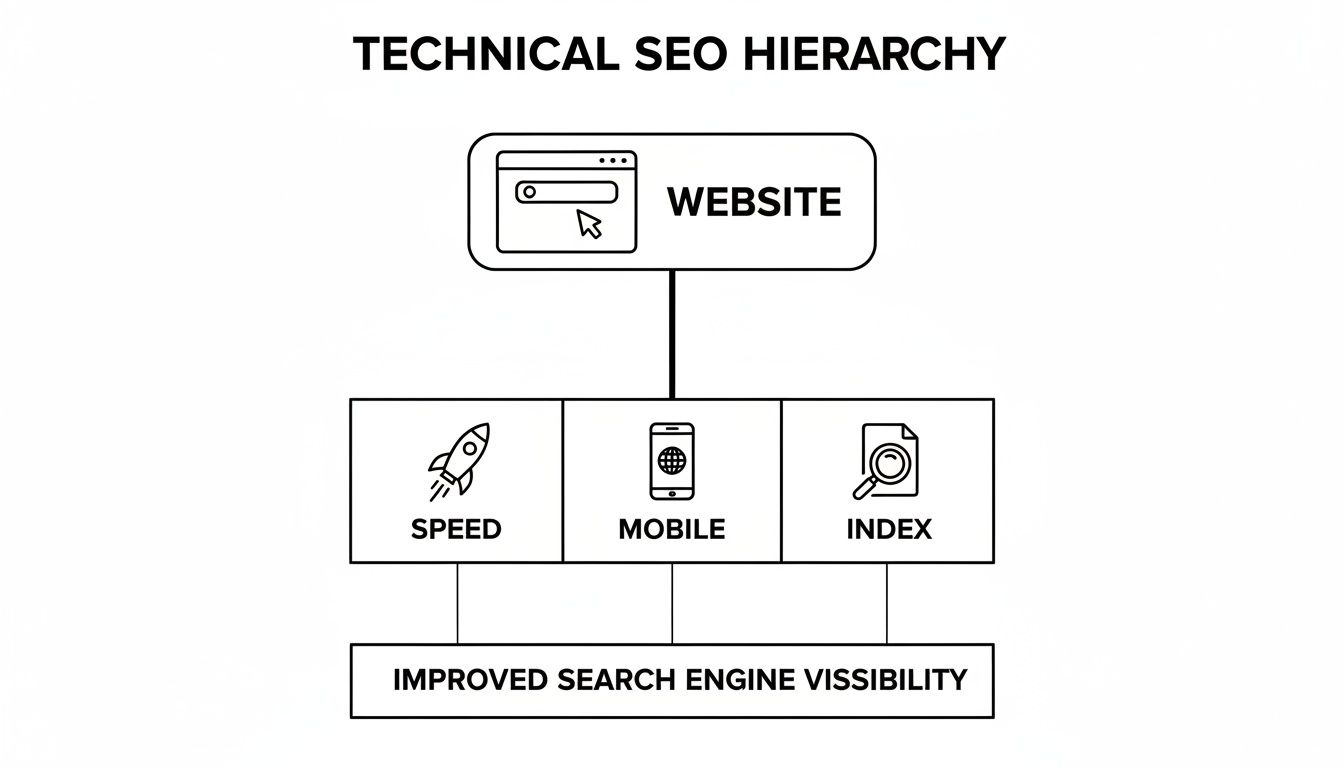
This just shows how a solid website relies on core vitals like speed, mobile-friendliness, and proper indexing before anything else.
Creating this level of authority-building content takes a significant amount of work—research, writing, editing, and planning. It's one of the main reasons so many businesses struggle with consistency.
And once you have these amazing assets, you have to get them in front of people. This is where smart automation can be transformative.
For example, an AI agent like Postbae can take your massive, in-depth blog post and automatically generate an educational multi-slide carousel for LinkedIn or a slick infographic for Instagram. It automates the creation of visual assets that drive traffic back to your site, with no design skills or manual prompting needed. It's built to produce the exact kind of authority-building social content—like tips, industry facts, and educational breakdowns—that perfectly complements your long-form articles.
When you pair a strategic content model like pillar-and-cluster with smart distribution, you create a powerful flywheel. Your website earns authority with deep, valuable content, and your social channels amplify its reach, driving a steady stream of the right kind of organic traffic. To dig deeper into this, check out the core advantages of content marketing and see how it builds a growth engine that lasts.
Turning Great Content into a Traffic Magnet: Backlinks & Social Proof
Hitting "publish" on an amazing, authority-building article feels great, but the work isn't done. Not even close. Even the best content on the internet needs a serious push to find its audience and start pulling in organic traffic.
This is where your off-page strategy kicks in. We'll focus on two game-changers: earning high-quality backlinks to build trust with search engines, and using social proof to drive a steady stream of referral traffic.
Earning Backlinks That Actually Move the Needle
Backlinks are just links from other websites pointing to yours. Simple, right? But in Google's eyes, they are one of the most powerful signals that your content is credible and valuable. Think of every backlink as a vote of confidence. A link from a respected industry site tells Google you're a trustworthy source, which directly helps you rank higher.
The key here is quality over quantity. Seriously. One link from an authoritative, relevant website is worth more than a hundred links from sketchy, unrelated sites.
A strong backlink profile doesn't just improve your rankings; it builds a network of referral traffic that brings in a highly relevant audience. These are visitors who are already engaged with your industry and are more likely to be interested in what you have to offer.
Guest blogging is a classic for a reason: it works. By writing a genuinely helpful, high-quality article for another reputable blog in your niche, you can secure an author bio that links back to your website. This introduces your brand to a new, established audience while earning you a valuable backlink.
Another powerful tactic is creating what we call link-worthy assets. This goes way beyond your standard blog posts. Think bigger.
- Original research or data studies: Publish unique industry insights that other people will want to cite in their own content.
- Free tools or calculators: Build a simple, useful resource that solves a specific problem for your audience.
- Comprehensive guides: Create the most in-depth, definitive resource on a topic that becomes the go-to reference for everyone else.
These kinds of assets attract links naturally because they provide so much value that other creators are eager to share them with their own audiences.
Transforming Your Content into Traffic-Driving Social Assets
While backlinks build your long-term SEO authority, social media is your engine for driving immediate visibility and referral traffic. The goal is to take your deep, insightful blog content and repurpose it into bite-sized, visually engaging assets that stop the scroll on platforms like LinkedIn, Instagram, and Facebook.
This is where so many small businesses and marketing teams get stuck. Creating professional-looking graphics, multi-slide carousels, or infographics from a 2,000-word article takes design skills and, more importantly, a ton of time.
This is exactly the problem an AI agent like Postbae was built to solve. It completely automates the production of these visual social media posts. You don't have to write a single prompt or open a design tool. Postbae just works in the background, autonomously transforming your educational content into ready-to-post graphics that build your expertise.
For instance, it can pull key takeaways from your latest guide and generate a slick, multi-slide carousel for LinkedIn. Or it can turn interesting stats into a shareable infographic. This lets you consistently promote your best work and drive traffic back to your site without any of the manual design headaches. And you still keep full creative control, with the ability to edit and tweak every post before it goes live.
Prioritizing Your Link Building Efforts
With so many tactics out there, figuring out where to focus your energy can be tough. Some strategies are quick wins, while others are a long-term investment. This table breaks down a few common link-building tactics to help you prioritize based on the effort required versus the potential SEO impact.
Effort vs Impact of Link Building Tactics
| Tactic | Effort Level | Potential SEO Impact | Best For |
|---|---|---|---|
| Guest Blogging | Medium | High | Building relationships and tapping into new, relevant audiences. |
| Creating Link-Worthy Assets | High | Very High | Establishing your site as a definitive authority in your niche. |
| Broken Link Building | Medium | Medium | Finding quick wins and providing value to other site owners. |
| Digital PR & Outreach | High | Very High | Earning high-authority links from news and top-tier publications. |
By combining a smart backlink strategy with an automated approach to social media, you create a powerful system for amplification. Your content not only earns the credibility it needs to rank well in search results but also gets the visibility required to attract an engaged audience today. This two-pronged approach is fundamental to increasing your website's organic traffic for the long haul.
Measuring Your Traffic and Actually Using the Data
Look, launching a brilliant SEO and content plan is just the first half of the game. If you don't have a clear way to measure what's working—and what's falling flat—you're basically just throwing content at the wall and hoping something sticks.
This is where you close the loop. It’s how you turn confusing data into a real, repeatable process for growth that doesn't rely on guesswork.
Effective measurement isn’t about drowning in every metric possible. It’s about zeroing in on the handful of key performance indicators (KPIs) that tell you the true story. And the best part? The two most powerful tools for this are completely free: Google Analytics and Google Search Console.
Get to Know Your Core Measurement Tools
Think of it this way: Google Analytics tells you what happens after someone lands on your site. It’s your go-to for tracking things like organic sessions (how many people found you via search), bounce rate (how many people left after seeing only one page), and conversions (the good stuff, like sign-ups or purchases).
Google Search Console, on the other hand, tells you what happens before they even click. It’s a direct line to how Google sees your site. You can see which keywords are getting you seen (impressions), what your average ranking position is, and that all-important click-through rate (CTR).
The performance report in Search Console is pretty much your command center for search visibility.
This is where you can spot pages that are showing up in search results but aren't convincing people to click. That's a huge, flashing sign pointing to an easy win.
Data without interpretation is just noise. The goal is to move beyond simply reporting numbers and start using them to ask smarter questions. Why did this page's traffic drop? Which keywords are driving high-quality leads? What content should we create next?
Turning Those Insights into Action
Your analytics are your roadmap. The real magic happens when you connect the dots between the data and your strategy, letting you make sharp, informed decisions instead of just guessing.
Here are a few ways to turn that data into actions that actually boost traffic:
- Hunt for "Low-Hanging Fruit": Dive into Google Search Console and find pages with high impressions but a low CTR. This is a classic sign that your content is relevant, but your title tag and meta description are boring. A quick rewrite of those two things can often deliver a surprisingly fast traffic boost.
- Revive Underperforming Content: Use Google Analytics to find posts that used to perform well but have been slowly bleeding traffic. This "content decay" is totally normal. Give these articles a refresh—update the stats, add new examples, maybe beef up the on-page SEO—and you can bring them roaring back to life.
- Double Down on Your Winners: Find the handful of pages that drive the most organic conversions. What makes them so effective? Is it the topic depth? The format? The specific examples you used? Figure out the formula and use those insights to create more content that follows a proven winner. A solid small business content marketing strategy will help you organize these efforts so you're not just creating random posts.
This cycle of measuring, analyzing, and refining is what separates sites that stay flat from those that see consistent, long-term organic growth. Treat your data like a feedback loop, and you'll build a powerful engine for attracting the right kind of visitors.
Got Questions? I've Got Answers
Diving into the world of organic traffic can feel a bit overwhelming, and you’re bound to have questions. I get these all the time from business owners and marketers. Here are some straightforward answers to the most common ones.
How Long Does It Really Take to See Results from SEO?
Anyone promising you page-one rankings overnight is selling snake oil. Seeing significant, needle-moving results from a solid SEO strategy typically takes anywhere from 4 to 12 months.
Why such a wide range? It really depends on where you're starting from. Factors like your website's current authority, how cutthroat your industry keywords are, and how consistently you’re putting in the work all play a huge role.
Sure, you might see some quick wins. Optimizing an existing page for a better click-through rate can show a little bump in a few weeks. But building a reliable, sustainable flow of organic traffic is a marathon, not a sprint. It’s all about patient, persistent execution of on-page, technical, and off-page SEO.
What's More Important: Amazing Content or Building Links?
This is a classic chicken-or-the-egg debate of SEO. The truth is, one isn't more important than the other. They're two sides of the same coin, and they absolutely depend on each other to work.
Think of it this way: Exceptional content is your foundation. Without it, you have nothing valuable for Google to rank and definitely nothing for other websites to link to. It’s the price of admission.
But even the most mind-blowing article or guide will just sit there collecting dust if no one knows it exists. That’s where link building and promotion come in. Backlinks are like votes of confidence that signal your content’s authority to search engines.
The best strategy is always a balanced one. Create something genuinely valuable first, then go out and actively show it to people who can give it the authority signals it deserves.
Can I Actually Increase Organic Traffic with a Tiny Budget?
Absolutely. While a big budget can definitely speed things up—letting you pay for premium tools or outsource time-consuming tasks—many of the most powerful organic growth tactics are incredibly cost-effective.
The most important investments you can make, especially early on, aren't financial. They're consistency and effort. A well-executed, patient strategy will always beat a big budget with no clear direction.
If you're working with limited funds, pour your energy into these high-impact areas:
- Create exceptional content that targets less competitive, long-tail keywords. This is where you can outsmart, not outspend, your competitors.
- Pitch guest posts on relevant industry sites. This is a fantastic way to build authority and earn powerful links without spending a dime.
- Master your on-page and technical SEO. You can get an incredible amount done with powerful free tools like Google Search Console.
- Use social media as a distribution engine. Don't just post your content—amplify it. Share it in relevant communities and get it in front of the right people.
Ready to turn your hard-earned content into traffic-driving social media assets without the manual work? Postbae is an AI agent that automatically generates professional visual social media posts to build your authority and drive visitors back to your website. No prompts, no design skills needed—just consistent, high-quality content on autopilot. Learn more at postbae.com.