12 Best AI Tools for Marketers to Automate Your Workflow in 2026

Discover the 12 best AI tools for marketers in 2025. Boost productivity with top platforms for content, social media visuals, SEO, and analytics.
Navigating the crowded market of marketing technology can be overwhelming. Every day, new platforms emerge, each promising to revolutionize your workflow. This guide cuts through the noise to deliver a curated list of the best AI tools for marketers, helping you find the right solutions to automate tasks, generate content, and analyze performance without endless trial and error.
This resource is designed for small business owners, social media managers, and marketing agencies looking to enhance their capabilities. We've structured this listicle to be a practical, scannable resource. Each tool is categorized by its primary use case, from content creation and social media visuals to analytics and ad optimization.
You'll find detailed breakdowns for every platform, including:
A concise description of what it does best.
Key features and real-world applications.
Clear pricing information to fit your budget.
"Best for" recommendations to match the tool to your specific needs.
To make your evaluation easier, we've included screenshots and direct links for every tool listed. Our goal is to provide a comprehensive overview that empowers you to make informed decisions and implement the technologies that will have the most significant impact on your marketing efforts. For those focused on improving search engine rankings and automating SEO tasks, exploring specialized AI-powered SEO tools can provide a more targeted advantage in that specific domain. This guide will help you build a powerful, efficient, and modern marketing stack.
1. Postbae
Postbae is an AI-powered content creation agent that automatically generates professional visual social media graphics for platforms like Instagram, Facebook, and LinkedIn. It is designed to handle the difficult process of creating authority-building content, which involves research, ideation, writing, and designing visually appealing graphics. Postbae automates this entire multidisciplinary process without requiring users to write a single prompt. It is particularly effective at creating multi-slide carousels, educational infographics, and other graphical posts that establish expertise.
Its core value proposition is the complete automation of visual social media post production. The AI agent works autonomously to create industry-specific, ready-to-post content. Postbae is not a social media scheduler, a caption generator, or a manual design tool. It focuses specifically on creating the graphical assets (text-on-image graphics) themselves, allowing users to maintain full editing control over every generated post. This makes it an affordable solution for businesses needing a professional social media presence, comparable to having a social media manager for a fraction of the cost.
Key Features & Use Cases
Autonomous Content Generation: The AI agent works on autopilot to generate complete visual social media posts, including multi-slide carousels and infographics, tailored to the user's industry.
Authority-Building Content: Specializes in educational content like industry insights, tips, and listicles that build credibility and audience trust.
Professional Visuals: Matches researched content with proven template layouts to ensure all graphics are aesthetically pleasing and professional.
Full Editing Capabilities: Users have complete creative control and can fully customize and edit every generated post before publishing.
Who is Postbae For?
Postbae is built for small business owners, social media managers, marketing agencies, startups, and content creators who need a consistent stream of professional visual content but lack the time or design resources. It's ideal for users who want to establish expertise and educate their audience on social media without the manual effort of content creation.
Website: https://postbae.com
2. G2
While not an AI tool itself, G2 is an indispensable starting point for any marketer researching the best AI tools for their specific needs. It's a massive software marketplace and peer review platform that allows you to sort through thousands of solutions using verified user feedback. Think of it as a strategic compass for navigating the crowded martech landscape. Instead of relying on vendor marketing, you get direct insights from real users about how a tool performs in practice.
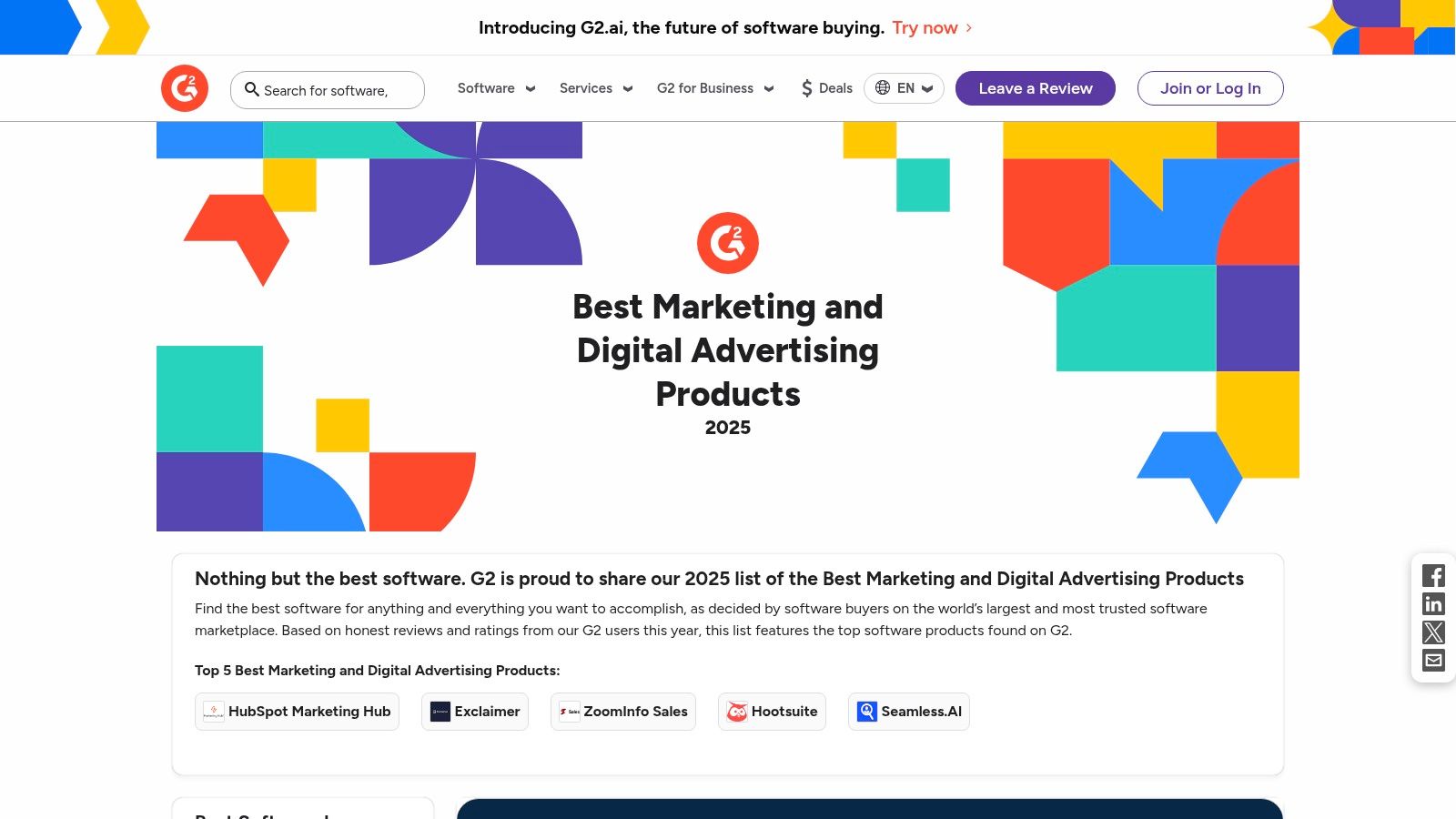
G2’s value lies in its structured data and sheer volume of reviews. Its annually updated “Best Marketing and Digital Advertising Products” lists are particularly useful. They provide a high-level overview of established leaders and rising stars, complete with badges that can help secure stakeholder buy-in for new software purchases. The platform’s granular filtering allows you to find tools that fit your company size, industry, and specific integration requirements, making it a highly efficient research hub.
How to Use G2 Effectively
To get the most out of G2, don't just look at the overall rating. Dive deep into individual reviews, paying close attention to comments from users with similar company profiles. Use the comparison feature to see how your top choices stack up on key features, ease of use, and quality of support. This level of detail is crucial for making an informed decision. For instance, when researching a social media content creation tool, G2 can help you evaluate and compare different options based on real user experiences.
Key Features & Details
Best For: Shortlisting top-rated AI marketing tools and validating choices with peer reviews.
Pricing: Free to browse reviews and create lists.
Pros: Trusted reputation, high volume of verified reviews, and consistently updated "best of" lists.
Cons: Reviews might not always reflect your specific industry niche, and popular incumbents can sometimes overshadow innovative new tools.
Website: https://www.g2.com/best-software-companies/top-marketing
3. Capterra
As a Gartner-owned company, Capterra brings a high level of authority to the software review space. It’s an expansive marketplace where marketers can research, compare, and discover AI tools. Think of it as a comprehensive directory that excels at breaking down complex software options into digestible, comparable data points. Capterra’s dedicated "AI Marketing Tools" category provides a focused environment for evaluation, saving you from sifting through irrelevant software.
Capterra's strength is its structured, feature-forward approach. It presents software solutions with clear matrices that highlight key features, pricing models, and deployment options, making side-by-side comparisons incredibly straightforward. This data-rich format is ideal for marketers who need to build a business case for a new tool, as it provides the specific details needed to justify a purchase. The platform's direct links to vendor trials and pricing pages also streamline the final steps of the decision-making process.
How to Use Capterra Effectively
To maximize your research on Capterra, start by using its robust filtering system. You can narrow down the list of the best AI tools for marketers by features like generative AI, campaign analytics, or AI writing. Once you have a shortlist, use the comparison tool to create a head-to-head analysis of up to four products. Pay close attention to the verified user reviews, particularly those from businesses of a similar size and industry to your own, to get a realistic picture of a tool’s performance.
Key Features & Details
Best For: Comparing AI marketing tools based on specific features, pricing, and deployment models.
Pricing: Free to browse and compare software.
Pros: Backed by Gartner, providing credibility. Clear feature matrices and pricing callouts simplify evaluation.
Cons: Some vendors pay for placement, which can influence visibility. Rankings may also favor more established, popular products over newer innovations.
Website: https://www.capterra.com/ai-marketing-tools-software
4. Product Hunt
While primarily a discovery platform, Product Hunt is an essential resource for marketers seeking the absolute latest in AI innovation. It’s a daily leaderboard for new and trending tech products, where the community upvotes and discusses fresh launches. For those looking to find the best AI tools for marketers, its dedicated topics on marketing, SEO, and social media act as a real-time filter, showcasing emerging solutions before they hit the mainstream. Think of it as the frontline for martech, offering a direct line to the creators and early adopters.
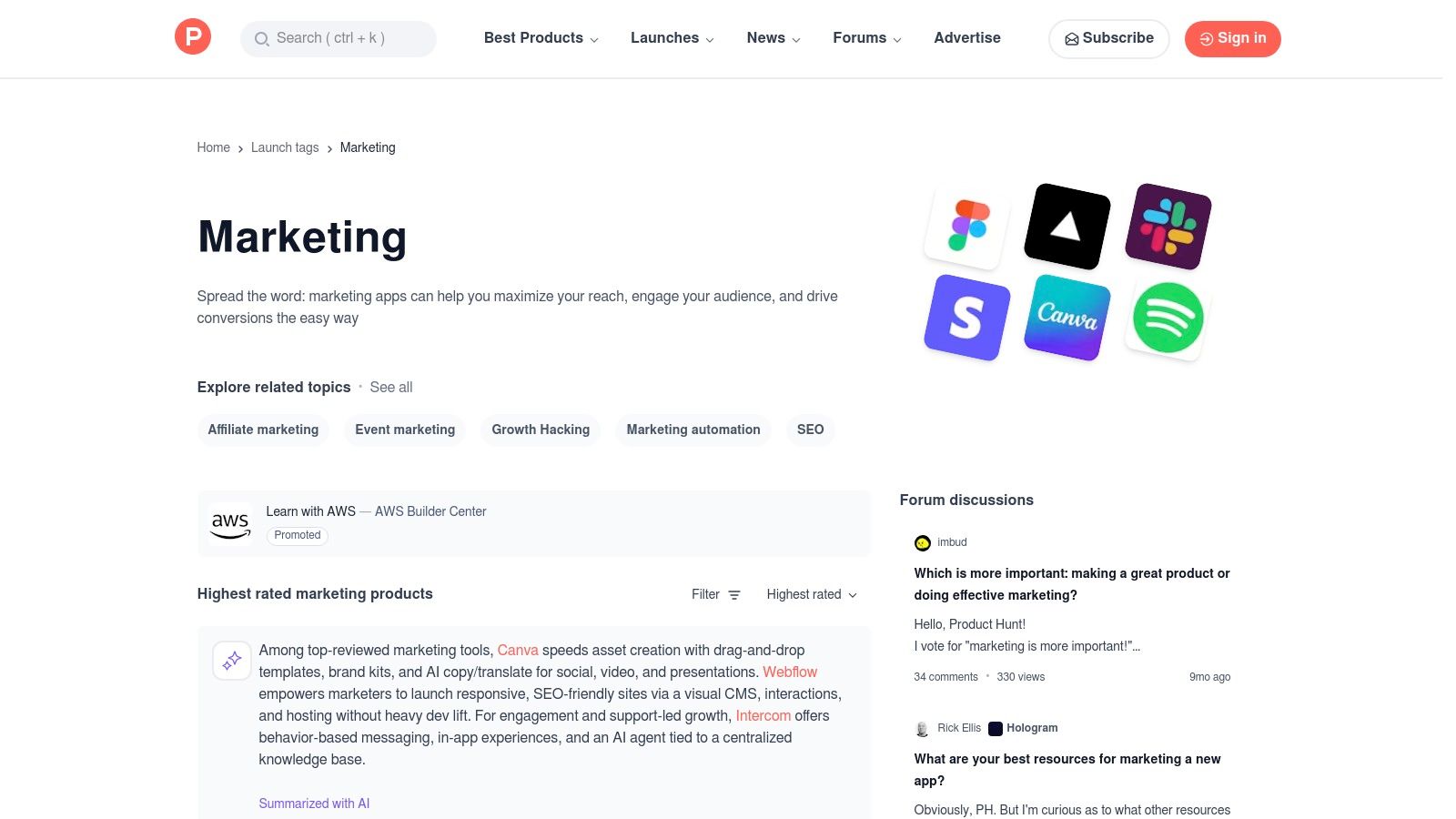
Product Hunt’s core value is its immediacy and community-driven curation. Unlike larger review sites that often feature established players, this platform gives you a chance to discover disruptive AI tools on day one. You can often find launch-day discounts, engage directly with founders in the comments to ask specific questions, and gauge initial user sentiment. This raw, unfiltered feedback is invaluable for assessing if a new tool is a genuine problem-solver or just a fleeting trend.
How to Use Product Hunt Effectively
To leverage Product Hunt, check the "Marketing" topic daily or subscribe to its newsletter for curated updates. Pay close attention to the number of upvotes and the quality of discussion in the comments section, as this is a strong indicator of a tool’s potential. Use it to spot tools that automate specific, niche tasks, like the AI-driven visual content creation offered by Postbae. Don't be afraid to engage with the makers; asking about their roadmap or integration plans can provide critical insights for your evaluation process.
Key Features & Details
Best For: Discovering brand-new and innovative AI marketing tools and accessing community feedback.
Pricing: Free to browse, upvote, and comment on products.
Pros: Excellent for finding cutting-edge tools before they become widely known, and direct access to founders and launch discounts.
Cons: Newly launched tools can be less stable or lack robust enterprise features, and the daily volume can be overwhelming.
5. AppSumo
For marketers, agencies, and small businesses looking to experiment with emerging AI tools without committing to expensive annual subscriptions, AppSumo is an essential destination. It's a leading digital marketplace that specializes in offering lifetime deals (LTDs) and heavily discounted software, including a vast array of AI-powered marketing solutions. Think of it as a launchpad for discovering innovative tools for content generation, social media management, and automation at a fraction of their standard cost.
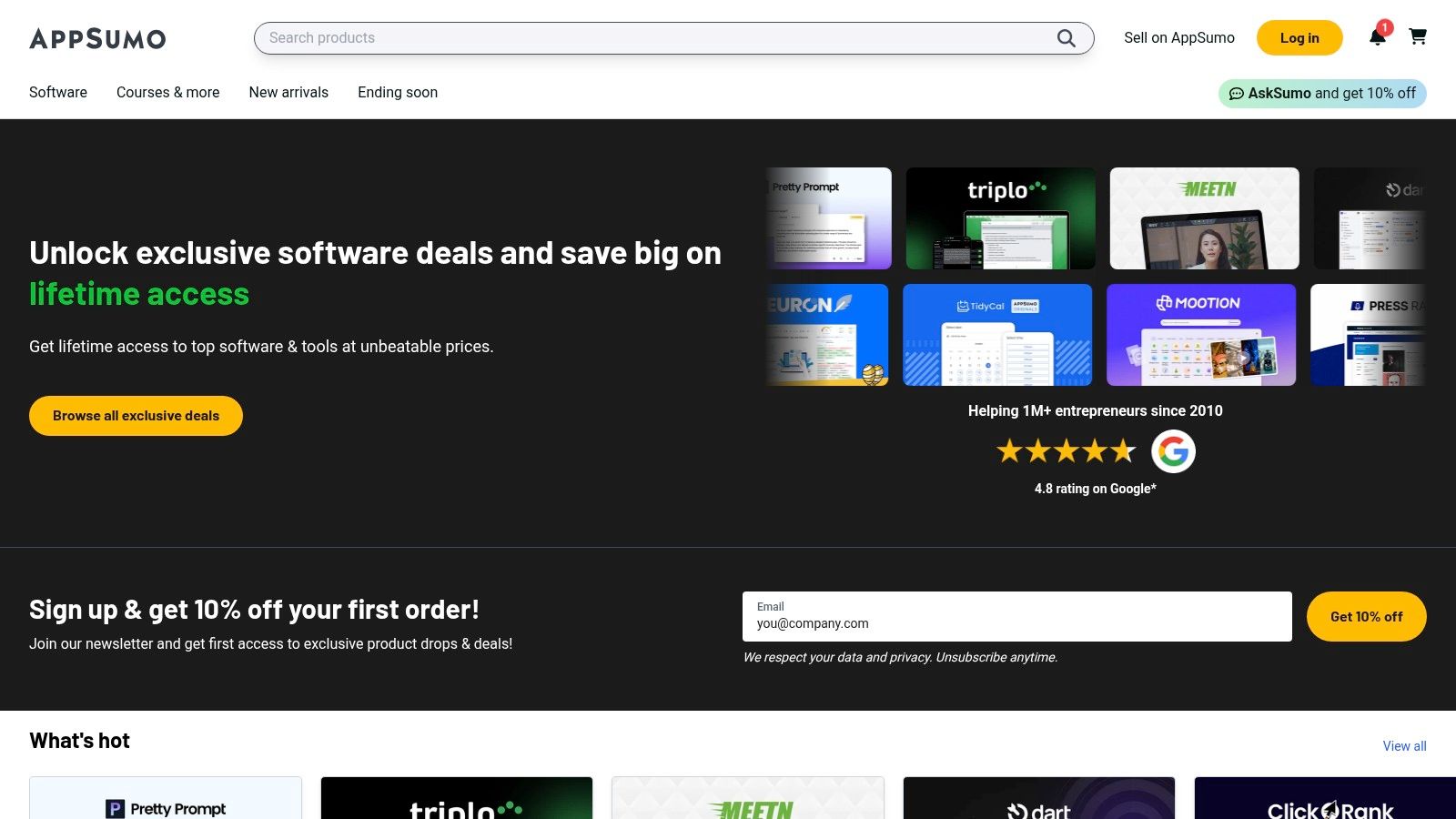
AppSumo's core value is providing affordable access to the latest technology. Many of the best AI tools for marketers make their debut here, offering early adopters a chance to get in on the ground floor. This model is particularly beneficial for testing multiple tools to find the perfect fit for your workflow. The platform’s user reviews and robust Q&A sections provide a transparent look into a tool's capabilities and potential shortcomings, backed by a generous 60-day money-back guarantee that significantly lowers the risk of trying something new.
How to Use AppSumo Effectively
To maximize AppSumo, it's crucial to act fast on promising deals, as they are often available for a limited time. Read the user reviews and the Q&A section carefully to understand real-world use cases and potential limitations not mentioned in the marketing copy. Pay close attention to the deal terms, such as usage limits and future update policies. This strategic approach allows you to build a powerful and cost-effective AI marketing stack without the burden of recurring monthly fees.
Key Features & Details
Best For: Testing and acquiring emerging AI marketing tools at a low, one-time cost.
Pricing: Free to browse; deals are purchased individually, often as lifetime licenses.
Pros: Incredible cost savings through lifetime deals, and a 60-day refund policy mitigates purchase risk.
Cons: Some startups may pivot or fail after their deal ends, and listed tools may lack enterprise-level security features.
Website: https://appsumo.com
6. HubSpot App Marketplace
For marketers already embedded in the HubSpot ecosystem, the official App Marketplace is the most direct route to finding powerful, integrated AI tools. Rather than a general software aggregator, it’s a curated collection of native and third-party apps specifically designed to enhance HubSpot’s CRM and Marketing Hub. This tight integration means AI tools found here can directly leverage your existing customer data and marketing workflows, providing a seamless and data-rich experience.
The marketplace’s value comes from trust and efficiency. Because every app is built to work with HubSpot, you avoid the common pitfalls of poor integrations and siloed data. The "AI Essentials" section is particularly useful, highlighting assistants and agents that automate content creation, chat responses, and data analysis. User reviews and install counts provide social proof, helping you quickly identify popular and effective solutions that are proven to work within the platform you already use daily.
How to Use the HubSpot App Marketplace Effectively
Start by exploring the "AI Essentials" category to see editorially curated recommendations. When evaluating an app, look beyond the feature list and focus on how it uses your HubSpot data. For example, an AI content tool that pulls from your contact properties or service tickets can create far more relevant material than a generic one. Always check vendor pages for pricing, free trial availability, and support details, as many apps require separate subscriptions.
Key Features & Details
Best For: HubSpot users looking for tightly integrated AI tools that leverage their existing CRM and marketing data.
Pricing: Free to browse, but individual app pricing varies and most require separate subscriptions.
Pros: Seamless integration with HubSpot improves data-driven workflows, and clear install metrics and curation help validate app choices.
Cons: Primarily valuable if you are already a HubSpot customer; less relevant otherwise.
7. Salesforce (Agentforce / Einstein)
For marketers already embedded in the Salesforce ecosystem, Agentforce (formerly Einstein Copilot) represents a powerful, integrated AI solution. It moves beyond simple content generation by providing pre-built, goal-oriented AI agents focused on buyer and campaign optimization. Think of it as an agentic layer over your CRM data, designed to automate complex marketing workflows and personalize customer journeys at scale. Instead of exporting data to a third-party tool, Agentforce works directly within your existing Salesforce environment, leveraging deep CRM context to inform its actions.
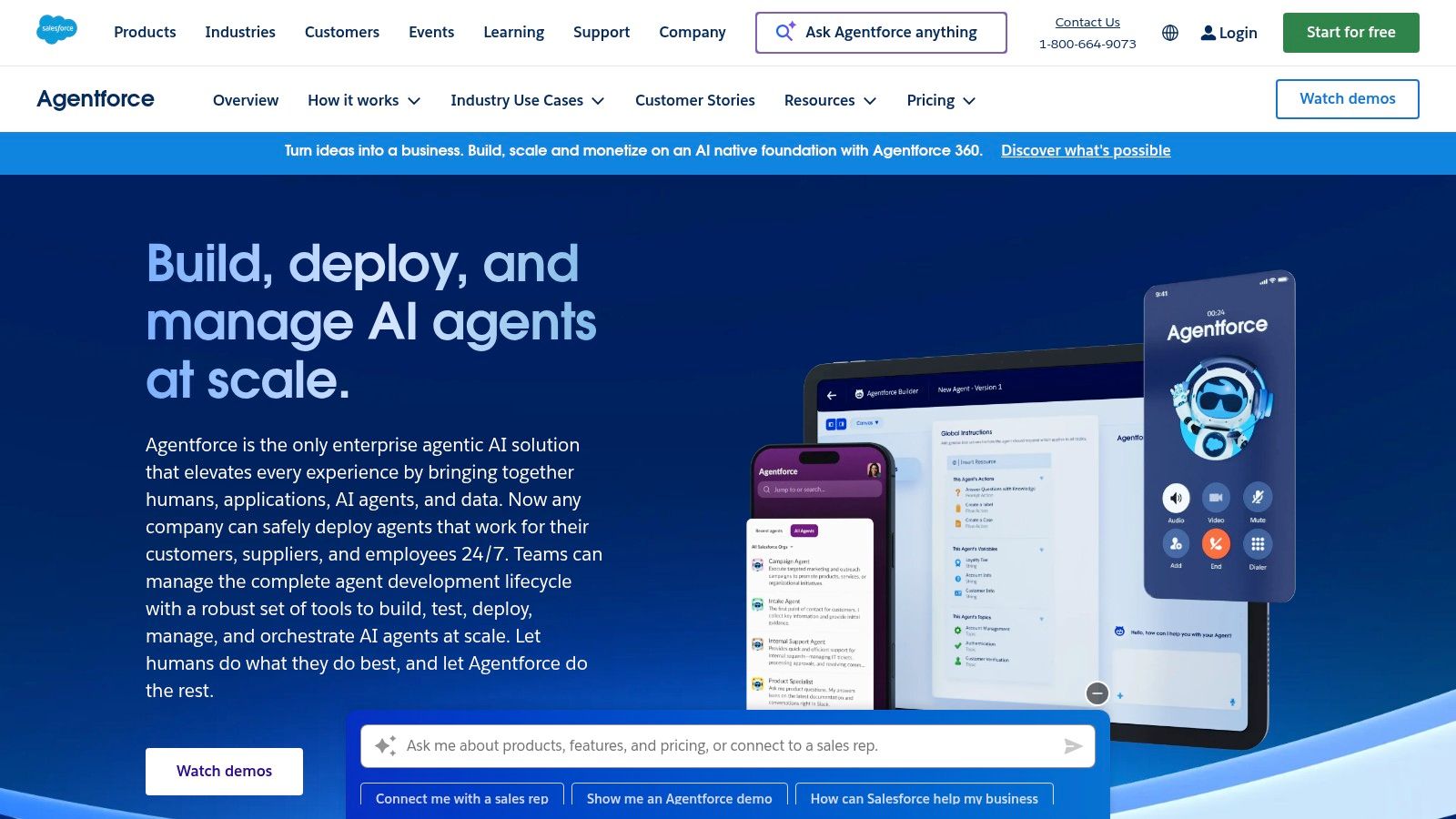
The platform’s strength lies in its native integration with Einstein AI and its low-code Agent Builder. This allows marketing teams to not only use out-of-the-box agents like the Campaign Optimizer but also to create custom agents that can access specific CRM data and execute actions. This makes it one of the best AI tools for marketers in large enterprises who need to ensure their AI initiatives are governed, secure, and extensible, providing a level of control that standalone tools often cannot match.
How to Use Salesforce Agentforce Effectively
To maximize Agentforce, focus on automating high-value, data-intensive tasks that are unique to your business. Start by deploying the pre-built Campaign Optimizer agent to analyze performance and generate personalized campaign suggestions. From there, use the Agent Builder to create a custom agent that automates a specific workflow, such as lead scoring based on recent engagement data or personalizing follow-up sequences. The key is to leverage the agent's direct access to your CRM to create hyper-relevant interactions.
Key Features & Details
Best For: Enterprise marketing teams using Salesforce who need to build and deploy governed, CRM-aware AI agents for campaign optimization.
Pricing: Pricing and licensing typically require sales engagement and are tailored to existing Salesforce subscriptions.
Pros: Strong enterprise governance and extensibility, and deep CRM context enables superior targeting and measurement.
Cons: Primarily geared toward existing Salesforce customers with setup dependencies, and it can be complex to implement without dedicated resources.
8. Shopify App Store
For marketers operating within the Shopify ecosystem, the official App Store is the primary hub for discovering powerful AI tools. It functions as a specialized marketplace where merchants can find, evaluate, and install AI-powered applications designed to enhance everything from SEO and ad performance to email marketing and social content creation. This direct integration streamlines the process of adding new capabilities to an online store.
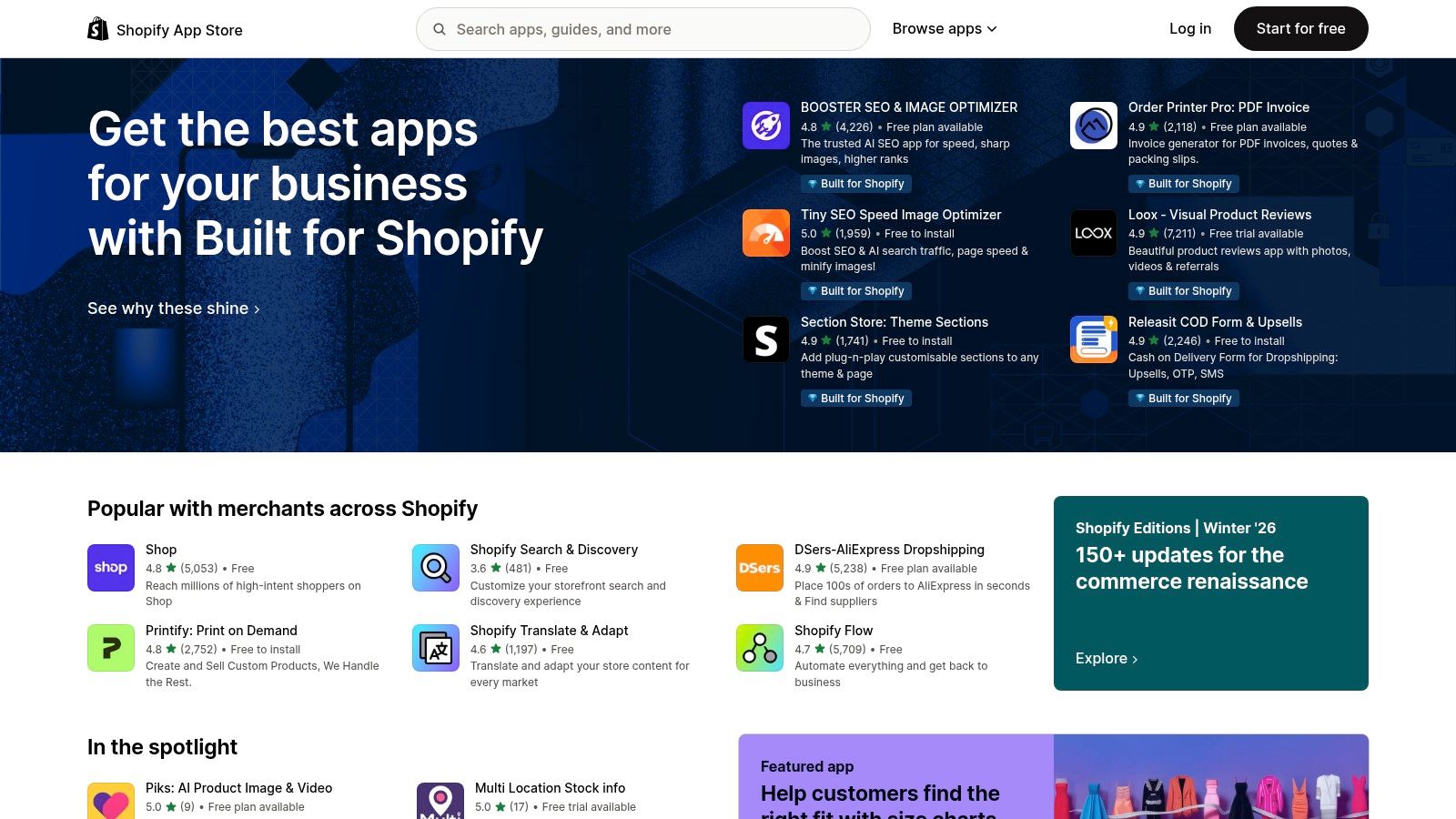
The value of the Shopify App Store is its focused, ecommerce-centric environment. Unlike general software marketplaces, every app is built to work within Shopify, minimizing compatibility issues. Merchant reviews, clear "Works with" tags (like Klaviyo, Meta Ads, and Google Ads), and transparent monthly pricing provide the critical information needed to make quick, informed decisions. This curated experience dramatically shortens the path from discovery to deployment for busy ecommerce teams looking for the best AI tools for marketers.
How to Use the Shopify App Store Effectively
To find the right AI app, use specific keywords related to your marketing goal, such as "AI product photos" or "AI ad copy." Pay close attention to the number of reviews and the overall rating, but also read recent comments to understand current performance and support quality. Always take advantage of free trials or free tiers to test an app's functionality and its direct impact on your store's workflow before committing to a paid plan.
Key Features & Details
Best For: Shopify merchants seeking to quickly integrate AI marketing tools for tasks like personalization, ads, and SEO.
Pricing: Varies by app; many offer free tiers or trial periods with transparent monthly subscription costs.
Pros: Seamless integration with Shopify stores, clear ratings and merchant reviews, and a fast path from app discovery to implementation.
Cons: Only relevant for Shopify-based businesses; app quality can vary, making it important to test before subscribing.
Website: https://apps.shopify.com
9. Semrush App Center
For marketers already embedded in the Semrush ecosystem, the Semrush App Center acts as a powerful force multiplier. Instead of being a standalone tool, it’s a curated marketplace of third-party applications designed to integrate directly with your existing Semrush data and workflows. This transforms Semrush from a powerful SEO and marketing suite into a centralized hub for a growing number of AI-powered marketing tools.
The primary advantage of the App Center is its seamless integration and convenience. It eliminates the need to manage multiple subscriptions, logins, and billing cycles. By connecting apps directly within the Semrush UI, you can enrich your existing data with specialized AI capabilities for content creation, competitor analysis, and social media strategy. This makes it one of the best AI tools for marketers who prioritize a unified tech stack.
How to Use the Semrush App Center Effectively
To maximize value, focus on apps that fill a specific gap in your current strategy or automate a time-consuming task. Before committing, take advantage of the exclusive trials often available to Semrush users. Evaluate how well an app’s AI-driven insights complement your core Semrush reports. For example, you can pair a content generation app with your keyword research data to create targeted articles directly within your established workflow.
Key Features & Details
Best For: Semrush users looking to expand their toolkit with integrated AI apps without leaving the platform.
Pricing: Varies by app; many offer free trials or freemium plans accessible through the marketplace.
Pros: Unified billing and single sign-on for existing Semrush customers, and a curated selection of apps ensures a baseline of quality.
Cons: The app selection is smaller compared to open marketplaces, and its value is primarily for those already subscribed to Semrush.
Website: https://www.semrush.com/app-center/
10. Adobe Marketo Engage
For B2B marketers operating at scale, Adobe Marketo Engage is a powerhouse platform that integrates generative AI deeply into marketing automation. As part of the Adobe Experience Cloud, it’s designed for mid-market and enterprise teams that need sophisticated journey orchestration and lead management. Its AI capabilities go beyond simple content creation, powering dynamic personalization, predictive audiences, and conversational marketing to accelerate the sales cycle. Marketo uses AI not just as a feature, but as the core engine for its automation and analytics.
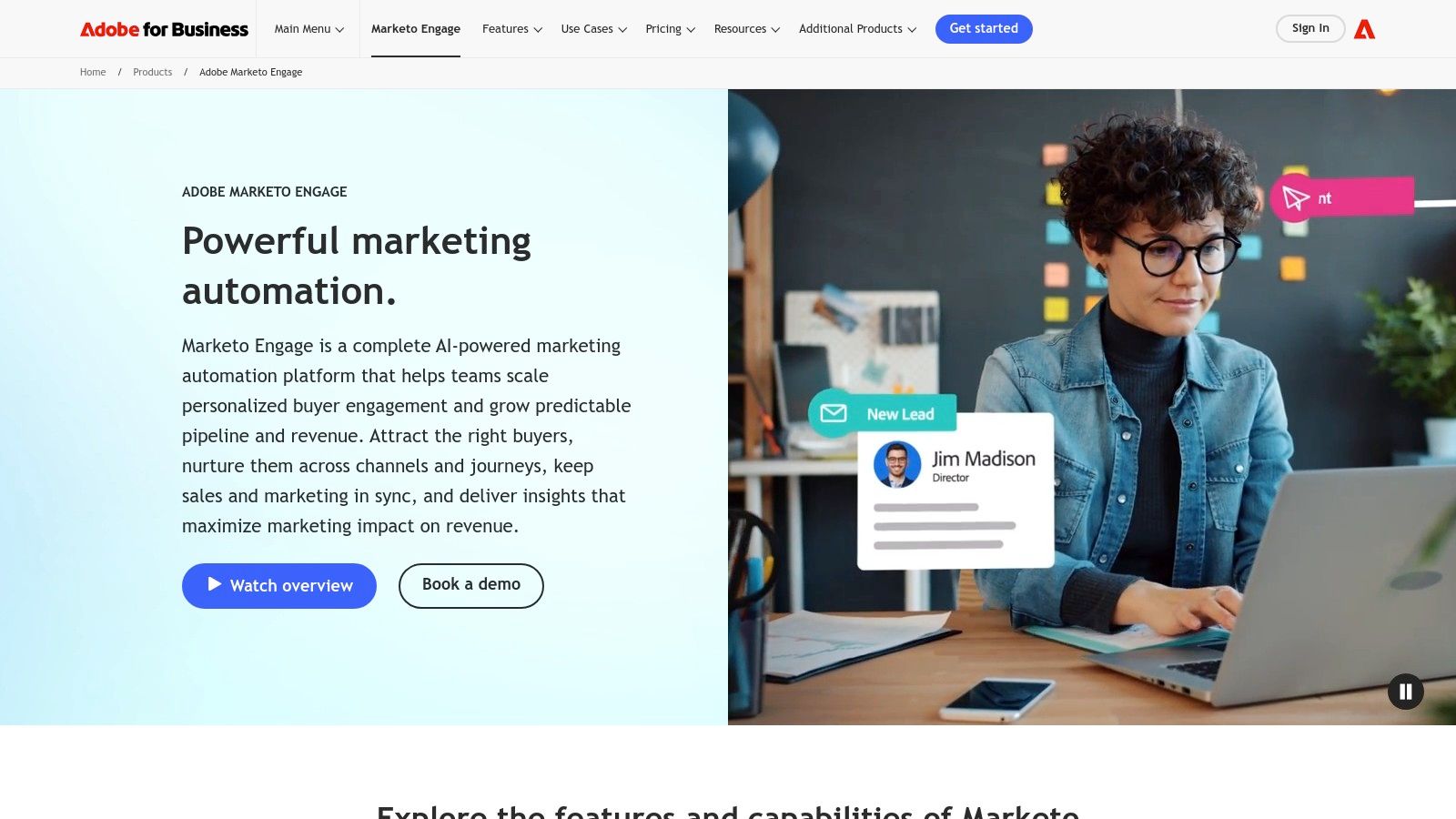
The platform’s strength lies in its comprehensive, enterprise-grade toolset. Generative AI helps marketers craft email copy and landing page content, while AI-powered agents and dynamic chat engage website visitors in real-time. This combination allows teams to create highly personalized, omnichannel campaigns and accurately measure their impact with Marketo Measure’s advanced attribution. Its seamless integration with Adobe Firefly and the broader Experience Cloud makes it one of the best AI tools for marketers in complex B2B environments.
How to Use Adobe Marketo Engage Effectively
To maximize Marketo Engage, focus on building intelligent customer journeys. Use the AI-driven predictive audience segmentation to identify high-value leads and tailor campaigns to their specific behaviors and needs. Leverage the generative AI content tools to quickly test different messaging variants in your emails and on your landing pages to optimize for conversion. By combining these AI features, you can implement highly effective marketing automation best practices that nurture leads from initial contact to conversion.
Key Features & Details
Best For: Enterprise and mid-market B2B marketing teams needing a comprehensive, AI-driven automation and lead management platform.
Pricing: Custom pricing based on database size and features; typically involves a significant investment.
Pros: Deep enterprise capabilities, extensive integrations within the Adobe ecosystem, and a recognized leader in B2B marketing automation.
Cons: Higher total cost of ownership and often requires specialized implementation support, making it less suitable for small teams.
11. Jasper
Jasper is an AI content and campaign platform built specifically for marketing teams. It moves beyond simple text generation by incorporating brand-specific knowledge, voice, and audience profiles to create cohesive, on-brand content at scale. It acts as a central hub for generating everything from blog posts and ad copy to entire marketing campaigns, all while maintaining strict brand consistency.
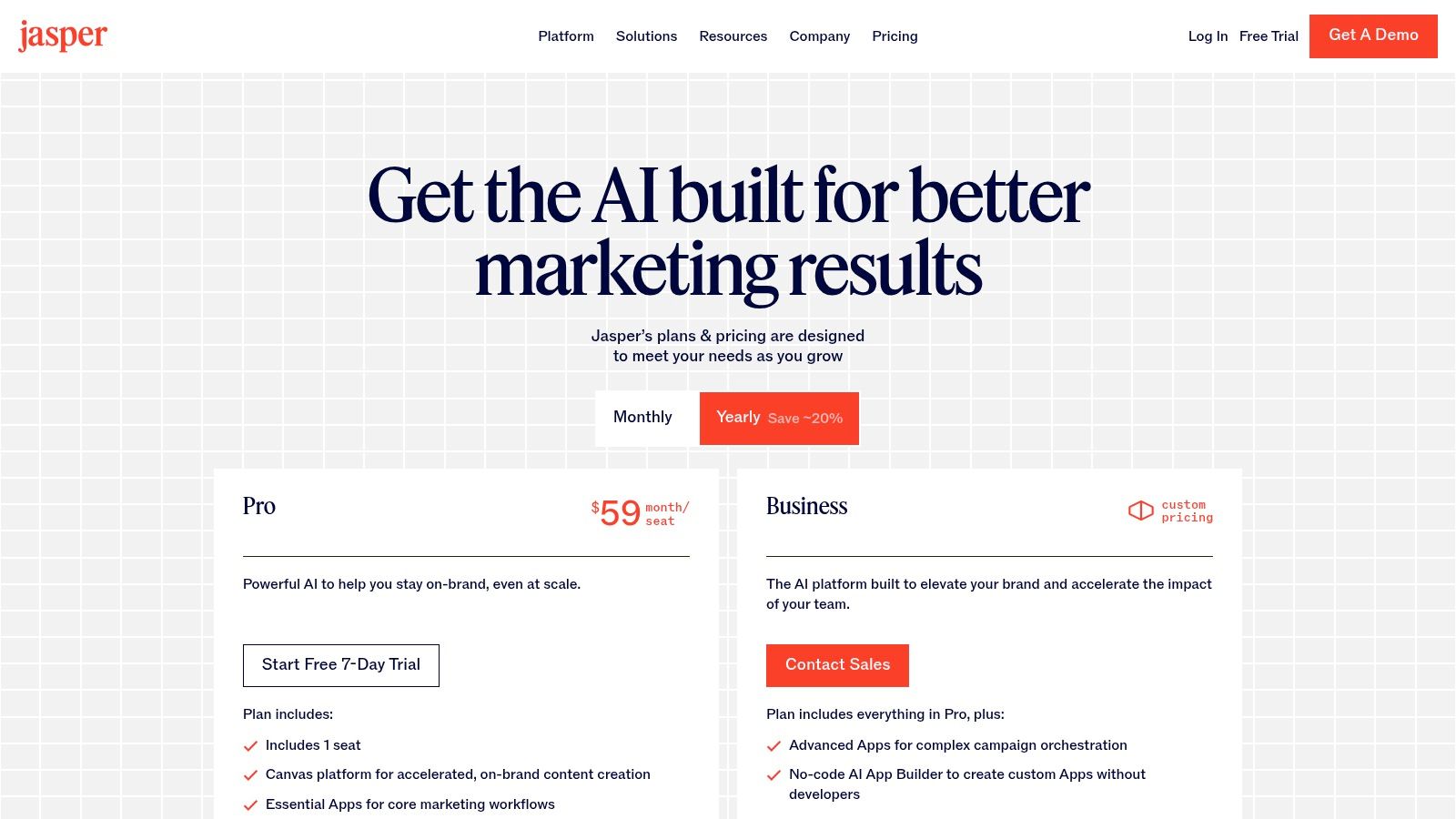
The platform’s strength lies in its marketer-centric design and powerful governance features. Unlike generic LLMs, Jasper offers purpose-built marketing agents, a collaborative Canvas workspace, and a no-code app builder to create custom workflows. Its ability to connect to your knowledge base ensures all generated content is factually accurate and aligned with your company’s messaging, making it one of the best AI tools for marketers looking to operationalize AI safely and effectively.
How to Use Jasper Effectively
To maximize Jasper's potential, start by thoroughly training its Brand Voice and Knowledge features. Upload your style guides, product information, and top-performing content so the AI understands your brand inside and out. Use the Canvas workspace to map out entire campaigns, from initial brainstorming to final copy, creating a connected workflow. For those focused on social media, integrating Jasper with a visual creation tool can streamline your entire process. To learn more about how different tools can work together, you can explore the landscape of AI social media content creation.
Key Features & Details
Best For: Marketing teams that need to scale content production while maintaining brand consistency and governance.
Pricing: Starts at $39/user/month (billed annually) for the Creator plan. Business plans with advanced features are available with custom pricing.
Pros: Marketer-centric UX and features are easier to operationalize than generic LLMs. It scales from solo marketers to enterprise teams with robust admin controls.
Cons: The per-user billing model can become costly for larger teams. Heavier use cases and advanced features often require the more expensive Business tier.
Website: https://www.jasper.ai/pricing
12. Copy.ai
Copy.ai positions itself as an AI-powered growth platform designed for go-to-market teams, moving beyond simple text generation into scalable workflow automation. It helps marketers encode repeatable processes like creating SEO briefs, product descriptions, or email drip campaigns into automated playbooks. This makes it one of the best AI tools for marketers looking to standardize and scale their content production efficiently.
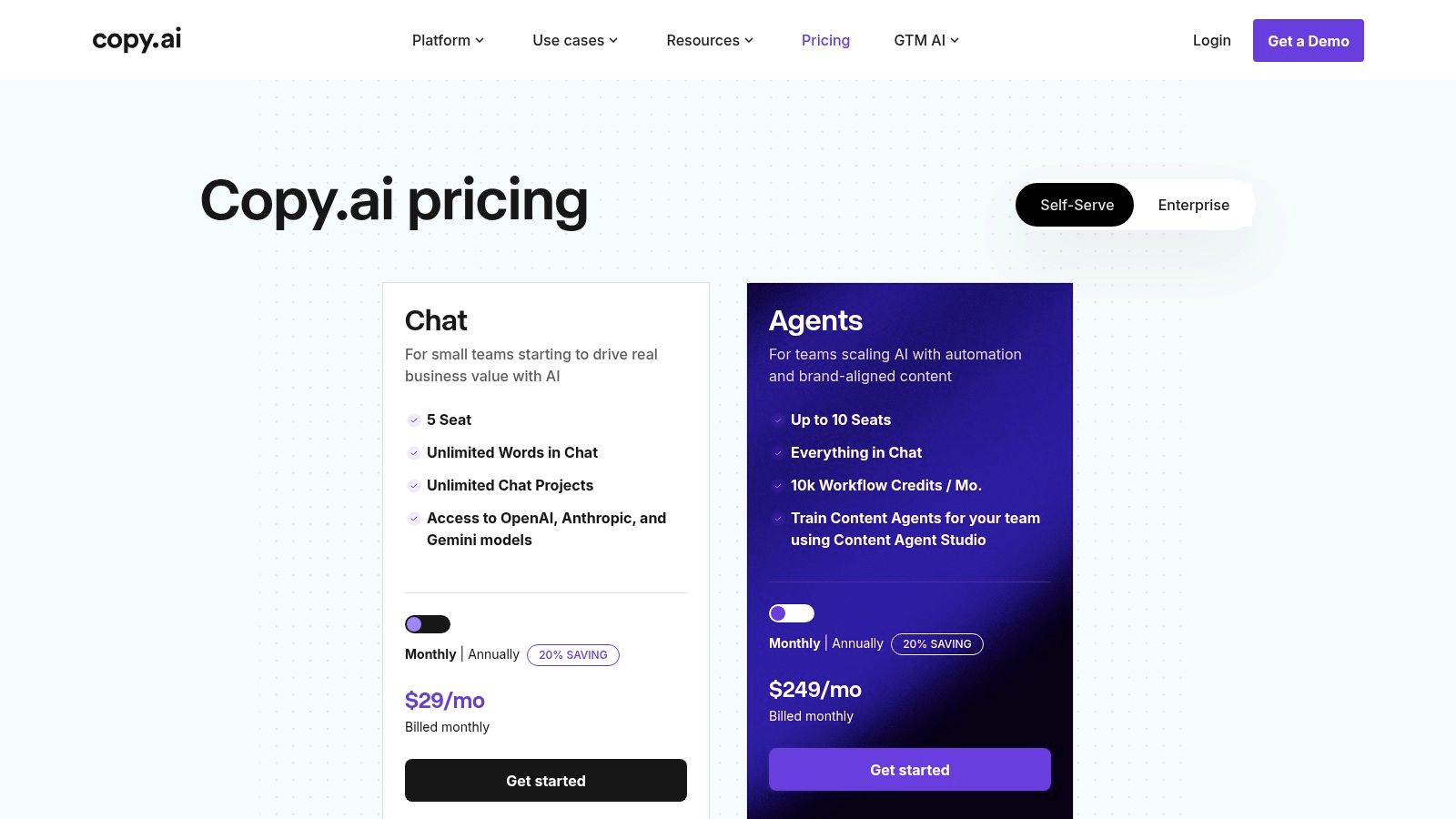
The platform’s key differentiator is its Content Agent Studio, which allows teams to build and deploy custom AI agents trained on their brand voice and business context. Combined with access to multiple large language models (including OpenAI, Anthropic, and Gemini), Copy.ai offers flexibility and power. Its workflow system allows for multi-step pipelines that can handle complex research and content creation tasks, making it ideal for teams with established and repeatable marketing playbooks.
How to Use Copy.ai Effectively
Start by identifying your most time-consuming, repetitive content tasks. Use the Content Agent Studio to build a custom workflow for one of these processes, such as generating first-draft blog posts from a simple brief or creating variants of ad copy. Integrate it with your existing GTM systems to streamline data flow. Don't be afraid to experiment with different models for different tasks to see which yields the best results for your specific needs.
Key Features & Details
Best For: Marketing and sales teams looking to automate repeatable content playbooks at scale.
Pricing: Offers a free plan with a 2,000-word limit. Paid plans start at $49/month, with custom pricing for Enterprise.
Pros: Practical for scaling repeatable marketing outputs, flexible multi-model support, and powerful workflow automation.
Cons: The workflow credit system can be complex for new users, and advanced automations require higher-priced tiers.
Website: https://www.copy.ai/prices
Top 12 AI Marketing Tools — Quick Comparison
| Product | Core features | UX & quality | Value / Price | Target audience | Unique selling points |
|---|---|---|---|---|---|
| Postbae 🏆 | Automated visual graphics (carousels, infographics); prompt-free AI agent; full editing control | ★★★★ — polished, hands-off visuals | 💰 Affordable ($30/month) | 👥 SMBs, social managers, agencies, creators | ✨ Fully automates visual content creation; creates authority-building graphics |
| G2 | Curated “best of” lists; verified reviews & badges | ★★★★★ — high review volume & trust | 💰 Free marketplace | 👥 Buyers researching enterprise & SMB tools | ✨ Aggregated verified feedback + click-through trials |
| Capterra | Category filters; side-by-side comparisons & reviews | ★★★★ — clear matrices for evaluation | 💰 Free; links to vendor pricing | 👥 SMBs & enterprise buyers | ✨ Gartner-backed comparisons; pricing callouts |
| Product Hunt | Daily launches; upvotes & community discussion | ★★★ — discovery UX; community signal | 💰 Free; often launch discounts | 👥 Early adopters, founders, marketers | ✨ Spot emerging tools & access launch deals |
| AppSumo | Lifetime deals; refunds & Q&A | ★★★ — deal-centric UX | 💰 Discounted / lifetime deals common | 👥 SMBs, agencies, testers on budget | ✨ Low-cost testing via lifetime offers + long refunds |
| HubSpot App Marketplace | Native HubSpot apps & install metrics | ★★★★ — integrated app listings | 💰 Varied; depends on app | 👥 HubSpot customers, marketers | ✨ Tight HubSpot integration & install analytics |
| Salesforce (Agentforce / Einstein) | Low-code agent builder; CRM-native agents | ★★★★★ — enterprise-grade governance | 💰 Enterprise pricing (sales engagement) | 👥 Enterprise marketers on Salesforce | ✨ Deep CRM context + extensibility & security |
| Shopify App Store | In-dashboard apps; merchant reviews & integrations | ★★★★ — merchant-focused listings | 💰 Monthly USD pricing / trials | 👥 Ecommerce merchants (Shopify) | ✨ Fast install + “Works with” integration tags |
| Semrush App Center | Curated marketing apps; unified billing | ★★★★ — curated marketplace for Semrush users | 💰 Add-on pricing (best with Semrush) | 👥 Teams using Semrush | ✨ Unified billing + SSO and editorial curation |
| Adobe Marketo Engage | Generative AI, journey orchestration, personalization | ★★★★★ — enterprise B2B marketing quality | 💰 High / enterprise TCO | 👥 Mid-market & enterprise B2B teams | ✨ Omnichannel orchestration + Adobe creative integrations |
| Jasper | Brand voices, knowledge base, marketing agents | ★★★★ — marketer-centric UX | 💰 Subscription tiers (seat-based) | 👥 Marketing teams scaling content ops | ✨ Brand voice + agent/workflow builder & governance |
| Copy.ai | Multi-model access; Content Agent Studio & workflows | ★★★★ — flexible workflows for teams | 💰 Usage tiers & workflow credits | 👥 Marketers automating repeatable content | ✨ Multi-model support + workflow automation studio |
Final Thoughts
The landscape of marketing is undergoing a seismic shift, driven by the rapid evolution of artificial intelligence. The days of siloed tasks and manual grunt work are fading, replaced by an era of integrated, AI-powered efficiency. As we've explored, the best AI tools for marketers are not just about automating what you already do; they are about unlocking entirely new capabilities, from hyper-personalization at scale to predictive analytics that foresee market trends before they happen. This shift empowers marketers to move from reactive execution to proactive strategy, focusing their human creativity where it matters most.
The tools we've covered, from comprehensive platforms like HubSpot and Salesforce Einstein to specialized solutions for SEO, content, and advertising, represent the diverse toolkit available today. Each offers a unique pathway to enhancing productivity and achieving better results. The key takeaway is that there is no single "best" tool for everyone. The right choice depends entirely on your specific goals, existing tech stack, team size, and budget.
Your Next Steps: Choosing and Implementing AI
Adopting AI successfully requires a strategic approach, not just a technical one. Before you commit to a new platform, consider the following framework to guide your decision-making process:
Identify Your Biggest Bottleneck: Where does your team spend the most time on low-impact tasks? Is it creating social media graphics, analyzing campaign data, writing ad copy, or personalizing email journeys? Pinpoint your primary pain point first. A tool like Postbae is a perfect fit if your bottleneck is the consistent, time-consuming creation of professional visual content for social media. Conversely, if data analysis is your challenge, an analytics-focused AI is the better starting point.
Evaluate Integration Capabilities: The most powerful AI tools don't operate in a vacuum. They enhance your existing workflows. Ensure any new tool integrates seamlessly with your current CRM, email marketing platform, or social media schedulers. A lack of integration can create more manual work, defeating the purpose of automation.
Start Small and Scale: Avoid the temptation to overhaul your entire marketing operation at once. Select one or two tools that address your most pressing needs. Run a pilot program with a small team or a single campaign to measure the impact. This allows you to demonstrate ROI, gather internal feedback, and build a case for broader adoption. A focused implementation is far more effective than a scattered one.
Prioritize User Experience and Training: A tool is only as good as your team's ability to use it. Choose platforms with intuitive interfaces and robust support resources. Allocate time for training and encourage your team to experiment with the new technology to discover its full potential.
The journey into AI-powered marketing is not about replacing human marketers but augmenting them. These tools handle the repetitive, data-heavy lifting, freeing you to focus on strategy, creativity, and building genuine customer relationships. For those specifically focused on content creation, the options are particularly exciting. For a deeper dive into content-focused AI solutions, our comprehensive guide on the Top 12 AI Content Creation Tools for Marketers in 2025 offers valuable insights. By thoughtfully selecting and implementing the right solutions, you can build a more intelligent, efficient, and impactful marketing engine for the future.
Ready to automate your most time-consuming content task? If creating high-quality, professional visual social media posts is your biggest bottleneck, Postbae is the solution. Let our AI agent autonomously generate industry-specific, authority-building graphics for you, so you can focus on growing your business. Try Postbae today and see the difference automation makes.