How to Improve Brand Awareness: A Playbook for Real Growth

Discover how to improve brand awareness with actionable strategies. Learn to define your audience, create compelling visual content, and measure success.
Improving brand awareness isn't about shouting into the void. It starts with two simple questions: who is your brand, and who are you talking to? Getting this foundation right from the start means every marketing dollar, every piece of content, and every minute you spend is targeted and effective. You stop wasting resources on campaigns that just don't connect.
Defining Your Brand and Audience

Before you can make your brand known, you need to know it yourself—inside and out. A strong brand is way more than a logo and a slick color scheme. It’s a promise, a personality, and a set of values that guides everything you do. Nail this, and you build consistency, which is the bedrock of recognition and trust.
On the flip side, trying to appeal to everyone usually means you’ll resonate with no one. The real magic happens when you identify a specific group of people whose problems you solve and whose values align with yours. This focused approach makes your marketing sharper and your message land with a much bigger impact.
Solidifying Your Brand Identity
Your brand identity is the collection of all the elements you create to tell the world who you are. It’s what makes you instantly recognizable. Think about your brand as a person. What's its personality? What does it stand for?
Start by hammering out the answers to these core questions:
- Mission: What is your "why"? Beyond making money, what purpose does your business serve?
- Vision: What future are you trying to create for your customers?
- Values: What are the non-negotiable principles that guide your company’s actions?
- Voice: How do you talk? Are you a polished authority, or are you casual and witty?
To get your gears turning, check out some compelling company bio examples that do a great job of telling a strong brand story. For a deeper dive into this whole process, our guide on small business branding tips is a great next step.
Developing Your Ideal Customer Persona
Once you know who you are, you have to define who you’re talking to. This is where an ideal customer persona comes in. It’s a semi-fictional profile of your perfect customer, pieced together from market research and real data on your existing audience. A solid persona goes way beyond basic demographics, giving you a crystal-clear picture of the person you're trying to reach.
A deep understanding of your audience allows you to create content, messaging, and products that genuinely hit home. You stop guessing and start connecting on a level that builds lasting loyalty.
To build a truly useful persona, you need to dig into these areas:
- Demographics: Nail down the basics—age, location, gender, income, and education level.
- Psychographics: This is the good stuff. Explore their interests, hobbies, lifestyle, and values. What really motivates them?
- Pain Points: What are their biggest challenges and frustrations? How can your product or service be the solution they've been looking for?
- Content Habits: Where do they hang out online? Do they binge educational blog posts, scroll through quick carousels on Instagram, or look for professional insights on LinkedIn?
This level of detail is a major advantage. For example, knowing your audience prefers scannable, visual content on Instagram tells you to invest in multi-slide carousels or sharp infographics, not long-form articles. This insight ensures your effort goes into the right formats on the right platforms, which is exactly how you improve brand awareness effectively.
When your brand, your audience, and your content are all aligned, you stop being just another business and start becoming a brand people recognize and trust.
Finding Your Stage and Crafting Your Look
Alright, you know who you are and who you’re talking to. Now, where do you show up? Trying to be everywhere at once is a classic mistake. It stretches you thin, dilutes your message, and burns you out.
The real goal is to pick your stage strategically and show up with a look that people remember. A scattered approach across every social platform just won't cut it. You need to focus your energy where your audience is already hanging out.
Picking the Right Social Media Channels
Not every platform is your platform. A B2B software company trying to go viral on TikTok is probably wasting its time. They belong on LinkedIn. Likewise, a cool direct-to-consumer fashion brand needs the visual-first world of Instagram and TikTok to really shine.
To get this right, go back to that customer persona you built:
- Where do they scroll? Pinpoint the apps they open every day for news, entertainment, or work.
- What content do they actually consume? Are they into deep-dive articles, quick-tip carousels, or bite-sized videos?
- How do they talk to brands? Do they want professional insights, a peek behind the curtain, or stories from other customers?
Think about it: in a world with 5.24 billion social media users, the brands that win are the ones with consistent, high-quality visuals. Platforms like LinkedIn pull an average engagement rate of 6.50%, with Facebook close behind at 5.07%. For small teams, this is great news. It means quality crushes quantity every single time. AI-driven feeds are designed to reward thoughtful posts that stop the scroll. You can explore more social media marketing statistics to see the whole picture.
Crafting a Cohesive Visual Identity
Your visual identity is your brand’s signature. It’s what makes someone recognize your content in a crowded feed before they even see your name. A strong visual identity doesn't just look good—it builds trust and makes you memorable.
This is way more than just your logo. It’s a complete system of visual elements that all work together.
A consistent visual identity is a silent promise. It tells customers you're professional, reliable, and you care about the details. They see that consistency and assume your products or services are just as dependable.
Here are the core pieces you need to nail down:
- Color Palette: Pick a primary color, two or three secondary colors, and a couple of accents. Make sure they reflect your brand's vibe. Blues often feel trustworthy, while a vibrant yellow can scream energy.
- Typography: Choose a primary font for headlines and a secondary one for body text. They need to be easy to read on any device and create a clear sense of hierarchy. No one wants to squint to read your post.
- Logo Usage: Set clear rules for how your logo can be used. Define minimum sizes, how much empty space it needs around it, and what color variations are okay. This prevents it from ever looking stretched, squished, or slapped on thoughtlessly.
- Imagery and Graphics Style: Decide on the overall feel of your visuals. Are you going for bright, candid photos? Custom illustrations? Data-heavy infographics? Whatever you choose, stick with it. Consistency is everything.
Pull all of this into a simple brand style guide. It doesn't have to be a hundred pages long. Just a quick document outlining these rules makes a huge difference. It ensures that anyone creating content for you—whether it's your in-house marketer, a freelancer, or an AI agent like Postbae—keeps everything looking sharp and consistent. This kind of discipline is how you build a brand that people don't just see, but truly remember.
Creating Content That Builds Authority
Once you’ve picked your platforms and locked in your visual style, the real work begins. If you genuinely want to build brand awareness, your content can't just be there. It has to earn its place in the feed by delivering real value and positioning you as the go-to expert in your space.
This means ditching random posts and getting strategic. You need a structured approach to content that educates, engages, and builds trust, post after post.
Find Your Content Pillars
The best way to do this is to establish your content pillars. These are the 3 to 5 core topics your brand will own and talk about consistently. Think of them as the main subjects you want to be known for.
For a small business, this focus is everything. It keeps your content from drifting and constantly reinforces your expertise in the areas that matter most to your audience.
Develop Repeatable Content Formats
Instead of reinventing the wheel every single day, create a few repeatable content formats that bring your pillars to life. This gives your audience a predictable (yet valuable) experience, making it easier for them to consume and remember what you have to say.
Here are a few powerful formats that are especially effective for building authority:
- Multi-slide carousels: These are perfect for breaking down complex ideas into bite-sized steps or telling a quick, compelling story. They get people to spend more time with your content, which is a huge green light for the algorithms.
- Educational infographics: Got a lot of data, a complicated process, or some industry stats? Infographics make that information digestible and, more importantly, highly shareable. A great infographic can travel far beyond your own followers.
- Listicles with graphics: Posts like "5 Common Mistakes to Avoid" or "Top 3 Tools for..." are scannable and deliver immediate value. Pair each point with a clean graphic, and you've got a super engaging piece of content.
This isn't just about making pretty pictures; it's a strategic process. You figure out your channels, define your visual identity, and then create a guide to keep everything consistent.
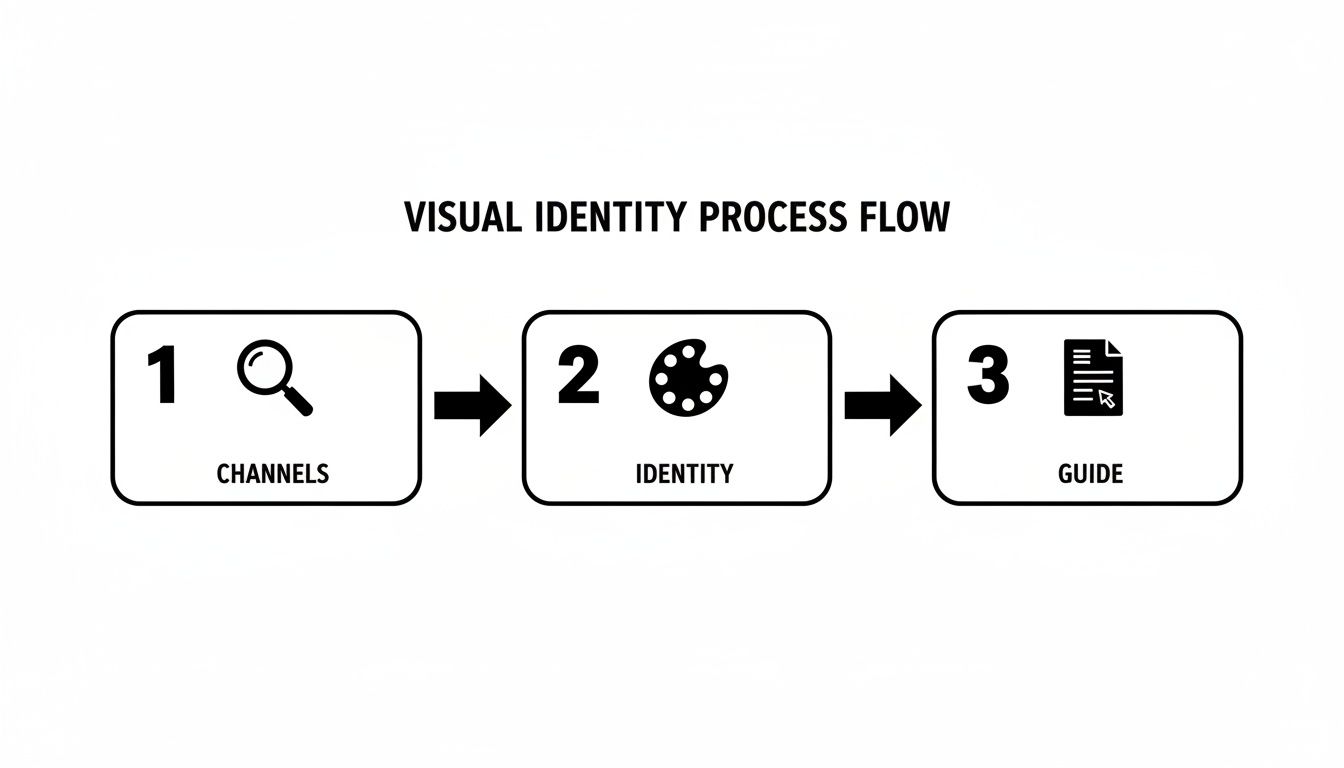
When these pieces work together, your content becomes instantly recognizable and much more effective on the platforms you’ve chosen to focus on.
From Content Pillars To Tangible Posts
Let's see how this works in the real world. Imagine a small marketing agency whose content pillars are "Social Media Strategy," "Content Creation," and "Small Business Growth."
Their content calendar could be built around repeatable formats that bring these pillars to life.
For the "Social Media Strategy" pillar, they might create:
- A weekly "Strategy Session" carousel that breaks down a single strategic concept.
- A monthly "Data Dive" infographic visualizing a key industry trend.
- A bi-weekly "Quick Tip" post sharing a simple, actionable piece of advice.
Suddenly, their feed isn't just a collection of disconnected posts. It’s a cohesive library of resources that people can rely on. This is the heart of what is thought leadership marketing—consistently delivering expertise that your audience finds indispensable.
To help you get started, here’s a quick breakdown of some content formats that are absolute gold for building authority.
Effective Content Formats for Building Brand Authority
| Content Format | Primary Goal | Best For | Key Metric |
|---|---|---|---|
| Carousel | Educate & Instruct | Step-by-step guides, storytelling, tutorials | Saves, Shares, Time on Post |
| Infographic | Simplify & Visualize | Data, statistics, complex processes | Shares, Website Clicks |
| Listicle Graphic | Quick Value & Tips | Top lists, "how-to" advice, common mistakes | Saves, Comments |
| Case Study Snippet | Build Trust & Proof | Showcasing client results, project highlights | Website Clicks, Inquiries |
| Quote Graphic | Inspire & Resonate | Industry insights, expert opinions, motivation | Shares, Likes |
These formats turn abstract expertise into tangible, shareable assets that work for you long after you hit "publish."
When your content consistently solves problems or offers fresh insights, people stop seeing you as just another brand. They start seeing you as an essential resource. That shift is where real authority is built.
The goal is to create material that encourages shares and, even more critically, saves. A "save" is a powerful signal. It means your content is so valuable that someone wants to come back to it later. This is the kind of high-quality, educational material that organically reaches new audiences looking for credible information.
For small businesses or busy social teams, this is often the biggest hurdle. The research, writing, and design required to create these high-value posts is demanding. This is where automating the production of visual graphics can be invaluable, allowing you to maintain a steady flow of professional, authority-building content without the manual grind.
Ultimately, the more you educate, the more you elevate your brand.
Time to Scale: How to Automate Your Visual Content

Consistency is the engine of brand awareness. Show up regularly with high-value, visually cohesive content, and you’ll stay top-of-mind. But for small businesses, agencies, and startups, this is often the single biggest hurdle.
The daily grind of ideation, copywriting, and graphic design is relentless. For teams without a dedicated designer, it’s completely unsustainable. This is where the manual approach to content creation completely breaks down.
When you’re stretched thin, quality drops, your posting schedule becomes erratic, and the momentum you worked so hard to build just evaporates. The solution isn’t working harder; it’s building a smarter system that removes the most significant bottlenecks from your workflow.
Let Robots Do the Heavy Lifting
Instead of staring at a blank canvas every single day, you can now lean on systems that handle the grunt work of visual production. This frees you and your team up to focus on the human side of brand building—strategy, community engagement, and actual customer relationships.
Think about the time it takes to build one multi-slide carousel. You have to research a topic, write sharp copy for each slide, find or create visuals, then meticulously arrange it all in a design tool. That process can easily chew up hours for a single post.
Automating this completely changes the equation.
How AI Agents Streamline Production
This is where AI-powered agents like Postbae come in. They introduce a new level of efficiency by working autonomously in the background. Unlike manual design tools, you don't even have to feed them prompts or ideas. Instead, they generate complete, ready-to-post visual social media graphics tailored to your industry.
This automation handles a few key areas:
- Industry-Specific Ideation: The AI comes up with relevant topics and insights for your niche.
- Content Creation: It writes the educational copy for your carousels, infographics, and listicles.
- Professional Design: It programmatically selects and populates proven visual templates with your branding.
Suddenly, you have a steady stream of authority-building visual content for platforms like Instagram, Facebook, and LinkedIn, without the burnout. The path to better brand awareness is paved with high-quality graphics that educate and engage, and new tech makes this a reality for small teams. To really get ahead, exploring the best AI tools for content creators is a smart move for automating workflows.
By automating the most repetitive and time-consuming parts of content creation, you're not losing control; you're buying back time. This reclaimed time is your most valuable asset for strategic growth and deeper audience connection.
The best part? Automation doesn't mean sacrificing your brand’s unique touch. With a tool like Postbae, every graphic generated is fully editable. You can tweak the colors, rewrite the text, or swap images to ensure every single post aligns perfectly with your brand identity before it goes live.
This blend of autonomous creation and full customization is a massive advantage. Social media is incredibly competitive, and your ability to improve brand awareness hinges on consistency. Picture your brand lighting up feeds worldwide—a reality where 58% of consumers discover new businesses through social media, a figure that now surpasses traditional search. This is where a staggering 83% of Instagram users find new products.
By automating the visual work, you can finally achieve the posting frequency needed to stay relevant and build the recognition your business truly deserves.
How to Measure Brand Awareness Meaningfully
Building brand awareness isn't a "set it and forget it" kind of deal. If you want real growth, you have to treat it as a constant cycle: create, measure, refine, repeat. But what should you actually be measuring? The key is to stop chasing vanity metrics and start digging into data that tells a real story about your brand’s impact.
Likes and follower counts feel good, but they don't paint the whole picture. Often, they're passive indicators that have little to do with whether someone actually remembers your brand when it's time to make a decision. To truly measure your influence, you need to go a level deeper.
This data-driven feedback loop is your greatest asset. It tells you what’s hitting the mark, what's falling flat, and where to put your energy for the biggest return.
Beyond Vanity Metrics: KPIs That Actually Matter
To get a clear picture of your brand's visibility, you need to track key performance indicators (KPIs) that reflect real awareness and audience penetration. These metrics give you a much more accurate view of how far your brand’s message is traveling.
Start by zeroing in on these core indicators:
Reach: This is the big one—the total number of unique people who see your content. It’s the most direct measure of your audience size and the most fundamental brand awareness metric. Are more individuals seeing your stuff this month than last?
Impressions: This metric tracks the total number of times your content was displayed on a screen, regardless of whether it was clicked. High impressions mean your content is showing up in feeds over and over, which is crucial for building that all-important familiarity.
Website Referral Traffic: How many people are actually clicking through to your website from your social media profiles? This is a strong signal of genuine interest and shows your content is compelling enough to drive action.
Social Share of Voice: This KPI is a bit more advanced but incredibly powerful. It measures how much of the conversation around your industry or keywords is about your brand versus your competitors. It's a fantastic way to gauge your market position and track your growing influence over time.
Tracking these numbers gives you a tangible way to answer the question, "Are more people becoming aware of my brand?" It moves your analysis from guesswork to a clear, data-backed understanding.
Tapping into Platform-Native Analytics
The good news? You don’t need expensive third-party tools to start gathering this crucial data. Nearly every social media platform offers a robust, built-in analytics dashboard that provides all the insights you need to get started.
For instance, Instagram Insights gives you detailed breakdowns of reach, impressions, and profile visits for every single post and story. Facebook's Meta Business Suite provides similar data, along with rich audience demographics. Over on LinkedIn, you can track visitor highlights and post impressions to understand your professional audience better.
Dedicating time to regularly review these analytics is non-negotiable. Look for patterns in your best-performing posts.
The goal is to move from simply making content to making content with purpose. Your data reveals what your audience truly values, allowing you to double down on the topics and formats that generate the most reach and engagement.
For example, you might discover that your multi-slide carousels consistently achieve 2x the reach of your single-image posts. That insight is gold. It tells you exactly where to focus your creative energy to grow brand awareness more effectively. For a deeper dive into these metrics, you might want to learn how to measure social media engagement in our detailed guide.
From Data to Actionable Insights
Collecting data is just step one. The real magic happens when you turn that data into actionable insights that shape your future strategy. Your analytics should be the guide for every content decision you make.
Here’s a simple framework to put your data to work:
- Identify Top-Performing Content: Each month, pull a quick report of your posts with the highest reach and impressions. What do they have in common? Are they listicles, infographics, or behind-the-scenes stories?
- Analyze the "Why": Look past the format. Was the topic especially timely? Did the headline ask a compelling question? Understanding why something connected with your audience is the key to replicating that success.
- Refine Your Content Pillars: Use these insights to tweak your content strategy. If posts about "industry trends" consistently crush it, maybe it's time to make that a more prominent content pillar.
- Test and Iterate: Don't be afraid to experiment. Use your data as a baseline, then test new formats or topics. Measure the results and continuously refine your approach based on what the numbers are telling you.
This continuous cycle of measurement and optimization transforms your brand awareness efforts from a shot in the dark into a well-oiled machine for growth. It ensures every piece of content you produce is smarter and more effective than the last.
Got Questions About Brand Awareness? Let's Talk.
If you’re working on building a brand, you’ve probably got questions. Good. Getting clear on the details is what separates a strategy that works from one that just keeps you busy. Let's tackle some of the most common things that come up.
How Long Does It Take to Build Brand Awareness?
There's no magic number here—it's a marathon, not a sprint. The timeline really depends on your industry, how noisy your market is, your budget, and most importantly, how consistent you are.
That said, with a sustained effort, most businesses start seeing real traction in metrics like reach and impressions within 3-6 months. But for that deeper recognition—where people start thinking of your brand unprompted—you're usually looking at a year or more of dedicated work. It's all about momentum.
What Are the Most Important Metrics to Track?
It’s tempting to get hung up on likes and follower counts, but those are mostly vanity metrics. They feel good, but they don't tell you much about your actual visibility.
To get a real sense of your progress, you need to look a little deeper. Prioritize these KPIs:
- Reach: This is the number of unique people who see your content. It’s the clearest measure of how far your message is actually spreading.
- Impressions: The total number of times your content gets displayed. High impressions are what build familiarity and that "I've seen them before" feeling.
- Social Share of Voice: This one’s a big deal. It compares your brand’s mentions against your competitors, showing how much of the conversation you own in your industry.
- Website Referral Traffic: How many people are clicking through from your social channels to your website? This tells you if your content is compelling enough to make someone take action.
Focusing on these numbers gives you a much more honest picture of your brand's growing footprint.
How Often Should I Post to Social Media?
This comes up a lot, and the answer is always the same: quality and consistency beat sheer quantity, every single time. Burning out your team to post three times a day is a waste if the content isn't hitting the mark.
For most small businesses and startups, a really effective sweet spot is posting 3-5 times per week on your main channels. This keeps you top-of-mind with your audience without overwhelming them or forcing you to sacrifice the strategy behind each post.
The goal isn't to be the loudest voice in the room but the most consistent and valuable one. A steady rhythm of high-quality content builds more trust and recognition over time than a sporadic burst of mediocre posts.
Can I Improve Brand Awareness With a Small Budget?
Absolutely. You don't need a massive ad spend to build a memorable brand. In fact, brand awareness often hinges more on creativity and strategic effort than on a huge budget. While paid ads can definitely speed things up, organic growth is where the real power is for smaller businesses.
Your best tool is high-value content that genuinely solves a problem for your audience. That’s what establishes your authority and gets people talking.
This is also where automation becomes a powerful advantage for lean teams. An AI agent like Postbae can autonomously generate a steady stream of professional visual content, like multi-slide carousels and infographics. It gives you the consistent, high-quality presence of a much larger team for a fraction of the cost, freeing up your budget for other things. Best of all, you still have full creative control to customize anything it creates.
Ready to scale your content and build brand authority without all the manual effort? Postbae is an AI agent that works autonomously to create professional, industry-specific visual posts for your social media. Get started and see how effortless great content can be.