Automated Social Media Posts to Save Time and Boost Engagement

Discover how automated social media posts using AI can save time and boost engagement. This guide covers AI content creation, workflows, and best practices.
When you hear "automated social media posts," your mind likely jumps to tools that publish content for you at a set time. Think of them like a reliable mail carrier—you create the post, and the scheduler makes sure it gets delivered on time.
For years, that’s all automation really meant. It was a massive time-saver, sure. You no longer had to be glued to your phone at 8 PM on a Friday just to get a post out.

But a much bigger shift is happening right now, and it’s changing the landscape completely.
The New Automation: AI That Creates Visual Content Itself
The new frontier isn't just about publishing content; it's about AI actually creating the visual social media posts for you from scratch. This is where things get really interesting.
Instead of just delivering the package you prepared, new AI tools are like an entire production studio that builds the complete visual asset for you. This tackles the single most multidisciplinary part of social media: the endless cycle of research, ideation, writing, and design.
For example, an AI agent like Postbae doesn't schedule your posts. It works autonomously to:
- Research topics that are relevant to your niche.
- Write educational copy that positions you as an industry authority.
- Design professional visual graphics, like multi-slide carousels or educational infographics that audiences want to save.
- Populate proven, high-engagement template layouts with this custom content.
This is a huge leap. We’re talking about automating the entire production of visual social media posts. Think about what that means for small businesses, startups, or marketing agencies trying to create a consistent stream of high-quality content without a dedicated design team.
Suddenly, you have an AI working in the background, creating ready-to-post visual content. You can then review, make any desired tweaks, and post. You get all the efficiency of automation without sacrificing your creative control. It’s the best of both worlds.
Comparing Two Types of Social Media Automation
To make it crystal clear, let's break down the difference between the traditional way and the new way. One saves you a little time on logistics; the other saves you a ton of time on creative production.
| Automation Type | Primary Function | Key Benefit | Example Tool Category |
|---|---|---|---|
| Content Publishing | Schedules and publishes pre-made posts at specific times. | Consistency and time management. No more manual posting. | Social Media Schedulers |
| Content Creation | Researches, writes, and designs complete visual social media posts. | Frees up creative resources and solves the "what to post" problem. | AI Content Agents (like Postbae) |
Ultimately, schedulers solve the "when" of social media. AI visual content creators solve the "what." Understanding that distinction is key to building a truly efficient content strategy that doesn't just save you time, but also eliminates creative burnout.
How AI Creates Visually Engaging Content
Not long ago, "automated social media posts" might have meant generating a few lines of text. That's changed. The AI we have today is more like a complete creative agent, handling everything from initial research and writing all the way to the final graphic design.
This is a major advantage for small businesses and agencies who struggle with the constant demand for visual content. Instead of waiting for you to feed it prompts, a smart AI gets to know your business first. It looks at your industry, your audience, and your core focus. Think of it as a built-in strategist that figures out your niche without you needing to write a 10-page brief.

From Raw Data to Polished Graphics
Once the AI has a handle on your business, it kicks off a process that looks a lot like what a human content team would do. It’s a step-by-step workflow to build complete, ready-to-post visual graphics from the ground up.
Here’s how it usually breaks down:
- Topic Identification: The AI scours the web for relevant topics, trends, and common customer questions in your space. It's looking for authority-building opportunities, like "5 Common Mistakes in [Your Industry]" or "The Top Benefits of [Your Service]."
- Content Drafting: After locking in a topic, the AI drafts short, punchy copy that provides real value. It's all about creating shareable tips, interesting facts, or myth-busters that are perfect for visual formats like carousels.
- Template Selection: Next, the system pairs the content with a professionally designed template. A listicle gets a list template. A comparison gets a side-by-side design. The goal is to ensure the visuals effectively communicate the message.
- Programmatic Design: In the final step, the AI automatically populates the template with the text and on-brand elements. The result is a finished, polished visual asset, ready for your social media channels.
The Power of Promptless Automation
A key innovation here is promptless automation. This is where the AI works in the background without needing daily instructions from you.
Take Postbae, for example. It’s an AI agent that continually creates industry-specific visual posts on its own. You set up your profile once, and the system takes over, generating a steady stream of carousels, infographics, and educational listicles.
This hands-off approach turns visual content creation from a daily chore into a background process. It frees you up to focus on the bigger picture—strategy, engagement, and actually talking to your customers—while the AI handles the production of visuals.
But here’s the crucial part: even though the creation is automated, you never lose control. Every single part of a generated post—the text, the colors, the images, the layout—is fully editable. You can tweak and customize everything until it’s a perfect fit for your campaign or brand voice.
This blend of autonomous creation and human oversight is what’s making professional automated social media posts a reality for everyone, not just large companies with huge marketing teams. You can see more of how this works in our guide to AI social media content creation.
What’s The Benefit of Automating Visual Content?
Creating genuinely good visual content for social media—like slick multi-slide carousels or infographics that teach something valuable—is a multidisciplinary effort. It’s not just one job; it’s several. You have to be a researcher, a copywriter, a designer, and a strategist all at once.
The most obvious win from automating this process is the sheer amount of time you get back. We're talking about dozens of hours every single month. Instead of losing a full day brainstorming and working in design software, an AI can quietly generate a week's worth of professional-looking graphics while you focus on other tasks.
That time saved isn't just a minor perk; it's a direct return on your investment. It's more time you can spend on strategy, engaging with customers, or growing your business.
Scale Your Content Without Scaling Your Team
Here’s a common challenge for small businesses and marketing agencies: you need to post more to grow, but posting more requires hiring people you may not be able to afford. A full-time social media manager or a graphic designer represents a significant expense.
Automation completely changes that equation.
A tool like Postbae can give a solo entrepreneur the output of a small content team for just $30/month. The AI works in the background, creating visual posts relevant to your industry, letting you show up consistently on Instagram, Facebook, and LinkedIn without adding a single person to your payroll. It levels the playing field, making professional-quality content accessible to everyone.
Nail Your Brand Consistency, Every Single Time
Brand consistency is one of those things that feels abstract but is absolutely critical for building trust. When you're rushing or have multiple people making posts, it’s easy for things to go off-brand—the wrong font, a slightly off color, an inconsistent layout. It happens.
Automation solves this. You set your brand guidelines once—your colors, fonts, and logo—and the AI uses that blueprint for everything it creates. Every single graphic, from a simple quote post to a detailed carousel, looks and feels like it came from the same professional source. It creates that cohesive, polished feed that makes your brand look established and trustworthy.
Boost Engagement and Become the Go-To Authority
Ultimately, social media is about connecting with people. And the fastest way to do that is by consistently providing real value. Automation tools are designed to produce authority-building content that actually helps your audience. Think industry insights, useful tips, and data-backed facts that position you as the expert.
Saving time is great, but this is where the strategy comes into focus. Knowing how to effectively boost overall customer engagement is the goal. The numbers back this up.
Research predicts that by 2025, a whopping 83% of marketing departments will be automating their social media. Why? They’re seeing an average engagement lift of 20-30% per post. That jump comes directly from the steady stream of high-value content that automation makes possible. You can dig into more of the data and trends in social media automation if you're curious.
Choosing The Right Automation Tools and Approaches
Navigating the world of social media tools can be confusing. Nearly every platform promises to make your life easier, but most just add complexity. The key is realizing that not all automation is the same. Different tools solve different problems, and picking the right one starts with asking one direct question.
Where’s the real bottleneck in your workflow? Is it the simple act of scheduling posts you’ve already made? Or is it the time-consuming grind of actually creating the content—the research, the writing, and the design? Your answer changes everything.
Differentiating Between Tool Categories
To make a smart choice, let's cut through the marketing jargon and break these tools into three main categories. Each one plays a different role in your content strategy, from hand-crafting visuals to automatically producing and publishing them. Understanding the difference will show you exactly where you're losing time and resources.
- Manual Design Tools: Think of these as your digital art supplies. They give you a blank canvas and all the elements you need to create something from scratch. They offer total creative freedom but demand a significant amount of your time, energy, and design skill to get professional-looking results. You are responsible for everything: the idea, the research, the copywriting, and every design decision.
- Social Media Schedulers: These tools are the delivery service of your social media strategy. They do one thing, and they do it well: publishing. You feed them finished content, and they push it live at the perfect time. However, they don't help you make the content. You still have to arrive with ready-to-go visuals and captions.
- Automated Content Creation: This is the newer category, built to tackle the most demanding part of the entire process—the actual content creation. An agent like Postbae doesn't just give you a canvas; it acts as your autonomous content team. It researches topics, writes copy, and designs entire professional graphics like multi-slide carousels, all tailored to your brand and industry.
This category is growing rapidly for a reason. The AI social media management market is projected to jump from $2.1 billion in 2021 to a staggering $12 billion by 2031. Right now, 56% of marketers are already using AI, and two-thirds of them are seeing better campaign results because of it.
A Head-to-Head Comparison
Let's put these tools side-by-side to see where something like Postbae fits in. While schedulers handle the delivery and design tools provide the canvas, Postbae is the automated production factory that creates the high-value visual assets you need to fill your calendar in the first place.
Comparing Social Media Tool Categories
This table breaks down the key differences, showing why Postbae isn't just another scheduler or design tool—it's in a category of its own, focused on automated production of visual content.
| Feature | Automated Content Creation (Postbae) | Manual Design Tools | Social Media Schedulers |
|---|---|---|---|
| Primary Function | Autonomous content production | Manual content design | Automated content publishing |
| Time Investment | Low: Autonomous background creation | High: Requires hours of hands-on work | Medium: Requires pre-made content |
| Skill Requirement | Minimal: No design skill needed | High: Requires design and copy skills | Low: Simple scheduling interface |
| Content Ideation | Fully Automated: AI researches topics | Fully Manual: You do all the research | Not Included: You supply the ideas |
| Visual Creation | Fully Automated: Designs carousels, posts | Fully Manual: You design every element | Not Included: You supply the visuals |
| Best For | Scaling high-quality visual content production | Full creative control over single designs | Distributing a pre-made content calendar |
As you can see, the choice depends entirely on what problem you're trying to solve. An AI social media post generator is for the marketer who's tired of the creation bottleneck and wants to scale output without scaling their workload.
If you want to go deeper, our guide on choosing a social media content creation tool breaks it down even further.
Ultimately, Postbae was built for people who need to automate the production of authority-building visual content, not just its publication. It does the heavy lifting for you, while still giving you full editing control to add that final, human touch.
Building a Practical Workflow for Automated Content
So, how do you actually plug this kind of automation into your day-to-day social media process without disrupting everything? It’s simpler than you might think. You’re not replacing your whole system; you’re just integrating a smart content creation engine to handle the heavy lifting.
The key idea is to separate content production from content publishing. Think of them as two distinct jobs. One is about making the visual assets—the graphics, the carousels, the TikTok slideshows. The other is about distributing that content to the world. When you separate them, you can optimize each one individually.
This means you can let an AI agent like Postbae generate a steady stream of high-quality visuals, and then use your favorite scheduler—like Buffer or Hootsuite—to handle the distribution. It's the best of both worlds: automated creativity meets streamlined publishing.
The Automated Visual Content Workflow
Here’s a simple, five-step process that shows exactly how a tool like Postbae fits into a modern marketing workflow. It takes the unpredictable, time-consuming task of visual content creation and turns it into a predictable system. This frees you up to focus on what matters most, like strategy and engaging with your audience.
Set Your Foundation: First, you need to introduce the AI to your brand. In Postbae, you'll set up your business profile. This is where you provide the essential context—what industry you're in, your brand's style, and who you're trying to reach. This initial setup is what allows the AI to generate content that is relevant to your business.
Activate Autonomous Creation: Now, let the AI get to work. You don't need to provide it with prompts or manage it daily. The system will operate on its own, generating a batch of professional visual posts, including multi-slide carousels, educational listicles, and graphics with industry tips.
Review and Customize: Once the posts are ready, it's your turn to be the editor. This is where you have 100% creative control. You can jump into the editor to tweak the text, switch up the brand colors, or ensure the visuals perfectly match your latest campaign.
Download Your Assets: Once you are happy with the edits, you can download all the polished, ready-to-use visuals. They’re yours to use however you want, on any platform.
Publish Your Content: Finally, take those new graphics and upload them to your preferred social media scheduler, or just post them directly. Your content calendar is now full and the creative work is done.
This flowchart breaks down the process into its core stages: design, create/schedule, and publish/analyze.
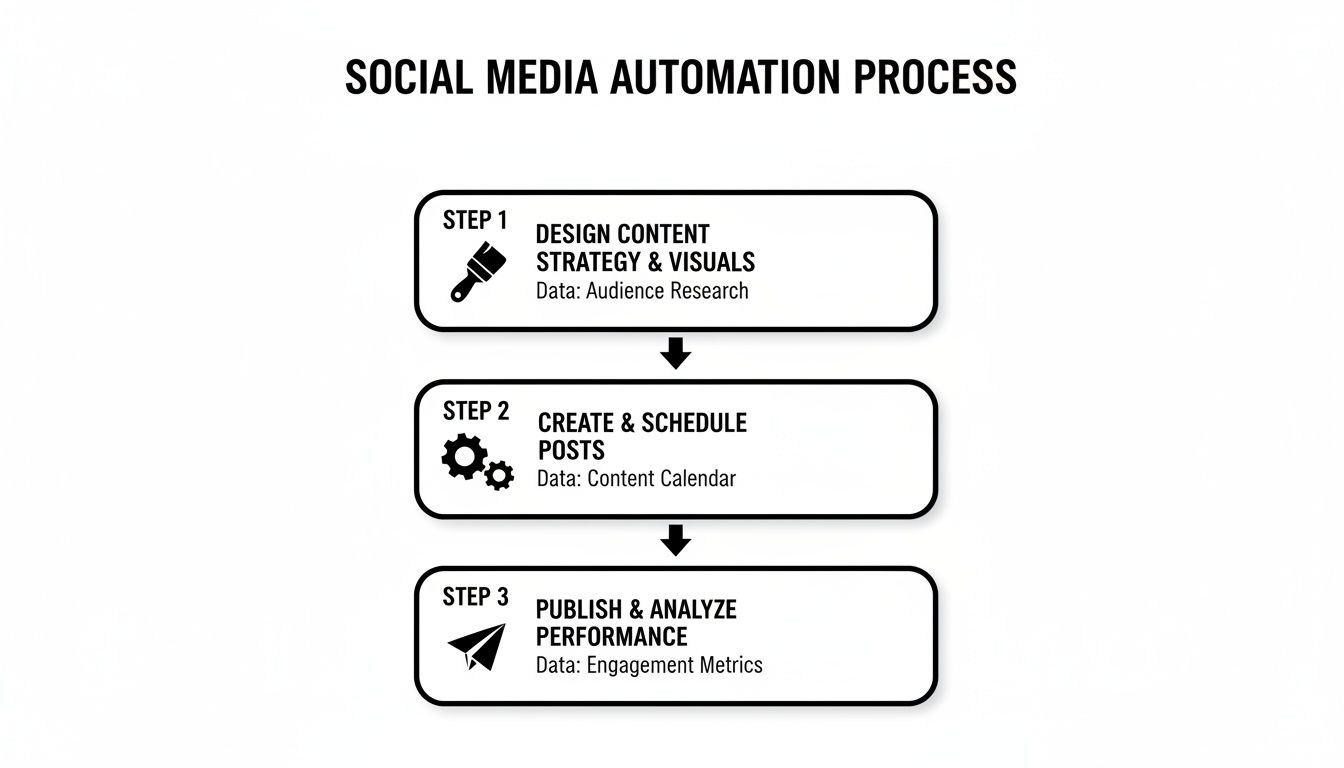
As you can see, tools like Postbae act as a powerful engine inside your larger strategy. They automate the most challenging part of the job—the actual creative production—so you can put your energy into distribution and analyzing what works. By slotting this workflow into your process, you’re turning automated social media posts from a simple scheduling task into a full-blown content generation machine.
Measuring the Success of Your Automated Strategy
Automation isn't just about saving a few hours in your week. It’s about getting actual, measurable results. To determine if your automated social media posts are truly effective, you have to look past vanity metrics like likes and follower counts.
While those numbers provide a quick confidence boost, they don't tell you if you're building real authority or earning your audience's trust. The real proof is in the actions people take when your content genuinely provides value.
Key Performance Indicators for Authority Building
When you’re using a tool like Postbae to create educational, visual content, your focus should shift to KPIs that signal a much deeper connection. These posts are designed to be resources, not just images, and they trigger actions that go beyond a simple double-tap.
Here are the metrics that actually matter:
- Share Rate: This is the ultimate sign of value. It means someone found your content so useful they put their own reputation on the line to share it with their network. It's a powerful signal of expertise.
- Save Rate: A high save rate, especially on carousels and infographics, tells you that your audience sees your content as a resource they need to come back to. You've established yourself as a source of valuable information.
- Comment Quality: Look past "great post!" comments. You're looking for genuine questions, detailed feedback, and real discussions. That's a sign your content is making people think.
Tracking these deeper metrics is crucial. When people save and share your content, they’re essentially endorsing you as an expert in your field. They're helping expand your reach to the right kind of audience.
This is exactly why AI-powered content is gaining traction. A recent study found that 71% of social media marketers say AI-created content actually performs better than content made only by humans, driving more of this meaningful engagement. You can explore more of these eye-opening AI in social media statistics if you're interested.
By consistently delivering high-quality, educational visuals, you'll start to see these key metrics climb in your platform's native analytics. For a deeper dive, check out our full guide on how to measure social media engagement the right way.
Got Questions About Social Media Automation?
Stepping into the world of automated social media can feel new, especially when AI is handling creative work. It’s completely normal to have questions. Let’s tackle some of the most common ones.
Will My Automated Posts Sound Like a Robot Wrote Them?
Not with the right tools. Older automation tools could be generic, but modern AI, like what's built into Postbae, is entirely different.
It’s designed specifically to create educational, industry-specific content that makes you look like an expert. The AI researches your niche to find relevant tips and insights, so the visual posts feel genuinely helpful to your audience, not like a generic template. Plus, you can edit every single word, so your unique brand voice always has the final say.
Can I Still Control My Brand's Look and Feel?
Absolutely. This isn't about the AI taking over your brand; it's about giving you back your time.
While the AI agent generates the first draft of your visual posts—saving you hours of brainstorming and design—you have 100% control to customize everything. You can tweak the colors, swap fonts, change images, and rewrite text to make sure every post is perfectly on-brand before it ever sees the light of day. It's the efficiency of AI combined with full human control.
Isn't This Kind of Thing Only for Big Companies with Huge Budgets?
It’s the opposite. Automated visual content is a valuable tool for small businesses, startups, and anyone who doesn't have a full-time designer on their team.
Affordable tools are leveling the playing field. For a low monthly cost, you can produce a steady stream of professional, high-quality social media content that competes with larger brands. It’s like having a social media manager and a graphic designer on your team for a fraction of the cost.
Ready to stop staring at a blank canvas and start building your authority on autopilot? With Postbae, you can generate a month's worth of professional, ready-to-post visual content. Check out how it works at https://postbae.com.