A Practical Guide to AI for Small Business Marketing

Discover how AI for small business marketing can automate visual content, personalize campaigns, and drive growth. Learn practical strategies and tools today.
Using AI in your marketing isn't some far-off, sci-fi concept anymore—it's here, it's affordable, and it's a real strategy you can use to grow your business. Today, AI tools can automate repetitive tasks, uncover deep truths about your customers, and let a small team punch way above its weight class, running campaigns that used to be only for the big guys with deep pockets.
How AI Is Redefining Small Business Marketing

If you're running a small business, you know time is the one thing you can't buy more of. Traditional marketing eats it up—designing social media graphics, agonizing over ad copy, trying to make sense of analytics, and personalizing emails one by one. This is exactly where AI comes in. Think of it less as a replacement for your brain and more as a powerful assistant that handles the execution.
AI marketing tools are built to do the heavy lifting. This frees you up to stop being a graphic designer or data analyst and get back to being a business owner. You can focus on the stuff that really moves the needle, like talking to customers and thinking about the big picture. Instead of burning a whole afternoon on one social media graphic, an AI tool can whip up a week's worth of professional visual posts in minutes.
The Shift from Manual Effort to Intelligent Automation
The core value that AI for small business marketing brings to the table is the jump from painful manual effort to smart, intelligent automation. That shift lets you operate with the efficiency of a much larger team, finally leveling the playing field.
Just think about the daily headaches you probably face:
Consistent Content Creation: Keeping your social media feeds alive and looking sharp demands a constant flow of quality visual graphics. That's a huge ask without a full-time designer on staff.
Effective Ad Campaigns: Getting the most out of your digital ads means constantly tweaking and monitoring them to maximize your return. It’s a complex, time-sucking task if you’re not an ad expert.
Personalized Customer Communication: You know you need to tailor your emails and messages to what customers actually care about, but trying to manage that for everyone by hand is a recipe for burnout.
AI-powered platforms tackle these problems head-on by putting the processes on autopilot. To really see how this works for local shops and services, it's worth exploring how marketing automation for small businesses can directly boost growth and make your life easier.
The point of AI in marketing isn't just about doing things faster. It's about doing the right things more effectively. It gives you the data-backed insights to connect with people on a deeper level, without needing a huge budget or a Ph.D. in computer science.
By plugging these smart tools into your workflow, even the smallest of businesses can tap into seriously powerful marketing capabilities. It gives you a fighting chance to build your brand, engage your audience, and grow in ways that, until recently, were completely out of reach.
Understanding Core AI Marketing Capabilities
To really get what AI can do for your marketing, you have to look past the hype and focus on what it actually does. Don't think of AI as one giant, scary robot. Instead, picture it as a set of specialized tools, each one built to solve a specific, nagging problem you face every single day.
Think of each capability as a dedicated expert on your team, working 24/7 to handle the stuff that drains your two most precious resources: time and money.
To make this crystal clear, let's look at how these AI tools stack up against the old-school, manual way of doing things.
Comparing Manual Marketing vs AI-Powered Marketing
This table breaks down the difference between grinding it out yourself and letting an AI co-pilot take the wheel for common marketing tasks.
| Marketing Task | Manual Approach (Without AI) | AI-Powered Approach (With AI) |
|---|---|---|
| Visual Content Creation | Brainstorming ideas, writing drafts, and designing social media graphics from scratch. It's slow and requires constant creative energy. | Automatically generates complete, professional visual social media posts like carousels and infographics based on your industry. |
| Ad Management | Manually setting bids, guessing audiences, and checking performance daily. It's a constant cycle of tweaking and hoping for the best. | Automatically adjusts bids in real-time, finds new customer segments, and reallocates your budget to the ads that are actually working. |
| Customer Personalization | Sending the same generic email blast to your entire list. Maybe you segment by "new customers," but that's about it. | Analyzes customer behavior to send hyper-relevant emails, show personalized website offers, and create one-on-one experiences at scale. |
| Data Analysis | Drowning in spreadsheets, trying to spot trends in website traffic or sales data. It's overwhelming and often leads to guesswork. | Instantly processes massive amounts of data to find your most profitable customers, predict future trends, and give you clear, actionable insights. |
The difference is pretty stark, right? It's not about replacing you; it's about giving you superpowers to get more done with less effort. Let’s dive into what these capabilities look like in the real world.
Automated Visual Content Creation
For most small businesses, creating a steady stream of professional-looking social media graphics is a constant headache. It takes design skills, creative juice, and time you just don't have. This is where AI content creation tools are an absolute lifesaver.
Imagine an AI agent who knows your industry, understands what your audience finds interesting, and just… designs complete visual posts for you. That’s exactly what tools like Postbae are built to do. This kind of AI agent works autonomously in the background—no prompts needed—to generate ready-to-post visual content.
With Postbae, you benefit from a steady stream of authoritative educational content that requires significant effort to conceptualize, write, and transform into captivating visual posts ideal for Instagram or TikTok slideshows. This includes: - Multi-slide educational carousels - Visually engaging listicles - Helpful tips & tricks visual posts
This completely takes the production of authority-building visual content off your plate, saving you countless hours. The best part? While the generation is automated, you still have 100% creative control to fully edit and customize every post before it goes live.
Intelligent Advertising and Campaign Management
Running digital ads can often feel like playing slots in Vegas, especially when you have a small budget. You place your bets, pull the lever, and just hope you don't lose your shirt. AI flips this on its head by adding a layer of smart automation that makes every single dollar work harder for you.
AI-powered ad platforms act like a tireless campaign manager that analyzes performance data in real-time. They automatically adjust bids, shift your budget to the ads that are crushing it, and even find new audience pockets you might have completely missed.
AI tools have totally changed the game for marketing efficiency. In fact, 75% of companies report better customer engagement from AI-enhanced ads. Systems like Google's Performance Max take out the manual guesswork, and smart bidding can improve cost-per-acquisition by 25-30%, delivering a much better ROI for small businesses. You can find more stats on AI's impact on advertising effectiveness.
Enhanced Customer Personalization
Generic, one-size-fits-all marketing just doesn’t fly anymore. Your customers expect you to talk to them like you actually know them. AI makes this kind of deep personalization possible at a scale that used to be unthinkable for a small team.
By looking at customer data—like purchase history, website clicks, and email opens—AI can help you create hyper-relevant experiences. This could be an automated email with product recommendations based on what someone just looked at, or a unique pop-up offer on your site tailored to a visitor's location.
This moves you away from shouting at a crowd and toward having meaningful, one-on-one conversations that build real loyalty and drive sales.
Data-Driven Analytics and Insights
Your business data is a goldmine. Buried in your website traffic, sales figures, and social media metrics are the answers to your biggest questions. The problem? Manually digging through all that data to find the gold is nearly impossible.
AI analytics tools act like your own personal data scientist, crunching huge amounts of information to spot patterns you’d never see on your own. These tools can tell you who your most profitable customers are, predict which products will be hot next month, or pinpoint the exact spot where people are dropping out of your sales funnel.
This gives you clear, actionable insights so you can stop guessing and start making smarter business decisions.
Ditching the Design Grind with AI Visuals
Look, AI is great at writing emails and crunching numbers, but let's talk about one of its most powerful uses for small businesses: tackling the never-ending headache of creating visual content. If you're like most owners, churning out a constant stream of professional, eye-catching graphics for social media is one of the most brutal, time-sucking parts of marketing. This is where specialized AI agents are stepping in to completely change the workflow.
These aren't just fancy templates or text generators. Think of them as your own autonomous creative partner, handling the entire visual creation process from the first spark of an idea to the final, ready-to-post graphic. No more staring at a blank canvas, brainstorming topics, and then wrestling with design elements for hours. The AI does it all for you.
Moving Beyond the Manual Design Bottleneck
The old way of creating social media graphics is a massive roadblock. You either have to be a design wizard yourself, shell out cash for a freelancer, or sink precious hours into manual design tools. It’s a recipe for inconsistent posting, generic-looking content, or just throwing in the towel altogether.
An AI agent built specifically for visuals flips this entire dynamic on its head. Imagine an AI that not only understands your industry but also knows exactly what kind of content builds trust and gets people to pay attention. Then, it just... makes it. Autonomously.
That's the whole idea behind Postbae. It's an AI agent designed to automate the creation of professional visual graphics for platforms like Instagram, Facebook, LinkedIn and TikTok. It works quietly in the background, generating a steady supply of industry-specific visuals without you even having to ask.
The point of this tech isn't just to make a task faster; it's to completely lift a huge operational weight off your shoulders. It gives small businesses the firepower of an in-house design team for a tiny fraction of the cost, delivering content that proves you know your stuff.
What Real Visual Automation Looks Like
True automation here means the AI is juggling multiple creative and strategic steps at once. It’s not just slapping some text on a colorful background; it's a sophisticated process that produces content people actually find valuable.
For a small business, this means a steady stream of scroll-stopping formats, like:
Multi-Slide Educational Carousels: Perfect for breaking down complex ideas into bite-sized, engaging slides that people love to save and share.
Illustrated Listicles: The AI can whip up posts like "5 Common Mistakes in..." or "3 Ways to Improve..." with compelling graphics for each point.
Myth-vs-Fact Infographics: These instantly position your brand as the expert by clearing up common confusion in your field.
"Did You Know?" Fact Cards: Quick, shareable nuggets of information that are easy to digest and build your authority one post at a time.
Visual Tips & Tricks: Actionable advice presented in a clean, graphical format that your audience can use right away.
Postbae specializes in this exact type of authority-building educational content. Instead of churning out pushy sales posts, it focuses on content that helps you build a loyal following by consistently teaching them something useful. That's how you build real trust and stay top-of-mind.
And here’s the best part: while the content creation is completely automated, you don't give up control. Every single graphic the AI agent generates is fully customizable. You get the insane efficiency of automation but still have the final say to tweak the wording or inject your unique brand personality. You can dive deeper into how this changes the game in our guide to AI social media content creation. By offloading the visual heavy lifting, you get your time back to focus on actually growing your business.
Your Step-by-Step AI Adoption Roadmap
Bringing AI into your marketing doesn't mean you have to flip your entire strategy upside down overnight. The best approach is gradual and smart. Think of it like starting a new workout routine; you begin with manageable exercises, see the results, and then build on that success.
This simple, four-step roadmap will help you weave AI tools into your daily workflow without the overwhelm. It’s designed to be approachable, measurable, and to deliver real impact right from the start.
1. Find Your Biggest Marketing Bottleneck
Before you even glance at a single AI tool, stop and ask yourself: what’s the single biggest headache in my marketing right now? What task eats up the most time or drives me absolutely crazy?
Is it the never-ending need for fresh social media graphics? Maybe it’s staring at analytics reports, trying to figure out what’s actually working. Pinpointing this specific pain point is the most critical first step. It gives you a clear target and ensures your first dip into AI solves a real, immediate problem for your business.
2. Research and Pick the Right Tool
Once you know the problem, you can hunt for the solution. Instead of getting blinded by a million different features, just focus on a few things that actually matter.
Is it easy to use? You're a business owner, not a data scientist. Look for a clean interface and a setup process that doesn't require a computer science degree.
Does it solve your problem? If your bottleneck is creating visual graphics, a fancy AI text generator isn't going to help. Stay focused on the tool that directly fixes your biggest headache.
How much does it actually automate? Some tools just create more busywork, requiring you to constantly feed them prompts. The best ones work autonomously in the background, freeing you up to focus on strategy.
For a ton of small businesses, that bottleneck is creating visual content. If that's you, a dedicated social media content creation tool can be a perfect starting point, automating graphics so you can get back to running your business.
3. Start Small and Measure Everything
Alright, time to test it out. But don't try to automate your entire marketing department at once. Pick one specific, measurable goal for a pilot project. For instance, you could automate the creation of all your visual content for Instagram for one month. That’s it.
This small-scale experiment lets you track results without blowing up your current workflow. You can measure concrete metrics like hours saved on design, an increase in how often you post, or a jump in audience engagement. This data is your proof. It shows you the tool’s value and makes it a no-brainer to expand later.
The whole process of AI turning your brand guidelines into ready-to-use content is shockingly efficient.
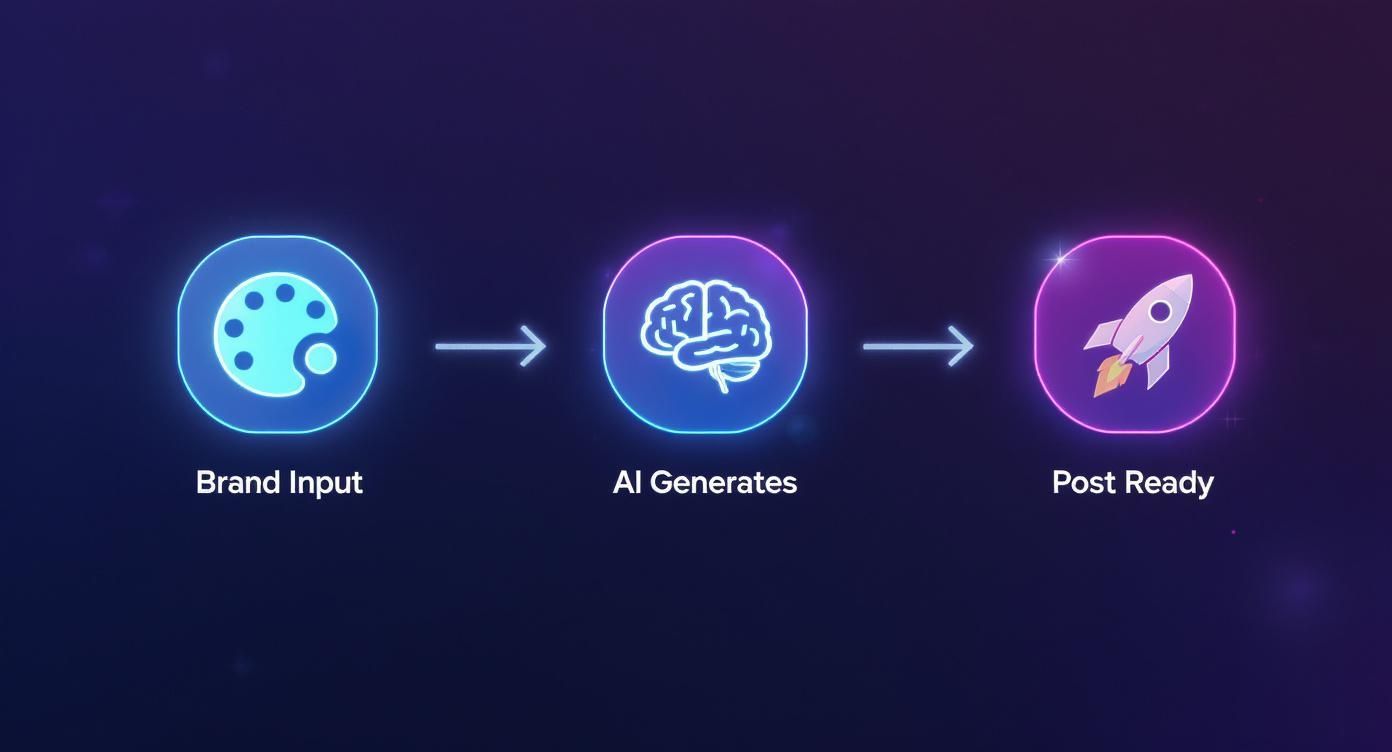
This workflow shows exactly how AI takes your brand inputs and spits out finished posts, cutting out all the tedious manual steps in between.
4. Scale and Integrate Across Your Strategy
Once your pilot project has delivered clear wins, it's time to scale up. If automating Instagram graphics saved you 10 hours a month, imagine what happens when you roll that out to Facebook and LinkedIn.
Interestingly, many businesses are getting started without big upfront costs. Research from the U.S. Small Business Administration found that about half of small businesses using AI reported no specific investment in things like software or training. They’re just jumping in. On average, they use AI for about two different business functions, which shows that this gradual, targeted approach is what works in the real world.
Key Takeaway: The goal isn't just to automate one task; it's to build a connected system where AI tools make your entire marketing engine run smoother. Each successful test builds momentum, making it easier to integrate AI into other areas like ad management or customer personalization down the line.
Real-World Examples of AI Marketing Success

Theory is great, but seeing how AI actually works in the trenches is what really matters. Let's move past the abstract ideas and look at tangible wins.
I'm going to walk you through how three different small businesses—just like yours—used specific AI tools to crush major challenges, claw back their time, and seriously fuel their growth. These stories show just how powerful a targeted AI solution can be, whether you're running a local shop, an online store, or a consulting practice. Each one breaks down the problem, the AI they used, and the results they could actually measure.
Boosting Engagement for a Local Cafe
The Challenge: A cozy neighborhood cafe was getting absolutely buried on social media. The owner was juggling staff, ordering beans, and mopping floors—leaving zero time to create professional-looking visual posts. Their Instagram was a ghost town, failing to capture the cafe's vibe or build any kind of online community.
The AI Solution: The owner signed up for an AI agent called Postbae, which is designed to automate the creation of visual social media graphics. The AI agent just ran in the background, churning out a steady flow of professional graphics that matched the cafe's brand. It autonomously created everything from "Did You Know?" facts about coffee to multi-slide carousels showing off the weekly pastry specials.
The real magic was that it was true automation—the owner didn't have to sit there writing prompts. The AI agent just made industry-specific visual posts, which the owner could quickly review, fully edit, and then post.
The Measurable Outcome: Within three months, the cafe's social media presence was unrecognizable. They were posting three times as often, and their average post engagement shot up by over 150%. The consistent, high-quality visual posts turned them into a local authority on all things coffee and drove a noticeable increase in foot traffic.
Slashing Ad Spend for an E-Commerce Brand
The Challenge: A small e-commerce brand selling handmade leather goods was basically setting money on fire with their digital ads. Their cost to acquire a new customer was sky-high because they had no clue how to properly optimize their campaigns. They were just guessing at audience targeting, and it was costing them a fortune.
The AI Solution: They plugged in an AI-powered advertising tool that took over the tedious parts of campaign management. The AI watched their performance data like a hawk, tweaking bids in real-time to get more conversions and shifting the budget to the best-performing ads and audiences automatically.
The Measurable Outcome: After just two months, the AI had cut their customer acquisition cost by a whopping 40%. It even found profitable new audiences they had never thought to target. This allowed the brand to scale up their ad budget with confidence, leading to a 30% bump in overall sales without spending a single extra dollar.
Converting More Leads for a Business Consultant
The Challenge: A business consultant was great at getting leads from a free webinar but terrible at turning them into paying clients. Her follow-up email sequence was a generic, one-size-fits-all disaster that she sent to every single lead. Unsurprisingly, open rates were low and conversions were even lower.
The AI Solution: She switched to an AI-driven email marketing platform to personalize her follow-ups. The AI tracked what each lead did—like which parts of the webinar they re-watched or which links they clicked—and used that data to segment them automatically. It then sent hyper-targeted messages with case studies and content that spoke directly to each person's specific problems.
The Measurable Outcome: The personalized, AI-powered emails resulted in a 75% increase in open rates and more than doubled her lead-to-client conversion rate. Better yet, the automation freed up more than ten hours of her time every week, which she poured back into client work and growing her business.
How to Measure Your AI Marketing ROI
Look, bringing AI into your marketing isn't just a cool tech experiment. It’s about getting real, measurable results that actually move the needle for your business. To know if any tool is worth the money, you've got to be able to track its return.
Measuring your AI marketing ROI means looking at the hard numbers, but also paying attention to the strategic wins that aren't so easy to slap on a spreadsheet. Let's break down what you should actually be tracking.
Key Quantitative Metrics to Track
The fastest way to see if your AI tools are paying for themselves is to look at the impact on your resources and revenue. Don't get lost in a sea of data; just focus on these three things.
Time Saved (Converted to Dollars): This one's a no-brainer. Figure out how many hours your team is getting back by automating tasks like creating social media graphics or tweaking ad campaigns. Multiply those hours by a realistic hourly rate, and you’ve got a clear dollar value. This is your most immediate win.
Reduced Cost Per Acquisition (CPA): If you’re using AI for your ads, keep a close eye on your CPA. AI-driven campaigns are shockingly good at finding cheaper ways to reach your ideal customers, which can seriously lower the cost of getting a new one.
Increased Engagement Rate: When you're using AI to create content, the whole point is to grab and hold attention. Are people liking, sharing, commenting, and saving your posts? That’s your proof that the content is hitting the mark. Our guide on how to measure social media engagement can help you figure out what "good" looks like.
Essential Qualitative Measures
Not every win shows up in your bank account right away. Some of the most important benefits are about building a stronger brand for the long haul.
Think about how AI is changing your brand's presence. Are your social media graphics looking more polished and consistent? Is your blog content better, positioning you as the go-to expert in your space? These things build trust and brand equity over time, which is priceless.
For e-commerce stores, using AI in your outreach can be a game-changer. There are some great strategies for maximizing Shopify store profits with automated email campaigns that show you how to measure the specific ROI from that kind of automation.
This isn't just a trend, by the way. A 2025 report found that 58% of small businesses are now using generative AI—that's more than double the number from 2023. And it's not just about cutting costs; 82% of those businesses also grew their workforce, proving AI is a tool for growth, not just replacement. You can read the full research on how small businesses are embracing AI.
Your Questions About AI Marketing, Answered
Jumping into AI for your marketing can feel like a big step, and it's totally normal to have a few questions. Actually, it's smart. Getting straight answers is the first step to making good decisions. Here are some of the most common things we hear from small business owners who are right where you are now.
Is This AI Stuff Going to Bankrupt Me?
Not a chance. A few years ago, maybe. But today? The game has completely changed. While the giant, enterprise-level AI systems can still cost a fortune, tons of powerful tools built specifically for small businesses are ridiculously affordable.
In fact, some of the marketing platforms you’re probably already using are adding AI features for free.
And for specialized tools, like an AI agent that automatically generates your social media graphics? You're often looking at a low monthly subscription. A tool like Postbae, for instance, gives you the power of an entire design team for a flat $30 per month. That's like having a full-time social media manager for a fraction of the cost. The trick is to start small. Pick one tool that solves your single biggest time-suck, and you'll see a return on that investment almost immediately.
Do I Need to Be a Tech Genius to Use This?
Absolutely not. The best AI marketing tools today are built for business owners, not coders. They’re designed with clean, simple dashboards that do all the heavy lifting behind the scenes. You never have to see a line of code or understand a single algorithm.
For example, an AI content agent like Postbae works on its own to create professional-looking visual posts. You don't write complex prompts or need any design skills. These tools are meant to take work off your plate, not add a new technical headache to it.
Will AI Make My Marketing Sound Like a Robot?
This is a huge—and totally valid—concern. But here's the twist: the right AI tool actually helps your marketing feel more human, not less.
Think about it. AI is at its best when it handles the boring, repetitive tasks that drain your creative energy. This frees you up to focus on what really matters: big-picture strategy and having real, one-on-one conversations with your customers.
AI-generated educational content, like data-driven infographics or handy carousels for your industry, builds your authority and trust in a very real way. Plus, the best tools give you full editing capabilities, so you always have the final word. You can easily tweak the text to inject your unique brand voice, giving you the perfect mix of automation and personal touch. It ensures your marketing always sounds like you.
Ready to get your time back and finally have a social media presence you're proud of? Let Postbae’s AI agent take over the visual content creation. You'll get a consistent stream of professional, authority-building graphics for Instagram, Facebook, and LinkedIn—all on autopilot. Start automating your visual marketing today.