Marketing Automation for Small Businesses: A Practical Guide

Discover marketing automation for small businesses with practical steps, templates, and strategies to boost efficiency and growth.
For a small business owner, marketing automation is the closest thing you'll get to cloning yourself. It’s software that takes over the repetitive, soul-crushing marketing tasks, freeing you up to actually run your business. Think of it as your new 24/7 digital employee—the one who never sleeps, never complains, and is perfectly happy sending emails, updating customer lists, and helping to create content for you. It’s how you run big-league campaigns without a big-league team.
What Is Marketing Automation Really

Let's cut through the jargon. Marketing automation isn't about firing your team and letting robots take over. It’s about giving your small team superpowers. Imagine having the most reliable employee ever—one who works around the clock handling the essential but mind-numbing tasks that clog up your day.
This is the great equalizer. It puts small businesses on a level playing field with giant corporations, letting you run sophisticated, personalized campaigns that used to require a massive marketing department and a budget to match.
Giving Your Small Business Scale
At its heart, the promise of automation is simple: do more with less. For a small business, that means getting back the countless hours you lose to manual grunt work. Instead of personally sending a welcome email to every new subscriber or remembering to post on social media every single day, you build a system that just handles it.
Suddenly, you're free to focus on what actually grows the business:
Strategy: Plotting your next big move instead of being buried in the daily grind.
Creativity: Dreaming up new products, services, or killer campaign ideas.
Customer Relationships: Having real, meaningful conversations instead of just managing data entries.
More Than Just Efficiency
Sure, saving time is a huge win, but real marketing automation goes way deeper. It’s about building stronger customer relationships that can actually scale as you grow. By setting up triggers and workflows, you make every customer feel like you're paying attention to them personally, without you having to manage every single interaction by hand.
Marketing automation is your secret weapon for delivering the right message to the right person at precisely the right time. This is how you shift from spammy, generic broadcasts to personalized conversations that build real trust and loyalty.
For instance, a new customer signs up. In the background, an automated welcome series kicks off, sending them a few emails over the next week introducing your brand, sharing helpful tips, and maybe offering a small discount. This entire journey unfolds while you’re busy with a dozen other things, quietly nurturing that new relationship and guiding them toward their next purchase.
And this isn't just theory—the impact is real. Businesses that get on board see a 14.5% increase in sales productivity and a 12.2% reduction in marketing overhead. That's real money and time you can pour back into growth. You can see more stats on the impact of small business automation from Campaign Monitor.
Ultimately, it’s about building a smarter, more effective marketing engine that works for you, even when you’re not working.
The Real-World ROI for Small Teams
Sure, saving time is great. But the true power of marketing automation for small businesses is its direct impact on your revenue. It’s not about doing things faster; it’s about doing the right things, more effectively, to get a return you can actually measure.
So, where does the money come from? It starts with systematically nurturing your leads. Instead of letting potential customers fall through the cracks because you got busy, automation makes sure every single person gets a timely, relevant follow-up. That consistent conversation keeps you top of mind and gently guides them toward buying when they're finally ready.
This leads us to the big promise: serious revenue growth. It’s not just talk. Research shows companies using automation see an average 34% jump in total revenues. Another study found a 10% revenue boost in just six to nine months, mostly from getting better at managing leads. Those aren't just fluffy numbers; for a small shop trying to scale, that's a massive advantage. You can dig into more stats on how automation impacts small business revenue from 310 Creative.
Boosting Revenue and Customer Value
Beyond that first sale, automation is a champ at increasing customer lifetime value (CLV). By keeping an eye on what your customers do, you can set up personalized campaigns that bring them back for more.
Think about it: you could automatically send an email with related products a month after their first purchase. Or maybe you offer a surprise discount to a loyal customer on their anniversary. These small, thoughtful touchpoints build real relationships and turn one-time buyers into repeat customers—which is way cheaper than finding new ones.
Here's exactly how automation pads your bottom line:
More Converted Leads: Nurturing sequences keep people engaged, dramatically upping the odds they’ll become paying customers.
Bigger Carts: Automated cross-selling and up-selling suggestions can nudge customers to add just one more thing to their order.
Stickier Customers: Personalized follow-ups and loyalty campaigns make customers feel seen, cutting down on churn.
The real magic here is that automation finally gives you a crystal-clear, data-backed map of your entire marketing funnel. You can see exactly which campaigns are turning into cash, letting you double down on what works and kill what doesn't.
Reclaiming Time and Beating Burnout
Let's talk about the "soft" benefits, because they're just as valuable. Getting countless hours back from soul-crushing repetitive tasks is a powerful tool against burnout for any small team.
That newfound time means you can finally shift from putting out fires to actually building your empire. Instead of getting bogged down in updating spreadsheets or manually designing social media graphics, you can focus on the big stuff—like developing a new product, forging strategic partnerships, or just thinking about where your business is headed.
This has a huge impact on morale. When you automate the drudgery, you slash the risk of burnout and free up your team to do more creative, fulfilling work. That's how you build an engaged, innovative, and resilient culture.
At the end of the day, marketing automation for small businesses is about building an engine that not only brings in money now but also supports steady, long-term growth without running your team into the ground.
Your Starting Points for Automation Success
Ready to jump in? The biggest mistake small businesses make with marketing automation is trying to do everything at once. It's a recipe for burnout and confusion.
Instead, let's get you some quick wins. We’re going to focus on a few high-impact areas that deliver the best bang for your buck. Think of it like building a house—you pour the foundation before you worry about what color to paint the living room. For us, that foundation has four core pillars.
Automate Your Email Marketing
Email is almost always the best place to start. Why? Because it’s a direct line to your audience, and it’s insanely profitable when done right. Automating it means you’re building relationships and driving sales 24/7, even while you’re busy with a million other things.
This isn’t about spamming your list with generic blasts. It's about sending the right message to the right person at the right time.
Here are the essential email workflows you should set up first:
The Welcome Sequence: Someone just trusted you with their email. Don't leave them hanging! An automated 3-5 part series can introduce your brand, tell your story, and deliver instant value. This is your one shot to make a killer first impression.
Abandoned Cart Reminders: If you run an e-commerce store, this is non-negotiable. Automatically sending a gentle nudge (or three) to shoppers who left items in their cart can claw back a shocking amount of lost revenue.
Post-Purchase Follow-Ups: The sale isn’t the end of the relationship; it’s the beginning. Automated follow-ups can ask for a review, offer tips for using the product, or suggest complementary items. This is how you turn a one-time buyer into a repeat customer.
Automate Your Social Media Presence
For most small business owners, social media feels like a hamster wheel you can never get off. The pressure to constantly create fresh, engaging content is real and relentless.
This is where automation becomes a lifesaver, especially for the single most time-consuming task: creating the actual visual content. Scheduling posts is the easy part. The real bottleneck for teams without a full-time designer is producing a steady stream of professional-looking graphics.
A powerful social media presence is built on two things: consistency and authority. Automation tools can handle repetitive posting, but true innovation lies in automating the content creation itself. That's how you establish expertise without spending all day on design.
This is the exact problem Postbae was designed to solve. Postbae is an AI agent that automatically generates professional visual social media content for you. It creates industry-specific, ready-to-post graphics like multi-slide carousels, educational infographics, and engaging listicles—all on autopilot. You don’t even have to provide prompts.
By automating the entire visual creation process, Postbae lets you focus on your business strategy while your Instagram, Facebook, and LinkedIn feeds stay packed with high-quality, authority-building content. Best of all? Every graphic it generates is fully editable, so you always have the final say and maintain complete creative control.
Automate Your Lead Nurturing
Here’s a hard truth: most people who find you aren’t ready to buy on day one. Lead nurturing is just the process of building a relationship with them over time, giving them value until they are ready to pull the trigger. Automation is what makes this process actually work without you losing your mind.
A simple lead nurturing workflow might look like this:
A visitor downloads your free PDF guide.
Your system automatically sends a short email series with more tips related to the guide.
It tracks who clicks on the links in those emails, "scoring" their interest level behind the scenes.
Once a lead hits a certain score, they get automatically flagged for a personal follow-up call or sent a special offer.
This system ensures no lead falls through the cracks and you’re only spending your precious sales time on people who are actually ready to talk.
Automate Your CRM
Think of your CRM as the brain of your business—it holds all your customer data. Automating it helps keep that brain organized, clean, and ready for action. Even a few simple CRM automations can make a massive difference in your team's day-to-day grind.
Get started with these workflows:
Automatic Contact Updates: When a customer updates their info or takes a key action, their CRM record updates automatically. No more manual data entry.
Smart Task Creation: Set up rules to automatically create tasks. For example, when a lead's score passes 100, a task is instantly created for a sales rep to give them a call.
Data Segmentation: Automatically sort contacts into different lists based on their behavior, what they've bought, or where they live. This makes running targeted marketing campaigns ridiculously easy.
To give you a clearer picture, I've broken down these core pillars into a simple table. This shows you exactly where to focus first for the biggest impact.
Key Automation Areas for Small Business Impact
| Automation Area | Primary Goal | Example Starter Workflow |
|---|---|---|
| Email Marketing | Build relationships & drive repeat sales | Create a 3-part "Welcome Series" for new subscribers. |
| Social Media | Maintain consistency & build authority | Use an AI agent like Postbae to auto-generate weekly educational carousels. |
| Lead Nurturing | Guide prospects from interest to purchase | Set up a follow-up email sequence for anyone who downloads a freebie. |
| CRM | Keep data clean & prioritize sales efforts | Automatically create a "follow-up" task when a lead visits the pricing page 3 times. |
Starting with these four areas provides a solid, scalable foundation. Master these, and you'll already be way ahead of the competition.
There’s a reason the adoption of these tools has exploded. The latest data shows 47% of small businesses are now using automation just for social media. This is all part of a global market that’s projected to hit a staggering $15.62 billion by 2030. For small businesses like yours, this translates to real money—personalized experiences now drive 75% of all email revenue. You can dig into more of these stats over at inbeat.agency.
How to Choose the Right Automation Platform
The world of marketing automation tools is a jungle. Seriously. There are hundreds of platforms, all screaming about how they’ll 10x your revenue while you sleep. It’s enough to make you throw your hands up, get overwhelmed, and just… do nothing.
But picking the right platform isn't about finding the one with the flashiest website or the longest feature list. It's about finding the one that fits your business, your budget, and your team like a well-worn glove.
The biggest mistake people make? They start by looking at software. Don't do that. Before you even think about watching a single demo, you need to create a simple "needs checklist." This little document will be your north star, guiding you to a tool that actually helps instead of one that just adds another monthly bill.
Create Your Needs Checklist
Grab a coffee, open a doc, and get brutally honest with yourself. Answering these questions first will save you from a world of pain later.
What’s my absolute max monthly budget? Nail this down. Knowing your hard limit instantly cuts the field in half and stops you from falling in love with a platform you can’t afford.
What are my top 3 ‘must-have’ features? Are you dying for killer email sequences? Is seamless social media automation the priority? Or do you just need a solid CRM to stop using sticky notes? List your non-negotiables.
What other software does this thing need to talk to? Think about your e-commerce store, your website builder, your accounting software. If a new tool can’t integrate smoothly, you're signing up for a future of manual data entry and massive headaches.
Who is actually going to use this? If it’s just you, a simple, clean interface is probably best. If you've got a small team, you might want to look for collaboration features.
A well-defined checklist turns a confusing mess of options into a clear, structured evaluation. It forces you to choose based on your actual business goals, not on some shiny feature you’ll probably never touch.
Once this checklist is done, your search becomes way easier. You can instantly say "no" to tools that don't fit, saving you hours of wasted time. For a deeper look at specific options, our guide on marketing automation software for small businesses breaks down some of the best contenders out there.
Understanding Different Types of Platforms
Not all automation platforms are created equal. They generally fall into a few different buckets, and knowing which one you need is a huge step. Some businesses just need one specialized tool to do one thing really well, while others are better off with an all-in-one suite.
And it’s not just about features. You have to look at their pricing models and figure out if they can grow with you. Many platforms have different tiers, so it's critical to compare platform pricing to make sure you won't hit a crazy expensive wall six months from now.
To help you figure out where to even start looking, here’s a quick breakdown of the main types of tools you'll run into.
Comparing Automation Tool Types for Small Businesses
This table should help you figure out which category of tool makes the most sense for your business right now.
| Tool Type | Best For | Typical Price Range ($/month) | Key Consideration |
|---|---|---|---|
| All-in-One Suites | Businesses that want a single platform for email, CRM, and landing pages. | $50 - $300+ | Can be complex and more expensive. Ensure you'll actually use the majority of the features offered. |
| Email-Focused Platforms | Small businesses whose primary goal is to build and nurture an email list. | $15 - $100 | Excellent for email sequences and segmentation but may lack advanced CRM or social media features. |
| Specialized Tools | Businesses with a specific, high-priority need, like social media visual creation. | $10 - $50 | Highly effective for one specific task. You may need multiple specialized tools to cover all your bases. |
| CRM with Automation | Sales-driven businesses that need to track customer interactions and automate follow-ups. | $25 - $150 | Powerful for managing the sales pipeline but marketing features can sometimes be less developed. |
At the end of the day, picking your marketing automation platform is a big deal. It's a foundational decision that will shape how efficiently you can grow for years. By starting with your own needs, understanding the landscape, and being realistic about your budget, you can find a tool that genuinely empowers your business instead of just complicating it.
Your First Marketing Automation Workflow (The No-Sweat Guide)
Diving into marketing automation can feel like learning a new language. My advice? Don't try to write a novel on day one. Just start with a single, focused conversation.
Your first workflow is all about building momentum. It's about getting that first small win that proves this whole thing actually works and gives you the confidence to tackle bigger projects. And trust me, it’s way simpler than it seems. The process starts not with software, but with a single, clear goal.
Forget trying to automate your entire marketing department at once. Pick one specific, high-impact problem to solve.
Define One Clear Goal
What's the one thing that would make the biggest difference for you right now? Maybe it's giving new subscribers a warmer welcome, recovering sales from abandoned carts, or just nudging clients about their upcoming appointments.
Pick a goal that’s both meaningful and measurable. Something you can actually track.
Goal: Get new email subscribers to actually open and click my stuff.
Goal: Recover 10% of abandoned carts this month.
Goal: Cut down on no-shows for consultation calls by 20%.
Having one clear objective keeps you from getting distracted and makes it dead simple to see if your automation is pulling its weight.
Map Out the Customer Journey
Once you know your goal, grab a whiteboard (or a napkin, I don't judge) and sketch out the customer's path. This isn't rocket science. Just visualize the steps from the starting point—the trigger—to where you want them to end up.
Let's say you're building a welcome series for new subscribers. The map might look like this:
Trigger: Someone subscribes to your newsletter.
Action 1: Instantly send a "Welcome!" email that confirms their subscription and says hi.
Wait: Give them a breather for 2 days.
Action 2: Send a follow-up email with your most popular blog post or a super helpful tip.
Wait: Pause again for 3 days.
Action 3: Send one last email with a small offer or an invite to follow you on social media.
This simple map is literally your blueprint for building the workflow inside your automation tool.
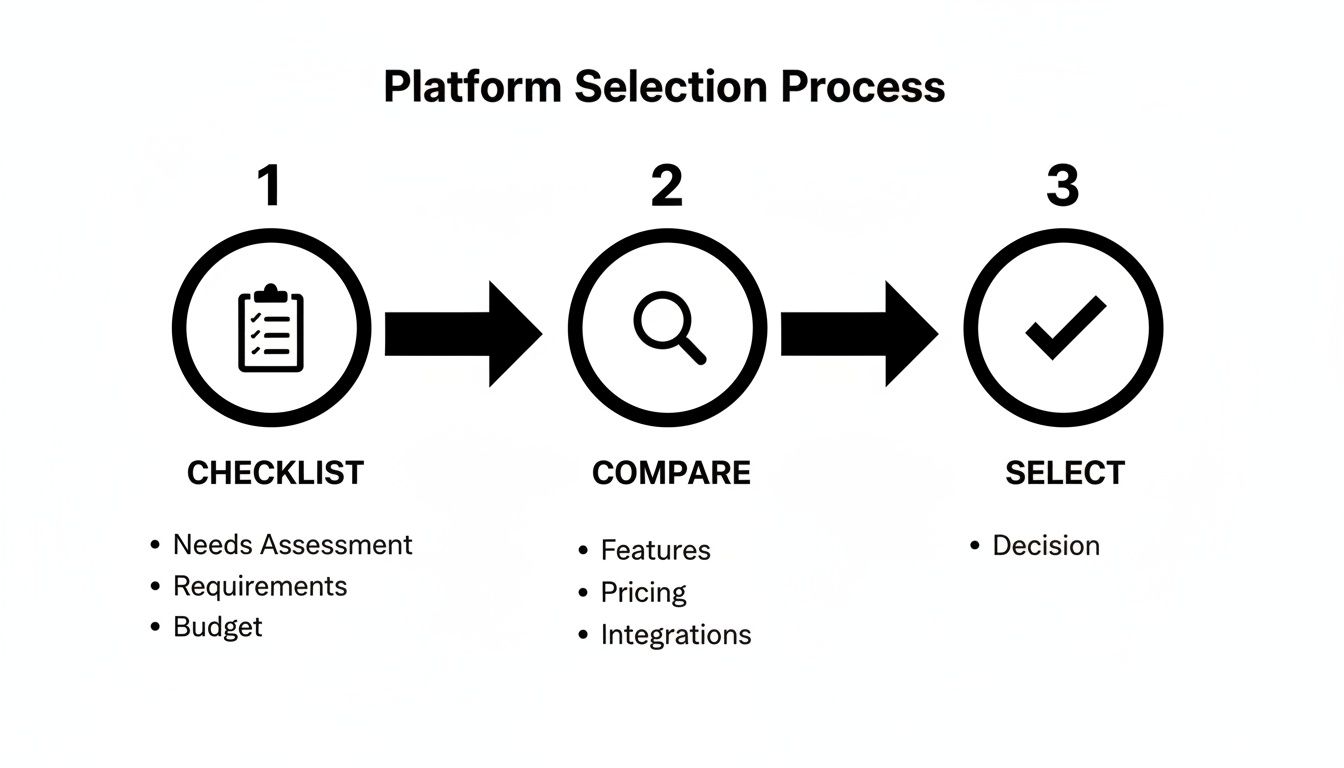
As the visual shows, success starts with a solid plan before you even think about tools. Get your strategy straight first.
Create Your Content and Set It Live
Alright, time to create the actual messages. This could be that three-part email series, a few SMS reminders, or the copy for a new landing page. If you need some ideas, checking out different landing page use cases for small businesses can spark some great strategies for converting visitors.
With your content ready, it's time to jump into your platform and build the workflow using the map you drew. Most tools have simple drag-and-drop editors, so this part is surprisingly easy. But before you hit "activate," test everything. Send the emails to yourself. Click every single link. Make sure it all works exactly as you planned.
A broken link or a typo in an automated email can make you look sloppy and do more harm than good. A five-minute test will save you from hours of headaches and angry customer emails. Believe me.
Finally, set it live and start watching. Keep a close eye on the numbers that matter for your goal. For that email workflow, you'll want to watch your open rates, click-through rates, and—most importantly—conversion rates. Seeing those numbers climb is the ultimate proof that you've got this.
And remember, these same principles apply everywhere. Building a content pipeline with a visual automation tool like Postbae follows a similar path: set a goal for your content, let the AI agent create the visual posts, customize as needed, and then your content is ready to be shared.
Common Pitfalls and How to Avoid Them
Marketing automation is powerful, but it's not a magic button you press to print money. Treating it like a "set it and forget it" tool is the fastest way to annoy your customers and burn through your cash.
There are a few classic mistakes people make, but they’re all fairly easy to sidestep once you know what to look for.
Sounding Like a Robot
The biggest mistake? Automating so much that you sound like a soulless corporate machine. When every single message is obviously pre-written and generic, you kill the human connection that makes small businesses special. People can sniff out a generic, impersonal email from a mile away.
The point of automation is to scale that personal touch, not get rid of it. And "personalization" means way more than just dropping a [FirstName] tag into your email.
Go Beyond Their Name: Use real data. Did they buy something specific? Look at a certain page on your site? Use that. Instead of "Hey [FirstName]," try something like, "Since you loved our last collection, we had a feeling you'd want to see this..."
Switch Up Your Messaging: Don't just copy-paste the same automated message everywhere. What sounds fine in an email can feel super weird and cold in a text message.
Let Your Brand's Voice Shine: Write your automated messages like you actually talk. A bit of humor or a friendly, casual tone makes a world of difference.
If you're not personalizing, you're leaving money on the table. Studies show 80% of customers are more likely to buy from a company that gives them a tailored experience. Automation is supposed to make this easier, not harder.
Working with Unreliable Data
Another huge trap is building your whole automation system on a pile of messy, wrong data. It’s like building a house on quicksand.
If your contact info is old or your customer lists are a jumbled mess, all your brilliant workflows will fall flat. Sending a "welcome back" email to a brand new customer doesn't just look sloppy—it makes people not trust you.
Make data cleanup a regular habit. Seriously, put it on your calendar. Clean out your email lists, merge duplicate contacts, and make sure your CRM is actually organized. Good data is the fuel for marketing automation for small businesses; without it, your engine is dead.
A little time spent on data quality pays off big time in your campaign results. For more ways to keep your system running smoothly, check out our full guide to marketing automation best practices. It'll help you make sure your automation grows with you, instead of holding you back.
Got Questions? You're Not Alone.
Jumping into marketing automation can feel like a big step. It’s totally normal to have a few questions swirling around. Let's tackle some of the most common ones we hear from small business owners just like you.
"Okay, But How Much Is This Actually Going to Cost Me?"
I get it, the budget is real. The good news is you don't need a massive investment to get started. Many of the best platforms have free or super affordable entry-level plans, often kicking off around $20-$50 a month. These are perfect for dipping your toes in the water without a huge commitment.
Just keep in mind, these starter plans usually have limits on how many contacts you can have or emails you can send. As your business grows (which is the whole point!), your costs might go up. The smart move is to pick a tool that feels right for your budget now but has a clear and affordable upgrade path for when you're crushing it later.
"Am I Going to Need a Computer Science Degree to Use This?"
Not a chance. That might have been true years ago, but modern automation tools are built for people who run businesses, not for developers. Most of them have really intuitive drag-and-drop editors, a library of pre-built templates for common campaigns, and tons of tutorials to hold your hand.
Look, there's a small learning curve with anything new, but you absolutely do not need to know a single line of code. My advice? Start small. Set up a simple welcome email series first. Once you see it working, you'll get a boost of confidence and be ready to build something more complex.
"Won't This Make My Marketing Feel... Robotic?"
This is probably the biggest fear people have, and it's a valid one. But here’s the twist: when you do it right, automation actually makes your marketing feel more personal, not less.
Think about it. By using data you already have—like what a customer bought last month or which pages they browsed on your site—you can send them messages that are incredibly relevant and perfectly timed. That's a world away from a generic, one-size-fits-all email blast.
The whole point isn't to fire your marketing team and replace them with robots. It’s about using technology to get the right message to the right person at the right moment. It actually makes customers feel seen and understood, not spammed.
"How Long Until I Actually See Any Results?"
You’ll see an immediate return on your time the second you hit "launch" on your first workflow. All those hours you used to spend on manual, repetitive tasks? You get them back instantly. That alone is a huge win.
As for leads and revenue, the impact can show up pretty quickly. Some businesses see a noticeable lift in the first 1-3 months. But the real, game-changing ROI usually comes over a 6 to 12-month period. That’s when your lead nurturing sequences have had time to work their magic and you've gathered enough data to really start optimizing things. With automation, consistency is what turns small wins into massive growth.
Ready to automate the part of social media that eats up the most time? Postbae is an AI agent that works on autopilot, creating professional, on-brand visual content for your industry. Stop wrestling with design tools for hours and get scroll-stopping graphics like carousels and infographics made for you. Check out how Postbae works.