A Guide to Content Pillars for Social Media Strategy

Build a winning social media presence with our guide to content pillars for social media. Learn to create, plan, and automate your content strategy.
Ever feel like you’re just throwing content at the wall, hoping something sticks? Content pillars are the secret weapon to get you off that hamster wheel.
Simply put, they are the core themes or subjects you build your social media presence around. Think of them as the foundational columns holding up your entire content strategy. They ensure every single post feels consistent, relevant, and like it actually has a purpose.
This is how you shift from random, chaotic posting to a smart, structured plan that actually works.
What Are Content Pillars and Why They Matter

Imagine your social media feed is a television network. If you just broadcast random shows at random times, your viewers would get confused and change the channel. Fast.
Content pillars are your network’s core programming—the specific genres that define your channel and give your audience a reason to tune in again and again.
These pillars are typically 3-5 broad, recurring topics directly tied to your business, your expertise, and what your audience is genuinely curious about. They’re the strategic framework that gives your social media presence a backbone.
To really get why pillars are so powerful, it helps to understand what a robust content marketing strategy entails. Pillars are the piece of the puzzle that turns that high-level strategy into something you can actually execute day-to-day.
Instead of waking up and asking, "What should I post today?" you'll start asking, "Which of my pillars should I talk about today?" That small shift changes everything.
The Strategic Importance of Content Pillars
Using a pillar-based approach does way more than just organize your content calendar. It fundamentally levels up the quality and impact of everything you post, turning your process from reactive and chaotic to proactive and authority-building.
Here’s where you’ll really see the difference:
- Creates Unwavering Consistency: By sticking to a few core themes, your brand’s voice becomes instantly recognizable. Your audience learns what to expect from you, which builds trust and hammers home your brand identity. Research shows that brand consistency can boost revenue growth by more than 10%.
- Streamlines the Content Creation Process: Pillars are the ultimate cure for the dreaded blank-page paralysis. They give you a clear starting point for brainstorming, making content planning faster and way less stressful. This structure is a key reason why 80% of highly successful marketers have a documented content strategy.
- Boosts Audience Engagement: When your content consistently hits on topics your audience actually cares about, engagement goes up. It's that simple. Pillars ensure you’re always delivering value—whether that’s through education, inspiration, or entertainment—keeping your followers hooked.
- Establishes Authority and Trust: Regularly sharing insightful content around a few key topics positions your brand as the go-to expert in your field. This focused approach builds incredible credibility and makes you the first resource people turn to when they have a question.
By defining your pillars, you're not just creating a content plan—you're building a communication framework that ensures every post, from a multi-slide carousel to a simple graphic, serves a larger business goal.
From Chaos to Cohesion
Without pillars, a social media feed feels disjointed. One day you’re posting a motivational quote, the next a hard-sell promo, followed by a random meme. Each post might do okay on its own, but the overall effect is confusing and fails to tell a cohesive brand story.
Content pillars are the thematic glue that holds your entire strategy together.
Each pillar supports the main structure of your brand’s narrative, giving you creative freedom within a defined framework. For instance, a single "Educational" pillar can spawn an endless stream of post ideas: quick tips, how-to guides, myth-busting carousels, and industry-specific infographics.
Ultimately, this framework prevents content fatigue for both you and your audience. You get a sustainable system for creating relevant content, and your followers get a consistent stream of valuable information they can count on. This is how you turn casual followers into a loyal community.
How to Choose Your Core Content Pillars
Finding your content pillars isn't about throwing random topics at the wall to see what sticks. It's about finding that sweet spot where your audience's problems, your brand's unique expertise, and your actual business goals all overlap. Think of it as a deliberate process of research and refinement, not a guessing game.
It all starts with listening. Your audience is constantly telling you what they care about through their actions—or their silence. Once you tap into their pain points, questions, and interests, you can build pillars that deliver real value. That's how you create content that doesn't just get seen, but gets saved and shared.
Start With Your Audience
Before you can decide what to talk about, you have to know exactly who you’re talking to. The best content pillars are built on a deep understanding of your audience’s world.
Your mission here is to uncover the problems they’re facing and the answers they're actively searching for. A great place to start is by looking at what’s already happening on your own channels.
- Analyze Your Comments and DMs: What questions are people asking over and over again? These are direct signals of what your audience needs help with.
- Review Your Top-Performing Posts: Go back through your analytics for the last few months. Do tutorials always get the most saves? Do behind-the-scenes posts get the most comments? These trends are clues to what already resonates.
- Conduct Simple Polls: Use Instagram Stories or LinkedIn polls to ask your audience directly what they want to learn more about. You could ask something simple like, "Which of these topics would be most helpful for you right now?"
This isn’t a one-time task. Think of it as an ongoing conversation that keeps your content relevant and ensures your pillars evolve right alongside your audience's needs.
Audit Your Brand's Expertise
Once you have a handle on what your audience wants, the next step is to look inward. Your content pillars need to be anchored in what your brand actually stands for and the unique knowledge you bring to the table. This is where you connect their needs to your strengths.
Ask yourself these core questions:
- What topics do we want to be known for? If someone were to describe your brand in three words, what would you want them to be?
- What unique value can we offer? Do you have proprietary data, a unique process, or a ton of experience in a specific niche?
- What conversations do we want to lead in our industry? Your pillars should position you as a knowledgeable and trusted voice.
The intersection of what your audience is asking for and what you're genuinely an expert in—that’s where your most powerful pillar ideas will live. This step ensures you're creating content that's not only in demand but also completely authentic to your brand. To dive deeper into this process, check out our guide on how to build a social media content strategy.
Refine and Select Your Pillars
Alright, time to bring it all together. By now, you probably have a long list of potential themes and topics from your brainstorming. The final step is to sharpen this list into a focused set of core pillars that will guide your entire strategy.
Most successful brands stick to 3–5 content pillars for their social media. It’s the perfect balance. Fewer than three can make your storytelling feel flat and one-dimensional, while more than five risks diluting your core message and just confusing people. You can discover more insights about content pillar strategy on StackInfluence.com.
Your content pillars aren't set in stone. Think of them as a strategic guide you can review and tweak quarterly or annually as your business evolves and your audience’s needs change.
Start by grouping your brainstormed ideas into broader themes. For example, ideas like "How to improve productivity," "Time management hacks," and "Best software for small teams" could all fall under a bigger pillar called "Workflow Optimization."
From these themes, pick the 3-5 that best align with your business goals. If your goal is to generate leads, for example, you should prioritize pillars that let you naturally introduce your product or service as a solution. This final selection is the foundation for a focused, effective social media presence.
Turning Pillars Into Engaging Social Media Posts
Having your content pillars nailed down is like having a perfect blueprint for a house. Fantastic. But the real work is turning that plan into something people can actually live in—transforming your strategic themes into visual content that physically stops the scroll.
This is where the high-level strategy gets its hands dirty and meets the daily grind of social media. The goal is to break down each big-picture pillar into an endless stream of post ideas and formats, so you never, ever run out of valuable things to say. It’s about translating your "why" into a compelling "what."
This simple, three-step process is how you turn those broad ideas into polished, ready-to-go content pillars.
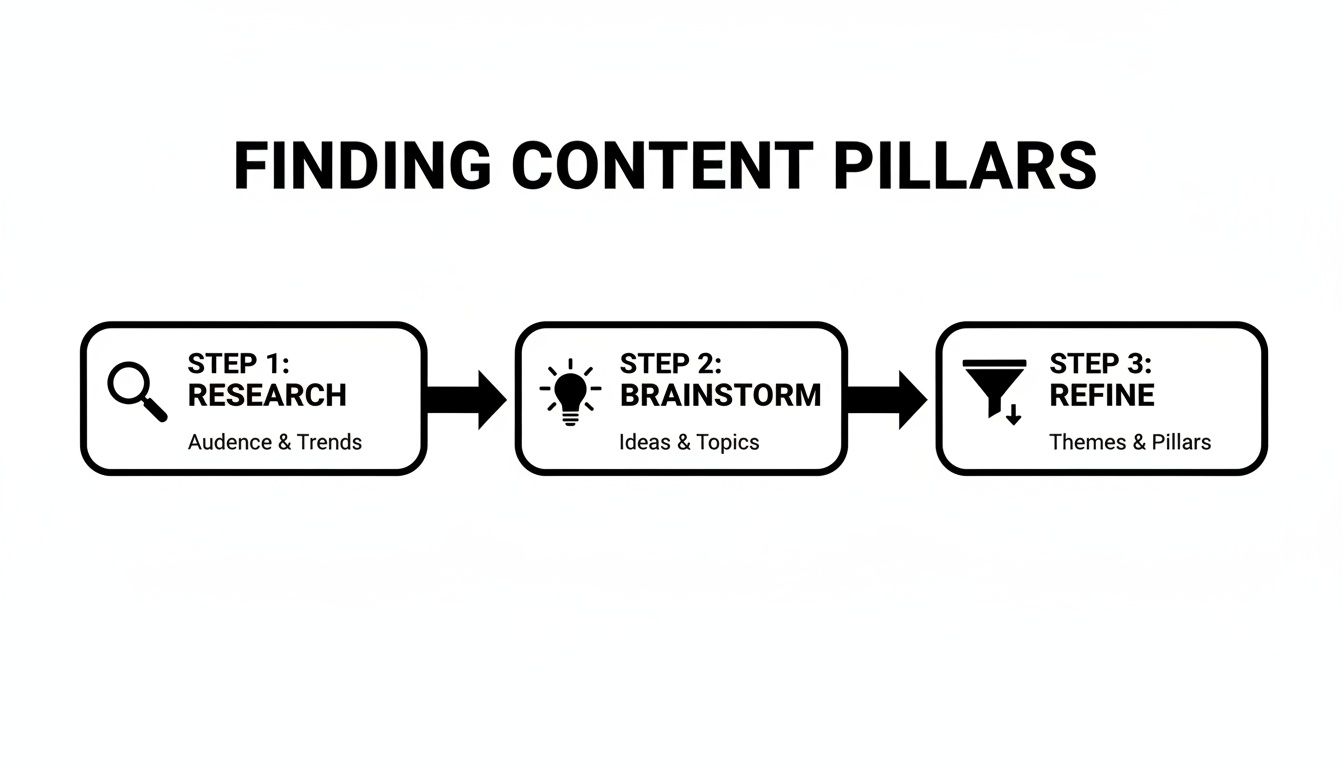
This journey—from digging into what your audience wants to refining your core topics—makes sure every single post is grounded in real value and brand expertise.
Mapping Pillars to High-Engagement Formats
Not all post formats are created equal. The secret to great execution is matching the purpose of your pillar to the format that tells its story best. For instance, a complex educational topic almost always lands better as a multi-slide carousel than a single, lonely image.
Here's a quick look at how you can map different pillar types to specific, high-engagement visual formats:
- Educational Pillars: These are your bread and butter for building authority and giving your audience direct value. The best formats are ones that slice and dice complex info into bite-sized pieces. Think multi-slide carousels that walk through a step-by-step process, detailed infographics that make data beautiful, or listicle-style graphics sharing quick tips and tricks.
- Inspirational or Storytelling Pillars: The goal here is pure emotional connection. You need visuals that tell a story. This could be a carousel celebrating a customer's success, a striking graphic with a powerful quote, or behind-the-scenes photos that show the real people behind your brand.
- Community-Focused Pillars: This pillar is all about interaction. You need to use formats that scream "talk to me!" Think "ask me anything" graphics, fun poll visuals, or posts that feature user-generated content. These posts are designed to start a conversation, not just broadcast a message.
The real magic happens when you stop thinking about a single post and start seeing each pillar as a content engine. One educational idea can be spun into a carousel, an infographic, and a series of quick-tip graphics.
Once your pillars are set, knowing when to deploy your content is just as important as what you post. For example, understanding the best time to post on Instagram for the beauty industry can make or break your engagement. Great timing and the right format are a powerful combination.
Mapping Content Pillars to High-Engagement Post Formats
This table breaks down how different pillar types translate into specific, visually compelling post formats that work wonders on platforms like Instagram, Facebook, and LinkedIn.
| Pillar Type | Primary Goal | Best Visual Format Examples | Platform Suitability |
|---|---|---|---|
| Educational & How-To | Establish authority, provide direct value | Carousels, Infographics, Listicles, Step-by-Step Guides | Instagram, LinkedIn, Facebook |
| Inspirational & Storytelling | Build emotional connection, humanize brand | Quote graphics, Before-and-Afters, Customer Spotlights | Instagram, Facebook |
| Community & Engagement | Drive interaction, foster conversation | Polls, Quizzes, "Ask Me Anything" (AMA), User-Generated Content | Instagram Stories, Facebook |
| Promotional & Product-Focused | Drive sales, showcase features | Product demos (as image carousels), Testimonial carousels, Feature breakdowns | All platforms |
By aligning your core themes with proven formats, you create a content machine that's not just consistent, but consistently engaging.
Content Pillar Examples for Different Businesses

Theory is one thing, but seeing content pillars for social media in action is how the concepts truly click. A pillar strategy for a local coffee shop will look completely different from one for a B2B tech startup, even if they both want to build a community or educate their audience.
The secret is tailoring these big themes to your specific industry, your expertise, and the unique problems your customers are trying to solve. Let's look at some practical examples to show you how this framework adapts to different businesses.
Example for a Local Coffee Shop
For a community-focused business like a coffee shop, the goal is to become a beloved local hub. The content should feel warm, inviting, and deeply connected to the neighborhood.
Pillar 1: Coffee Education
- Goal: Establish your expertise and deepen your customers' appreciation for the craft.
- Post Ideas: A carousel explaining the difference between a latte and a flat white. An infographic on the flavor notes of beans from different regions. A "Meet the Machine" post introducing your espresso maker.
Pillar 2: Behind the Counter
- Goal: Humanize your brand and build real connections with your staff and customers.
- Post Ideas: A "Meet the Barista" carousel with fun facts about a team member. A listicle showing the "5 Steps to Our Signature Cold Brew." A post highlighting the local bakery that supplies your pastries.
Pillar 3: Community Spotlight
- Goal: Weave your shop into the fabric of the local community.
- Post Ideas: A graphic promoting an upcoming open mic night. A photo dump from a recent event you hosted. A post shouting out a neighboring small business you love.
Example for a Social Media Manager
As a social media manager, your content needs to scream, "I know what I'm doing, and I can get you results." Your pillars should be a direct showcase of your expertise.
Pillar 1: Actionable Social Media Tips
- Goal: Provide immediate value to potential clients and prove you know your stuff.
- Post Ideas: An infographic on "5 Ways to Boost Instagram Story Engagement." A carousel breaking down the latest algorithm update. A listicle graphic of the "Top 3 Tools for Content Planning."
Pillar 2: Client Success & Case Studies
- Goal: Build trust and offer social proof that you deliver on your promises.
- Post Ideas: A "Before & After" carousel showing a client's follower growth. A testimonial graphic with a glowing quote from a happy client. A data-focused infographic highlighting key results from a campaign (like +200% reach).
Pillar 3: Industry Insights & Trends
- Goal: Position yourself as a forward-thinking expert who's always ahead of the curve.
- Post Ideas: A "Myth vs. Fact" carousel about social media marketing. A visual post sharing predictions for upcoming platform changes. An educational graphic that simplifies a complex marketing concept.
Example for a B2B Marketing Agency
An agency needs to attract sophisticated business clients. Your content pillars have to demonstrate strategic thinking, a deep understanding of the marketing world, and a sharp focus on ROI.
The most effective content pillars for an agency are those that solve a problem or answer a question a potential client is already thinking about. The goal is to become their trusted advisor before they even sign a contract.
Pillar 1: Deep-Dive Marketing Strategy
- Goal: Showcase high-level strategic expertise that attracts qualified leads.
- Post Ideas: An educational infographic explaining the marketing funnel. A carousel on "How to Build a Lead Generation Machine." A detailed visual breakdown of a successful content strategy framework.
Pillar 2: Data & Performance
- Goal: Prove your agency is obsessed with measurable results and business impact.
- Post Ideas: A carousel showing how to track key marketing KPIs. A graphic explaining the importance of A/B testing with real examples. An infographic visualizing industry benchmark data.
Pillar 3: Agency Life & Expertise
- Goal: Highlight the talented team and unique culture that make your agency stand out.
- Post Ideas: A "Meet the Strategist" carousel. A visual post outlining "The [Agency Name] Way" of client onboarding. A behind-the-scenes look at a team brainstorming session.
Ready-to-Use Content Pillar Templates by Industry
To help you get started even faster, we’ve put together a table with some plug-and-play pillar ideas for different industries. Think of this as a launchpad—you can take these concepts and customize them to fit your unique brand voice and audience needs.
| Industry / Persona | Pillar 1 Example (Educational) | Pillar 2 Example (Behind-the-Scenes) | Pillar 3 Example (Community-Focused) |
|---|---|---|---|
| Real Estate Agent | "Home Buying 101" (explaining mortgages, inspections, etc.) | "A Day in the Life" (showings, paperwork, client calls) | "Neighborhood Spotlight" (featuring local parks, cafes, schools) |
| Fitness Coach | "Workout Form Fixes" (demonstrating proper exercise technique) | "My Weekly Meal Prep" (showing healthy eating habits) | "Client Transformations" (celebrating member success stories) |
| SaaS Company | "Productivity Hacks" (tips using your software's features) | "Meet the Dev Team" (introducing the people behind the code) | "User Case Studies" (how customers use your tool to succeed) |
| Fashion E-commerce | "How to Style [X Item]" (showing versatility of a product) | "From Sketch to Store" (the design and production process) | "Styled by You" (featuring user-generated content from customers) |
| Financial Advisor | "Investing Myths Debunked" (clarifying common misconceptions) | "Our Philosophy on Wealth Management" (explaining your approach) | "Answering Your Top Money Questions" (addressing community FAQs) |
These templates show how the core ideas—educate, humanize, and connect—can be applied anywhere. The goal is to find the right mix that resonates with your specific audience and consistently delivers value, post after post.
Automating Your Content Pillar Strategy With AI
Okay, so you've mapped out your content pillars. That’s a huge strategic win. But this is usually the moment when a new, much bigger challenge smacks you in the face: actually making all the content.
The single biggest hurdle for any pillar-based strategy is the relentless demand for high-quality visuals. This is where so many small businesses, content creators, and marketing agencies hit a wall. It’s one thing to brainstorm ideas, but it's another thing entirely to consistently design professional multi-slide carousels, infographics, and educational graphics week after week.
This production bottleneck can sink even the best strategy, leading straight to inconsistent posting and burnout.
Thankfully, modern AI tools are built to solve this exact problem. They can turn your strategic pillars from a plan on paper into a tangible, ongoing pipeline of visual social media posts.
Moving Beyond Manual Design
The old way of creating visual content is a grind. It’s a multi-step process that involves research, writing, and hours of manual design work. This requires a mix of skills that most small business owners and marketers just don't have time for. The challenge multiplies when you need to pump out several top-tier visual posts every single week to keep your pillars fed.
This is where automation becomes a lifesaver. An AI agent like Postbae can take over the entire visual creation process, working in the background to bring your content pillar strategy to life. It doesn't just generate text; it autonomously produces complete, ready-to-post graphics.
You set the strategy once, and in return, you get a continuous flow of professional visuals perfectly suited to your industry and pillars, minus all the manual labor.
How AI Agents Automate Visual Content Creation
Unlike a manual design tool you have to babysit, an AI content creation agent works on its own. Postbae, for example, runs on autopilot based on your business context. You don’t need to feed it prompts for every single post.
The system understands your industry and your core themes, then gets to work generating relevant, authority-building content automatically.
Here’s how this automated process lines up perfectly with your content pillars:
- Pillar-Driven Ideation: The AI looks at your core themes—like "Industry Education" or "Product Benefits"—and generates a whole host of relevant sub-topics and post ideas.
- Automated Visual Design: It automatically picks proven, high-engagement formats like multi-slide carousels or listicles that are best suited to deliver the information.
- Content Population: The AI then fills these professional templates with well-researched, educational content, creating a finished visual asset from scratch.
The real magic here is effortless consistency. It’s like having a full-time social media designer dedicated to executing your pillar strategy, making sure your feed is always stocked with valuable, on-brand content.
Maintaining Full Creative Control
Automation doesn't mean you give up control. Not at all. While the initial creation is hands-off, you always have the final say.
Every visual post generated by Postbae is fully editable. You can jump in and tweak the text, change the brand colors, or adjust the layouts to get everything looking exactly right for your brand's unique style.
This blend of automation and customization is the best of both worlds. You save countless hours on the heavy lifting of content production, but you never lose creative oversight. For a deeper dive, check out our complete guide to AI content creation for social media.
By bringing AI into your workflow, you can finally close the gap between strategy and execution. Your well-defined content pillars will transform into a consistent stream of professional graphics that build authority and keep your audience coming back for more.
How to Measure Your Content Pillar Success
So, you’ve built your content pillars. That’s a huge first step. But a strategy is just a pretty document until you know if it's actually working. The real magic happens when you start measuring the impact of each pillar, figuring out what truly resonates with your audience and what’s falling flat.
It’s time to move past surface-level vanity metrics like your total like count. We’re going deeper. The goal is to use your platform's analytics to see which specific themes are driving meaningful results, giving you the data you need to stop guessing and start making smarter decisions.
Key Performance Indicators for Content Pillars
To get a clear picture of what’s working, you need to look at your performance through the lens of each pillar. Instead of just glancing at overall account growth, start tracking metrics for every distinct content theme you've set up. This lets you put them head-to-head and see who the real winner is.
Here are the most important KPIs to keep an eye on for each pillar:
- Engagement Rate Per Pillar: This is your holy grail metric. Calculate the average engagement (likes, comments, shares, saves) for all the posts under a single pillar. For instance, if your "Educational" pillar is pulling in sky-high engagement, it’s a massive signal that your audience is hungry for your tips and tutorials.
- Website Clicks or Conversions: If a pillar is designed to send people to your website, this is non-negotiable. Track how many users are hitting that link in your bio after seeing posts from that theme. A little pro-tip: use UTM parameters to see exactly which pillars are sending you the most valuable traffic.
- Follower Growth Attribution: Did you post something under one pillar that just blew up? Jump into your analytics and see if that viral moment corresponded with a spike in new followers. This is how you pinpoint which themes are magnets for your ideal audience.
Tracking these metrics is the difference between guessing and knowing. You’ll have cold, hard proof that your "Behind-the-Scenes" content, for example, drives the most comments, while your "Industry Insights" pillar is your best bet for getting website clicks.
A Simple Framework for Tracking Pillar Performance
You don’t need some fancy, expensive software to get started. Honestly, a simple spreadsheet is all it takes to begin gathering game-changing insights and spotting trends in your content.
- Categorize Your Posts: In your content calendar (or a fresh spreadsheet), tag every single post with its pillar. Think "Educational," "Community," "Inspirational," etc.
- Record Key Metrics: Set aside a little time once a week to pull the core metrics for each post—likes, comments, shares, saves, and link clicks—and log them right next to their pillar.
- Analyze and Optimize: At the end of each month, do the math. Calculate the average performance for each pillar. The data won't lie; it will clearly show you which themes are your heavy hitters and which ones might need a rethink or even be swapped out.
This systematic approach creates the feedback loop you need to get better and better over time. By understanding how to properly measure your social media engagement, you can sharpen your content pillars until they’re consistently delivering results and making all your content creation efforts worthwhile.
Got Questions? We’ve Got Answers.
Alright, you’ve got the framework down, but a few questions might still be bouncing around in your head. Let's tackle some of the most common ones that come up when people start putting content pillars into practice.
How Often Should I Review My Content Pillars?
Think of your pillars like a strategic check-in, not a permanent tattoo. It's a good idea to review them quarterly or at least semi-annually. This gives you enough time to see what’s working while staying flexible enough to adapt.
Things change—your audience’s interests evolve, new industry trends pop up, or your own business goals shift. A major product launch or a pivot in your company's direction is also a perfect time for a refresh.
But here’s the key: don’t change them too often. Consistency is the cornerstone of a solid pillar strategy. It’s how you build that brand recognition and trust over the long haul.
Can a Single Post Fit into Multiple Pillars?
Great question. While most of your posts should tie back neatly to one primary pillar for the sake of clarity, some bigger content pieces can definitely bridge two.
For example, a detailed case study might fall under an ‘Educational’ pillar because you're teaching your audience something, but it also clearly supports a ‘Product Value’ pillar by showcasing results.
The trick is to keep the main message focused. Decide which pillar is the primary driver for that specific post and let that guide your core objective and call-to-action. This keeps you from sending mixed signals and confusing your audience.
How Are Content Pillars Different from Content Categories?
This is a super common point of confusion, but getting it right is crucial for your strategy. The distinction is actually pretty simple.
Content pillars are your big-picture strategic themes. They are the high-level topics that guide your entire content plan. Content categories are the tactical formats and subtopics you use to organize posts within those pillars.
Let’s say one of your pillars is ‘Industry Education.’ That’s the strategic theme.
Within that pillar, you could have specific content categories like ‘Quick Tips,’ ‘Myth Busting,’ and ‘Deep Dive Explainers.’
Put another way: pillars are the ‘why’ behind your content, and categories are the ‘what.’
Ready to turn your content pillars into a consistent stream of professional visual posts without the manual work? Postbae is an AI agent that works on autopilot to generate industry-specific carousels, infographics, and more, directly from your strategic themes. No prompts needed. Automate your social media graphics with Postbae.